
At DelightedCooking, we're committed to delivering accurate, trustworthy information. Our expert-authored content is rigorously fact-checked and sourced from credible authorities. Discover how we uphold the highest standards in providing you with reliable knowledge.
Why does Yeast Make Bread Rise?
 Tricia Christensen
Tricia Christensen
Tricia Christensen
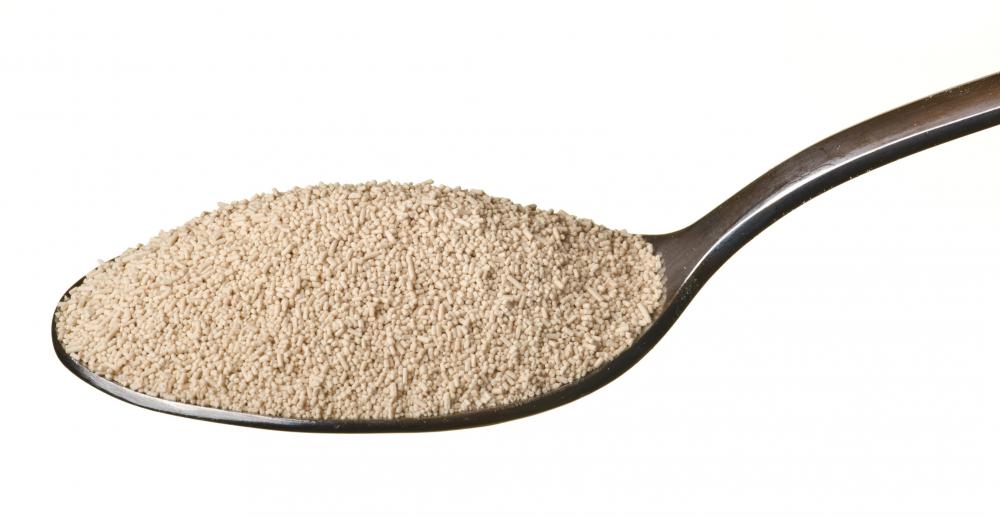
If you’ve ever taken a bite of bread you’ve made, you may wonder how simple ingredients like flour, salt and yeast can produce raised, sometimes wonderfully bubbly bread. It makes people a little squeamish to know it that yeast makes bread dough rise because it is a live single-celled organism. Specifically it is a variety of fungi called Saccharomyces cerivisiae, which is harnessed to eat, drink and be merry, before dying a quick death when exposed to oven heat.
You can buy several different types of yeasts on the market. The first of these is called live or fresh yeast. This is relatively unstable, requiring refrigeration, and it has a very short shelf life. Dried versions, sold in packages or cubes is essentially cells of Saccharomyces cerivisiae, which are waiting to be activated.

Like many fungi types, yeasts for bread dough responds to warm water, which begins to bring the little cells to life. Then when exposed to sugars in bread and in flour, it begins to eat, digesting portions of these sugars. This eating process goes on for a short period of time only. Eventually the yeast will die within a few hours, especially if the dough is allowed to grow cold or exposed to too much air. Don’t feel too sorry for it when you have a slice of bread, as its life would be short under any circumstances. At least by using it for bread or wine, you get to give this fungus a happy and full life.

It might be embarrassing to the yeast to have to admit that this rapid eating/digestion cycle makes it just a trifle gassy. As Saccharomyces cerivisiae is feasting, it begins to release gas bubbles of carbon dioxide, and small amounts of ethanol alcohol. These bubbles, trapped in the bread dough, cause the rising action with which we’re familiar. This is why bread making can be time consuming; you’ve got to let this fungus work for a couple of hours in order to sufficiently rise dough.

Once dough has been acted upon by fungi, not all of the cells are quite dead. Putting the bread in the oven is relatively macabre, from the standpoint of the yeast (if it had a point of view). The heat from the oven makes remaining cells go into overdrive, madly munching away at the sugars and expelling carbon dioxide prior to expiring from the oven heat. This is why bread continues to rise during its early cooking stages, and then may deflate slightly as cooking continues.

There are a few things that inhibit these microbes from their natural function. Too much salt can halt its rising action. Therefore bread dough recipes usually contain a little salt and a little sugar for balance. Shortening and animal fats can also inhibit the fungi, and you’ll note that breads that have butter in them, especially salted butter may not have the same rise due to the butter’s presence.

Sometimes inactivated or dry yeast unfortunately dies before you get a chance to use it. This is why many bakers use a proofing process, adding a package to warm water to make sure the yeast is alive before combining it with flour. Within a few minutes of exposure to warm, not hot water or milk, the fungi begin to bubble up and expand if it is alive.
Tricia Christensen
Tricia has a Literature degree from Sonoma State University and has been a frequent DelightedCooking contributor for many years. She is especially passionate about reading and writing, although her other interests include medicine, art, film, history, politics, ethics, and religion. Tricia lives in Northern California and is currently working on her first novel.
Learn more...
Tricia Christensen
Tricia has a Literature degree from Sonoma State University and has been a frequent DelightedCooking contributor for many years. She is especially passionate about reading and writing, although her other interests include medicine, art, film, history, politics, ethics, and religion. Tricia lives in Northern California and is currently working on her first novel.
Learn more...AS FEATURED ON:
AS FEATURED ON:


-
![The yeast used in baking is a variety of fungi called Saccharomyces cerivisiae.]() By: RobinsonThe yeast used in baking is a variety of fungi called Saccharomyces cerivisiae.
By: RobinsonThe yeast used in baking is a variety of fungi called Saccharomyces cerivisiae. -
![Various types of bread.]()
Various types of bread. -
![Slices of bread.]() By: IrochkaSlices of bread.
By: IrochkaSlices of bread. -
![A bowl of active dry yeast.]() By: South12thA bowl of active dry yeast.
By: South12thA bowl of active dry yeast. -
![Oven heat kills the fungi known as yeast that's used to make bread dough rise.]() By: fabiomaxOven heat kills the fungi known as yeast that's used to make bread dough rise.
By: fabiomaxOven heat kills the fungi known as yeast that's used to make bread dough rise.


Discussion Comments
I liked the article and understand the basic chemistry of adding acid to yeast in order to facilitate rising; however, and this is what I was hoping to ascertain from the article, this source does not direct me to the ratio of vinegar to flour.
Not that it really matters, but "ethanol alcohol" (from the article) is over-specified. It would simply be ethanol or ethyl alcohol because the "ol" at the end of the ethanol implies it is an alcohol, which is a functional group that behaves in a certain manner.
My daughter and I conducted a science fair project to see which "food" would cause the yeast to produce the most "gas". The two ingredients that did the best were when yeast was mixed with flour and when it was mixed with pancake syrup (high-fructose corn syrup). Between these two, do you know why the yeast/flour mixture produced more gas then the yeast/syrup mixture?
Is there any harm to let yeast bread rise for 13 hours?
I have never used live yeast and wonder if this works the same as dried yeast? The biggest reason I probably haven't used this is because it has such a short shelf life.
I never know when I am going to be in the mood to bake some bread and like to keep packets of dried yeast on hand. I usually use the rapid-rise yeast, which doesn't take nearly as long to make the dough rise as the regular yeast.
I have also had problems with my bread deflating and sinking after it had been in the oven for a while. Once I started adding some dough enhancer to my batter, this made a big difference.
I finally got in the habit of taking the temperature of the water I used when I dissolved my yeast. Before doing this, I would just guess when the water was lukewarm and this ended up in many loaves of bread that didn't rise.
If the water is too hot or too cool, the yeast won't respond the way it should and you will be disappointed. Now I use a handy thermometer so I don't have to guess when the water is at just the right temperature to dissolve the yeast, yet not kill it off before it goes in the oven.
Baking bread can be a challenge even though it only requires a few ingredients. I have learned a few things from trial and error, but every now and then, still have a loaf of bread that doesn't rise like it is supposed to.
I got in the habit of proofing my yeast and know that if it gets bubbly on the top it is good to go. I also watch the expiration date on the package, but if it is past the date and the yeast still proofs, it will be OK for your bread.
Yeast breads are my favorite type of breads but sometimes if I want something that doesn't take as much time I will bake quick breads. Baking things like banana bread and muffins don't require yeast and they still rise because of the baking soda that is in them. As far as traditional bread goes though, I don't know of a way of getting it to rise without using yeast.
@surreallife: Not only do changes in temperature affect yeast, but humidity levels do as well. We have a lot of humidity during the summer months and I have to watch my bread more closely when we have high levels of humidity like this.
It is hard to think about yeast actually being a fungi when the end product is such delicious bread. I have always enjoyed baking my own bread and feel like the time is well worth it. There is nothing better than a slice of warm bread from the oven with a little bit of butter and honey on it.
To Clayton: I know that when you bake regular bread, sweet bread, pastry or anything else involving yeast, you have to keep the oven door closed for the first 20 minutes of baking.
Only after 20 minutes you should open the oven door and check on the progress.
Yeast is very finicky and can not handle changes in temperature.
This quick, fast, easy to read article made it so easy for me to study for my seventh grade science test. Thanks so much.
Thank you! This really helped with background info for my science fair project!
My bread falls when I bake it. Why? --Clayton
does anyone know any more resources on yeast bread? i need more help on teaching myself how to make yeast bread!
nhusein - There are two things I can recommend for your bread making adventure. If you have to leave while your dough is rising, do not put it in warm oven, since heat speeds up the rising action.
Cover your bread with a clean kitchen cloth, and leave it at room temperature to rise. This process will take longer, and give you more time for your errands.
Then when you come home if the dough did not grow enough, you can put it into the warm oven for a while before baking.
Second, I am not positive about this, but I think if you kneed the dough one more time and let it rise for the third time, I think it will turn out reasonably well. But whatever you do, do not give up. Somehow when you bake your own bread it tastes so much better, and also after a while you will get the feel for it.
Happy baking!
i have been trying to teach myself to bake bread (without a bread maker). on my first attempt to bake a loaf of simple white bread, i didn't give myself enough time to let the divided loaves rise for the second time after i put them into loaf pans. i had to leave, so i left them in my warm oven, and was planning to bake them when i got home. well, i was gone longer than i expected and came home to loaves that had fallen. i decided to bake them anyway to see what would result, and they ended up tasting very yeasty. i hear that this can happen if the dough is left to rise too long. wish me luck for better results next time!
Post your comments