
At DelightedCooking, we're committed to delivering accurate, trustworthy information. Our expert-authored content is rigorously fact-checked and sourced from credible authorities. Discover how we uphold the highest standards in providing you with reliable knowledge.
Why does Milk Form a Skin When It is Heated?
Milk forms a skin on top when heated because of a chemical reaction that affects how protein and fat molecules interact with each other. When milk is heated rapidly, some of the water in it evaporates from the surface. This exposes proteins and fat molecules, which bind and dry out as warming continues. Skin most commonly forms when milk is heated over a stove top, as stoves are generally capable of reaching very high temperatures quite quickly, though it can happen in the microwave as well. The film is not harmful, but is distasteful to many and can be prevented with constant stirring and a close eye on temperature.
Chemical Reaction

When water evaporates from milk during heating, the milk’s protein and fat molecules become more condensed on the surface. Casein and beta proteins in particular tend to clump when they reach an internal temperature of around 113 to 122°F (about 45 to 50°C). As the heating continues, the soft protein layer begins to dry out, forming a skin-like film on the surface. This layer of skin forms a hard barrier, causing steam to build up, which can increase the liquid’s temperature even faster. This temperature increase is often what causes milk to boil over.
Varying Thicknesses Depending on Milk Type

The degree to which milk forms a skin when heated has a lot to do with the type of milk at issue. Raw milk tends to form the thickest skin, in part because of how dense the fat and protein globules are in this sort of milk. The pasteurization and homogenization processes that commercial milk goes through tend to break down the sizes of these molecules.

Simply breaking down molecules in no way prevents them from clumping when exposed to heat, however. Among pasteurized and homogenized milk varieties, whole milk — that is, milk with all of its original fats in tact — usually forms the most pronounced skin. Nearly all milk forms a skin of some sort when heated for long periods of time, though.
Skin’s Perplexing Presence on Fat Free Milk

It is often surprising to see a film or skin on nonfat or “skim” milk, since it would seem that, without fat, the proteins would have nothing to bind to. In truth, it is rare to encounter milk that is truly fat free. Most of the skim milk that is sold commercially has very low fat content, but is rarely ever truly fat-free. Even trace amounts of fat on the surface can contribute to skin formation.
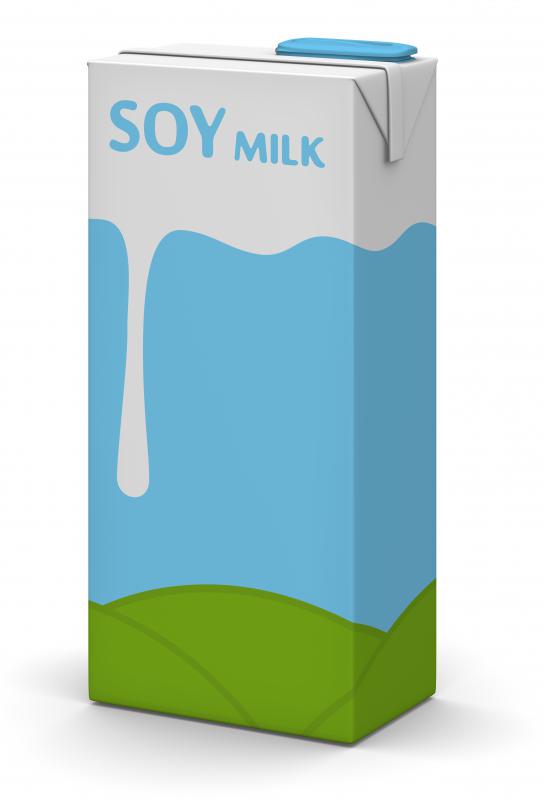
A similar phenomenon happens with soy milk, which is generally marketed as fat free. Natural fats still occur in trace amounts, and can be drawn to the surface when exposed to very high temperatures. Soy film can be discarded, but is also considered a delicacy in many Asian cultures. When removed and dried, it is referred to as yuba, or soybean curd, which is used in a variety of recipes.
Nutrition Concerns
Many people elect to remove the skin from hot milk. Doing so necessarily rids the milk of some of its proteins, but the effects on overall nutrition are usually negligible. Only the surface proteins and fats contribute to the film.
Prevention Techniques
Milk forms a skin the fastest when left to stand over high heat. Stirring or whisking the milk as it warms is one of the easiest ways of preventing skin formation. Simmering for a longer time over low heat might also help.
It is entirely possible for skin to form on milk after it has been removed from heat, as its internal temperature remains high and water is still, in most cases, evaporating. Covering the milk with a tight piece of plastic can sometimes delay film formation, as can adding dense toppings like whipped cream or marshmallows. These will both cool the surface and help break up protein binding.
AS FEATURED ON:
AS FEATURED ON:


-
![Soy milk will form a skin if heated rapidly.]() By: 3dsguruSoy milk will form a skin if heated rapidly.
By: 3dsguruSoy milk will form a skin if heated rapidly. -
![Milk skin forms when it is heated rapidly.]() By: KelpfishMilk skin forms when it is heated rapidly.
By: KelpfishMilk skin forms when it is heated rapidly. -
![Milk.]() By: Elena SchweitzerMilk.
By: Elena SchweitzerMilk. -
![Bottled milk that has been pasteurized and homogenized will not form as thick a skin as the raw product.]() By: Budimir JevticBottled milk that has been pasteurized and homogenized will not form as thick a skin as the raw product.
By: Budimir JevticBottled milk that has been pasteurized and homogenized will not form as thick a skin as the raw product.


Discussion Comments
That's not entirely true. Casein is stable even at 100 °C. It's the other protein - beta-lactoglobulin (whey, basically) - that reacts to heat (thermolability). It starts to denaturate at as low as 69 °C. Once it does, it coagulates with the milk's fat and then skin forms over the surface of the milk.
If you really don't want a skin forming on the top of milk or custard, just get a piece of plastic wrap and put it over the bowl, so that it is actually touching the surface of the milk or custard. You can then put the bowl in the fridge and when you take the plastic wrap off -- even if the bowl has been in the fridge overnight -- no skin!
That skin part of the milk, which form after boiling and cooling of milk on the surface is call "malai" or "khoya." For thousands of years it was, is and should remain a delicacy in India. Just add some sugar and yummy! Where do you think ice cream came from?
That thick layer of cream has all the best nutrients as per Ayurvedic instruction. Add a sprinkle of turmeric to it and use it for skin cream.
@feasting – Yes, it will. Just keep a close watch on it and don't let it get too hot. It's best to heat it on low.
Also, you're right about the stirring. You don't have to stir it constantly, but once or twice a minute should hopefully keep the skin from forming.
I will say that I don't think the skin makes much of a difference in the taste, though. I've made truffles with hot whipping cream before, and you basically just beat the skin in with the chocolate, so it sort of disappears.
Does heavy whipping cream form a skin on top, too? I've got to use some to make chocolate truffles, and I want to know if I need to be stirring it often so that a skin won't form. I really don't want a skin mixed in with my truffles.
I didn't know that the skin would trap heat in the milk! Maybe that's why several of my recipes that call for milk say not to boil it.
The recipes want the milk to form a few bubbles at the edges but not to boil. I believe that if milk trapped under skin came to a full boil, it would be scalded and ruined.
I am currently on a milk free diet. I drank some warm milk that had a skin on it two months ago, and it grossed me out so much that I haven't been able to drink any milk since.
My allergy symptoms have nearly disappeared since I stopped drinking milk. I think I was allergic to it all this time and just didn't realize it. I don't have that constant mucus dripping down into my throat anymore.
I'm glad that I drank the milk skin, because it led to me ultimately feeling so much better. Something gross turned into a revelation.
@anon37106-- I also think that skim milk contains a tiny bit of fat in it, that's why it forms a skin. If dairy free milk forms a skin, regular milk certainly will.
I don't take chances with my warm milk. I always pour it through a strainer before I drink it.
This is interesting, I never thought that someone would write an article on this!
Milk skin was the nightmare of my childhood. Our neighbors in the farm next door had milk cows and my mom would buy fresh milk from them every week. She would boil it at home to pasteurize it and make me drink a warm glass of it every morning before I went to school.
Of course the milk always formed a skin which I thought was just milk fat at the time. I hated the skin, it would make me gag. But my mom made me drink it so I would chug that cup of milk down as fast as possible before I got nauseated. It was terrible. To this day, I cannot drink milk with skin on it.
@anon21816-- I don't think so. I think it's just the protein and fat on the very top that gets exposed to air that forms the skin. The rest of the milk still contains protein and fat. So you will get the nutrition even if you throw out the skin.
There's usually at least some fats in even non-fat things. Soy milk gets the skin too when heated.
I also get skin forming on skimmed milk.
In the UK skimmed milk still has 0.1 percent fat in it, so I assume skimmed milk in America (or whether this was written) is completely skimmed.
I just barely heated up skim milk on the stove and poured it into a mug. I let it sit for a few moments to cool, and there was definitely a skin on top. I added a little brown sugar and cinnamon to the brew, but nothing with any fat in it. Why did my skim milk grow a skin??
Does this mean that if you discard the skin on the top of milk, you also discard the protein?
Post your comments