
At AllThingsNature, we're committed to delivering accurate, trustworthy information. Our expert-authored content is rigorously fact-checked and sourced from credible authorities. Discover how we uphold the highest standards in providing you with reliable knowledge.
Why do Trees in Rainy Places Have Big Leaves?
 Jeff Petersen
Jeff Petersen
Jeff Petersen
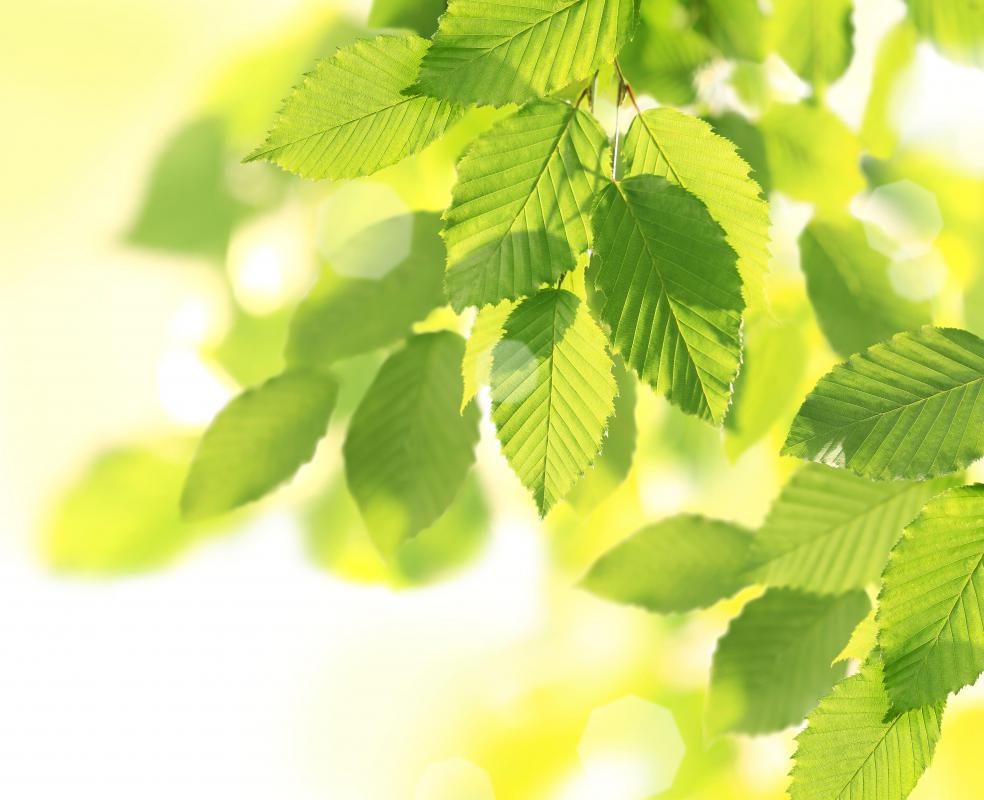
The simple answer to why trees in rainy places have big leaves is "Because they can." Having big leaves provides both benefits and disadvantages for a tree, and a rainy environment maximizes the positive reasons and minimizes the negative aspects. Big leaves are well suited to rainy climates, so many trees that grow well in rainy places have them.
The leaves on a tree fill a variety of purposes. They are the primary location for photosynthesis, the process plants use to convert sunlight and carbon dioxide into the chemical energy that they use to grow, and oxygen, which they release back into the air. The leaves also collect rainfall and direct it to the tree's root system. A rainy location encourages the trees there to grow big leaves to address both of these issues.

To grow big leaves, a tree needs plenty of nutrients. Wet soil encourages the decomposition of plant and animal matter in the soil, which means that the soil of rainy places often contains a lot of nutrients. This rich soil allows the trees that grow in it to more easily produce big leaves. The soil in a dry location would have slower decomposition, so nutrients may be harder to come by.

Trees also need ample water to grow, and a very rainy location obviously has plenty of that. The big leaves catch the rainfall and funnel it down to the tree's root system, where it can be absorbed. Leaves also release water vapor into the air. In dry climates, trees with large leaves would quickly dry out, but those in rainy climates can support large leaves because they easily replace the water lost to the air.
Very rainy locations tend to have a lot of cloud cover. The more cloud cover an area has, the less direct sunlight it will get. Trees need sunlight to perform photosynthesis, and having larger leaves in a rainy climate allows them to absorb more of the limited sunlight. Larger leaves have more surface area to catch the sun's rays. If the trees in a rainy climate had smaller leaves, they would get relatively less sun.
Trees in rainy places have tend to have large leaves and those in dry places tend to have smaller leaves because the size of the leaves need to fit the environment in order for the tree to survive. When the water and nutrients are easy to come by, as they are in rainy places, a tree is better able to support larger leaves. The leaves provide a larger area for photosynthesis to take place. The rainy climate also means that the tree can afford to lose the water vapor that comes from the larger leaves.
Frequently Asked Questions
Why do trees in rainy places tend to have larger leaves?
Trees in rainy environments often have larger leaves to maximize photosynthesis in low-light conditions. The dense canopy and frequent cloud cover in such areas reduce sunlight, so bigger leaves increase the surface area for absorbing light. Additionally, large leaves can collect and funnel water to the roots more efficiently.
Do big leaves provide any advantage during heavy rainfall?
Yes, big leaves can be advantageous during heavy rainfall. They act like umbrellas, protecting the soil from erosion by lessening the impact of falling rain. Moreover, their broad surface allows for the collection and channeling of water directly to the tree's root system, ensuring that the tree captures as much water as possible.
Are there any disadvantages to having big leaves in rainy climates?
Big leaves can be a disadvantage in rainy climates due to their susceptibility to wind damage and fungal infections. The larger surface area can act like a sail, making them more prone to tearing in strong winds. Additionally, the moist conditions can promote fungal growth, which can be detrimental to the tree's health.
How do big leaves affect a tree's transpiration process?
Large leaves can increase a tree's transpiration rate due to their greater surface area. This can be beneficial in rainy areas as it helps to prevent waterlogging around the roots by moving excess water from the soil through the tree and into the atmosphere. However, it can also lead to water loss during dry periods.
Can trees with big leaves survive in environments with less rainfall?
Trees with big leaves are generally less suited to environments with less rainfall. Their large leaves would lose water rapidly through transpiration in dry conditions, which could lead to dehydration. Trees in arid climates typically have smaller leaves or needles to minimize water loss and conserve moisture.
Is leaf size the only adaptation trees have in rainy environments?
No, leaf size is just one of many adaptations trees have in rainy environments. Other adaptations include buttress roots for stability in wet soils, waxy or glossy leaf surfaces to repel water, and specialized leaf drip tips that allow water to run off quickly, preventing mold and bacteria growth on the leaves.
Jeff Petersen
Jeff is a freelance writer, short story author, and novelist who earned his B.A. in English/Creative Writing from Creighton University. Based in Berkeley, California, Jeff loves putting his esoteric knowledge to good use as a AllThingsNature contributor.
Learn more...
Jeff Petersen
Jeff is a freelance writer, short story author, and novelist who earned his B.A. in English/Creative Writing from Creighton University. Based in Berkeley, California, Jeff loves putting his esoteric knowledge to good use as a AllThingsNature contributor.
Learn more...AS FEATURED ON:
AS FEATURED ON:









-
![Trees in sunny places don't need large leaves to harness the sunlight they require.]() By: XavierTrees in sunny places don't need large leaves to harness the sunlight they require.
By: XavierTrees in sunny places don't need large leaves to harness the sunlight they require. -
![Photosynthesis is the transformation of carbon dioxide and water into glucose and oxygen.]() By: designuaPhotosynthesis is the transformation of carbon dioxide and water into glucose and oxygen.
By: designuaPhotosynthesis is the transformation of carbon dioxide and water into glucose and oxygen.

Discussion Comments
Nutrient availability and rain don't necessarily go together: Tropical Rainforests are particularly nutrient-poor.
Vburmester - Many gymnosperms (pine relatives) from wet, warm climates do indeed have larger leaves.
For the same leaf mass, one that has a smaller area is longer-lived, and may therefore be less costly in the long run. If plants are slow-growing they are more likely to have hardy little leaves that they don't need to keep replacing.
Large leaves heat up more, but also cool down more. If keeping leaf temperature around air temperature is less likely to cause heat/frost damage, leaves will be smaller.
Maybe they have enough light and don't need to put out more leaf area, because other things than light limit their growth.
Very interesting post. What is the reason for pine needles, from wet and cloudy climates being tiny? I can't see how the needles maximize water retention or available light; perhaps evolution has another reason for designing tiny pine needles?
Post your comments