
At TheHealthBoard, we're committed to delivering accurate, trustworthy information. Our expert-authored content is rigorously fact-checked and sourced from credible authorities. Discover how we uphold the highest standards in providing you with reliable knowledge.
Why do They Dilate my Eyes for an Eye Exam?
 Mary McMahon
Mary McMahon
Mary McMahon
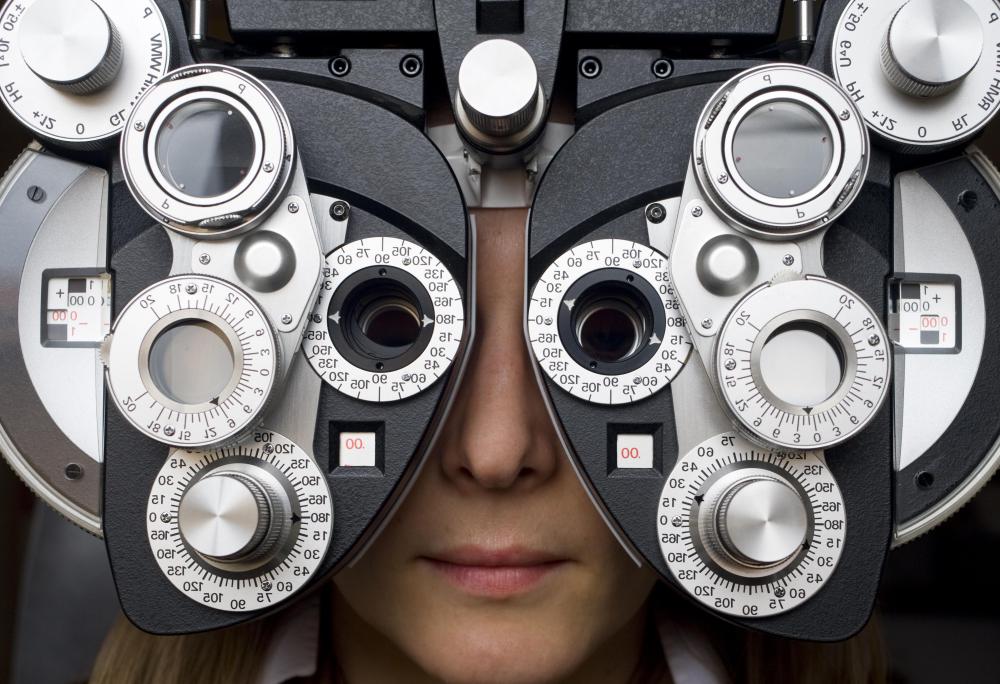
Getting regular eye exams is an important way to monitor your optical and general health. Part of a thorough eye exam is pupil dilation, which is accomplished by putting eye drops in the eye which will force your pupil to stay open, even in bright light. The procedure is not uncomfortable, but it does represent a loss of part of your day, as the drops take approximately 30 minutes to work, and you will have difficulty seeing for around an hour after your exam, until the drops have stopped working. Some patients question whether or not they need pupil dilation with every eye exam.
Pupil dilation is extremely important, because it allows the optometrist to see all the way into the back of the eye. During a normal eye exam, the optometrist will use a bright light and a lens to look into the eye, inspecting the health of the cornea, iris, and lens of the eye. However, the bright light causes the pupil to contract, making it difficult for the optometrist to see the back of the eye. When the regular eye exam is done, the optometrist will dilate your pupils so that he or she can completely check your optical health.

The back of the eye hosts the retina, optic nerve, and important blood vessels. When your pupils are open, the optometrist will be able to clearly see these parts of the eye and evaluate them. The procedure can reveal general health problems like hypertension, and can also catch the signs of glaucoma and cataracts early. For these reasons, optometrists ask their patients to submit to the procedure with every eye exam, despite the inconvenience, because they would rather catch serious medical problems early.

Healthy adults should have an eye exam, along with pupil dilation, every one to two years, or more frequently as recommended by an optometrist. People who are at high risk for developing optical conditions may need to have their eyes examined more frequently. In any case, remember to bring a pair of sunglasses along to your eye exam, so the bright light outside will not hurt your eyes after the examination. The optometrist's office will usually have several pairs of disposable sunglasses as well, just in case you forget. Because you may feel disoriented after pupil dilation, you may also want to consider asking someone else to drive you to your eye appointment, or accompany you on public transportation.
Mary McMahon
Ever since she began contributing to the site several years ago, Mary has embraced the exciting challenge of being a TheHealthBoard researcher and writer. Mary has a liberal arts degree from Goddard College and spends her free time reading, cooking, and exploring the great outdoors.
Learn more...
Mary McMahon
Ever since she began contributing to the site several years ago, Mary has embraced the exciting challenge of being a TheHealthBoard researcher and writer. Mary has a liberal arts degree from Goddard College and spends her free time reading, cooking, and exploring the great outdoors.
Learn more...AS FEATURED ON:
AS FEATURED ON:


-
![Optometrists dilate a person's eyes so they can see the inside and back of the eyes.]() By: Johanna GoodyearOptometrists dilate a person's eyes so they can see the inside and back of the eyes.
By: Johanna GoodyearOptometrists dilate a person's eyes so they can see the inside and back of the eyes. -
![Anatomy of the human eye.]()
Anatomy of the human eye. -
![An ophthalmologist examines a patient.]() By: daniel rajszczakAn ophthalmologist examines a patient.
By: daniel rajszczakAn ophthalmologist examines a patient. -
![An eye exam should be performed annually.]() By: pio3An eye exam should be performed annually.
By: pio3An eye exam should be performed annually. -
![Routine eye exams are painless and can help detect vision or eye problems early.]() By: RTimagesRoutine eye exams are painless and can help detect vision or eye problems early.
By: RTimagesRoutine eye exams are painless and can help detect vision or eye problems early. -
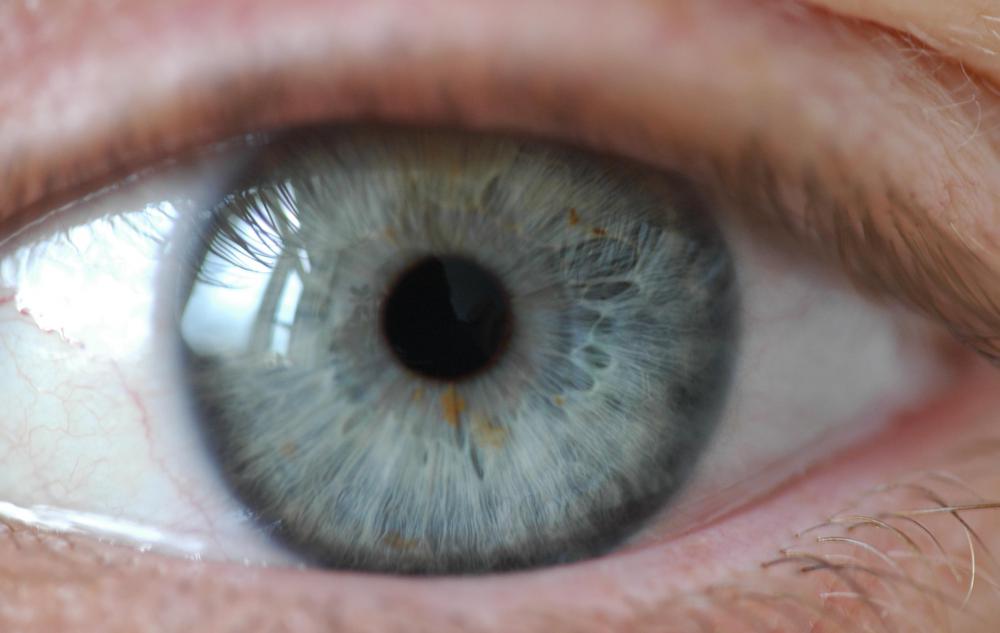
![Normally, a person's pupils contract when light is bright.]() By: mtthsNormally, a person's pupils contract when light is bright.
By: mtthsNormally, a person's pupils contract when light is bright.



Discussion Comments
Dilation is the standard of care for eye exams. It does not cause any harm to your eyes. It enlarges the pupil by activating the dilating muscle and then temporarily paralyzing the constricting muscle in the iris, thereby keeping the pupil open. The eyes will feel light sensitive due to being unable to regulate the amount of light getting to the retina. It "hurts" just like hearing a loud sound "hurts." Wearing sunglasses and staying indoors helps.
Dilation causes temporary blurring of near vision. This is normal. It is because the eye cannot accommodate (engage near vision focusing).
Dilation is 100% necessary for a new exam in a child both to perform retinoscopy (an objective assessment of the eye's prescription not dependent on their cooperation) and paralyze the accommodative reflex (to get an accurate prescription). It is imperative in patients who are strongly nearsighted, and for diagnosis of certain eye crossing problems (strabismus). Adults lose accommodative ability with age, which is why dilation becomes less necessary for checking the glasses prescription. A complete exam also includes an exam of the peripheral retina, which is enabled by dilation.
There are different drugs used for eye dilation. The effect will be more dramatic, immediate, and longer-lasting for lightly-colored irises. For the usual drugs (tropicamide/phenylephrine), 6-8 hours is typically the time it takes to wear off. Others like cyclogyl (more often used in kids) can take more like 12-24 hours, and atropine can last a week. Atropine is not used for a routine office visit. The eye is not harmed by staying dilated for longer if cyclogyl is used. The amount of times your eyes stay dilated is not clinically meaningful. It's just an inconvenience.
Your doctor cannot see your peripheral retina without dilating your eyes. Diseases of the eye can exist in just the peripheral retina. So, you are not having a complete exam without dilation. This is like going to your dentist and not having your molars examined because they are too far back/hard to see. You are missing areas of the eye which could contain pathology, which is probably not consequential for otherwise normal, healthy eyes, but just might be. Also, if your eyes/skin are very dark, it is much harder to see your retina in general. Dilation helps your doctor to do a better exam. You should be suspicious of an eye doctor who doesn't want to dilate your eyes at least every few years.
They dilated my daughter's eyes 18 hours ago, and they're still dilated. Anyone that says the eyes are back to normal in 6 hours does not know what they're talking about.
The job of an eye doctor is not let their patients go blind. Retinal issues are the number one cause of blindness in north america, and most limiting factor of seeing the retina is the size of the pupil. Dilation is standard of care in the industry. It is a common procedure performed to diagnose and monitor eye health.
If you can, take the day off if you know you're having your eyes dilated. After the exam, go home and take a nap. Your eyes should be improved when you wake up, depending on what your doctor used to dilate your eyes to start with.
Dilation lasts four to six hours.
I've had an eye dilation at 5:30pm this afternoon, now it's 8:40pm and I still can't read the fine print. My pupils look like I'm on amphetamines for days. I hope tomorrow it'll be fine.
i have a similar problem. my boss mentioned to me that my eyes were completely dilated the other day and since then i have noticed it a lot. they are dilated in light and dark. I also have a sensitivity problem where if i hear a loud sound like a hammer banging i blink automatically and when i try and force my eyes to stay open the nerves are too strong to keep them open.
I have also had light sensitivity problems and have to wear sunglasses when in the sun or bright light, i have black spots in the retina of my eye which i see everywhere i look (doctor said it was dead blood cells caused by stress). I hope this can contribute to a conclusion as i am not sure what is happening either. Any advice would be great.
When I was a child they dilated my eyes and I left the office in bright sunlight. I asked my Dad for a pair of sunglasses but he said I didn't need them. I've had light sensitivity ever since.
I'm a 'mature' adult now, and never, ever go outside without my sunglasses. I feel that the dilatation was unnecessary since I had no complaints or health issues. Never had one since either.
Unfortunately, I also have hearing problems that started in childhood because they gave me a medication for earaches that shocks MD's now. Oh well.
My son's eye is still dilated 24 hours after his exam. We are going back to doctor but what is this?
how long does it take for the pupil to function normally after dilation for eye examination?
They always say i will be light sensitive for just a couple of hours but it lasts more like six hours for everybody i know, no matter who they have them checked by.
My pressure is borderline high so i take the eye drops every day and it's normal but i want to skip having them dilate my eyes every year. Perhaps every other year?
With today's technology, a less invasive and therefore less dangerous method would be high speed digital photography. Use the numbing method which allows the optometrist to test for pressure, and get close and snap pictures of the eye in a darkened room. The flash would be too quick for the eye to respond, thereby allowing for a less anxiety prone visit, as well as providing a hard copy photo for storage in the patient's files and the doctor could study the photo whenever a need arose.
to Anon4179: Yes, it is very common for your eyes to hurt in the light for a short period of time. You see when you are in the dark your pupil(the black circle in your eye) gets larger to absorb as much light as possible, it goes the opposite when your in the sunlight. So when your eye doctor dilates your eyes, your pupil doesn't react to the light yet because of drops. Hope this helps!
just got my eyes dilated. my eye hurts but i look cute.
just had eye dilation and they have found a bulge behind left eye. The optician will write to my doctor re this. Should I be worried because I am at the moment. What could it be?
what is the difference between dilation and Optomap?
Who knows how much damage has been done from the dilatation exam procedure itself, and cause young people to become eye patients when they grow older.
Jacinta, he is probably on the heroin. Drug test him and if he comes out positive you should probably search through everything in his room, and even send him to jail. I know it might seem tough at first but jail would be the kick in the pants he needed since he has started abusing. In the long run, he will thank you.
To anon4179: Yes, perfectly normal with pupil dilation. To MoGrandma: Quite obviously because he doesn't need to dilate them and can see into your eyes just fine without causing you any more discomfort than is necessary to complete his job properly.
Why would an optometrist say that he doesn't need to dilate your eyes, that he can see into them just fine?
Why do my son's eyes dilate instead of contracting in bright light?
- Jacinta
After my dilatation, i am not being able to see clearly, and my eyes really hurt with anything bright. Can you tell me if that's common? If not, what should i do?
Post your comments