
At WiseGEEK, we're committed to delivering accurate, trustworthy information. Our expert-authored content is rigorously fact-checked and sourced from credible authorities. Discover how we uphold the highest standards in providing you with reliable knowledge.
Why do so Many People Find Clowns Scary?
 Michael Pollick
Michael Pollick
Michael Pollick
According to some phobia studies, an estimated 20 to 30% of the entire population find clowns scary, or at least a little unsettling. A certain segment of that group finds them frightening enough to trigger panic attacks, anxiety, and other phobic reactions. The fear of clowns is called coulrophobia, from the Greek word for "limb," surprisingly enough. The association with clowns and apparatus such as stilts most likely inspired the name for the condition. There are a number of theories as to why people find them scary, including fears of the hidden face and frightening media portrayals.
One common theory involves a connection between the presence of clowns and a personal trauma suffered during early childhood. For a young child, a circus can create a sensory overload with all of its unusual sights, sounds, and smells. When professional clowns begin their routines, a child can easily become overwhelmed by the surreality of it all. Heavy makeup, colorful costumes, and over-sized prosthetics all help to mask the true emotions and intentions of the performers, which can become very unnerving to a child.

There is also the concept of what role clowns play in society. According to the established "rules," children have the right to behave as children and adults have the responsibility to act like adults. Some people find clowns scary because they are adults who are permitted, even encouraged, to act like children. If clowns are not restricted by the same social norms as their audience, they could be capable of doing other things besides entertaining crowds. Subconscious fears of molestation by a masked or disguised attacker may be one reason some people have this fear.

Clowns are often portrayed as emotionally unstable or even psychotic in many forms of media. The idea of a "killer clown" has been used in horror films and novels for decades, and photos of serial killer John Wayne Gacy as a clown have been published many times. Clowns are also often portrayed as emotionally conflicted, projecting a false impression of happiness to their audiences while hiding great personal pain. These images may instill a sense of dread or fear in impressionable children, which in turn could lead to coulrophobia later in life.

Not all people find clowns scary, and some just consider them to be annoying or unfunny. Much of a clown's humor is meant to be broad and physical, complete with pratfalls and pies in the face. The interaction with audience members, which often involve acts of humiliation, could be another reason some people don't like clowns. Feeling humiliated or ridiculed in public can be a very traumatic experience for some people, even if the performer's actions were done in the name of comedy. Many audience members dread the idea of becoming part of the act, so the association of public mockery and clowns could leave a long-lasting scar on a person's psyche.

There are actual treatment centers that specialize in treating coulrophobia and other unusual social phobias. Treatment usually involves intensive personal counseling or psychotherapy, along with group therapy and a supervised desensitization program involving real clowns. True phobia sufferers often experience the same social anxieties as agoraphobics, remaining indoors rather than risk an incidental encounter with a clown or seeing images of clowns in public areas.
Michael Pollick
A regular WiseGEEK contributor, Michael enjoys doing research in order to satisfy his wide-ranging curiosity about a variety of arcane topics. Before becoming a professional writer, Michael worked as an English tutor, poet, voice-over artist, and DJ.
Learn more...
Michael Pollick
A regular WiseGEEK contributor, Michael enjoys doing research in order to satisfy his wide-ranging curiosity about a variety of arcane topics. Before becoming a professional writer, Michael worked as an English tutor, poet, voice-over artist, and DJ.
Learn more...AS FEATURED ON:
AS FEATURED ON:









-
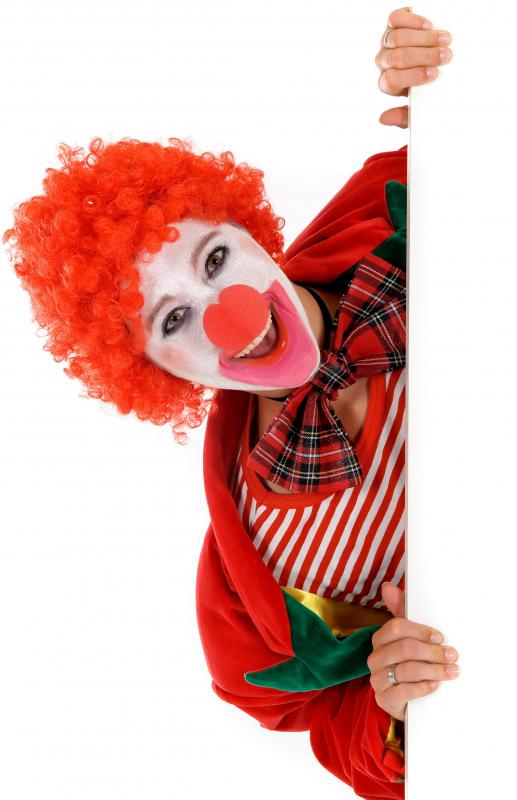
![About 20 to 30% of people are afraid of clowns.]() By: Patrick HermansAbout 20 to 30% of people are afraid of clowns.
By: Patrick HermansAbout 20 to 30% of people are afraid of clowns. -
![Clowns often appear in horror films.]() By: BrocreativeClowns often appear in horror films.
By: BrocreativeClowns often appear in horror films. -
![Suffering a clown-related trauma during childhood could cause an individual to fear clowns later in life.]() By: fasphotographicSuffering a clown-related trauma during childhood could cause an individual to fear clowns later in life.
By: fasphotographicSuffering a clown-related trauma during childhood could cause an individual to fear clowns later in life. -
![Group therapy is one option for individuals struggling with a fear of clowns.]() By: Monkey BusinessGroup therapy is one option for individuals struggling with a fear of clowns.
By: Monkey BusinessGroup therapy is one option for individuals struggling with a fear of clowns. -
![Cognitive behavioral therapy (CBT) may help treat coulrophobia or another anxiety disorder.]() By: nadezhda1906Cognitive behavioral therapy (CBT) may help treat coulrophobia or another anxiety disorder.
By: nadezhda1906Cognitive behavioral therapy (CBT) may help treat coulrophobia or another anxiety disorder.


Discussion Comments
I was getting over my fear of clowns until I read giddion's post. Now I get chills thinking of a clown walking my way. But my question is what makes clowns so scary? I am scared, but I don't know why they are so creepy. Is it the makeup or the shoes or even the round noses what makes them so scary?
When I was child I liked the circus and Soviet clowns such as Nikulin, Yengibarov, Popov, but when I see clowns with traditional western makeup, I feel scared. They look like monsters indeed.
I first saw the movie when I was about 9 and it terrified me. The movie does a great job of making the clown look both menacing and creepy. I am not terrified by clowns today, but when I see one I do still fell a little unsettled. I imagine that he lives in the sewer and he is very eager for me to join him.
@DylanB – My nephew was kidnapped by a man posing as a clown at a fair. He was missing for two months, and once we got him back, we found that he understandably has an intense case of coulrophobia.
Even the most happy clown outfit is to him a scary clown costume. I fear that he may become agoraphobic because of this experience.
He was only eight when he was kidnapped. He's been in therapy for a year now, but he's still afraid of clowns.
My husband hates clowns. He has been afraid of them since childhood, and I think that most of this stems from certain horror movies featuring clowns.
We have a friend who thinks it's funny to email him random clown faces. My husband has stopped opening any emails from this guy, because he finds them so disturbing.
I think it's important for everyone to respect the fears and wishes of someone who is afraid of clowns. We may not understand the fear, but we all have our own strange fears, and I know that we would hate it if someone mocked us for them.
I had no idea that coulrophobia was so intense! I know of people who dislike clowns, but I've never heard of anyone being afraid to leave their home for fear that they might bump into one!
I've seen traditional circus clown costumes on workers at various circuses and amusement parks all my life, and they've never bothered me. I suppose if someone had lived through a traumatic experience with one, just the appearance might throw them back.
I don't see the need for fake noses, painted faces, and huge shoes. Why can't clowns just do tricks and make kids laugh? Why do they need all the makeup and clown costumes that scare some kids half to death?
I certainly hope genevamech (post 2) has consulted a pediatrician about that 2 year old's "long list of phobias". That kid ain't right! Something is wrong!
Being able to read a person's face, and judge their intent, is part of us from shortly after birth. A clown's face is impossible to read, therefore fearsome. Also, one early fear is that of dolls being animated, as in nightmares. I myself dislike clowns and dolls. It encompasses the fear of the unknown.
I think a lot of people that say they're afraid of clowns aren't really. It's just something to be afraid of.
@ Parmnparsley- Clowns don't bother me personally, but I think that they would scare my daughter half to death. She is only a year and a half, but she has a long list of phobias. She screams when she walks in the bathroom and I have shaving cream on my face. She cries whenever the Spongebob pirate sings on television. She discovered her shadow today, and was trying to run away from it. She is also deathly afraid of a sculpture I have. I have a weird wooden head that is as tall as she is, and she refuses to go anywhere near it, touch it, or otherwise look at it (I actually have to hold her hand when she walks past it).
Anyway, everything she is afraid of has to do with surreal characters, strange faces, and distorted features that should be familiar.
I think that John Wayne Gacy had a lot to do with modern coulrophobia. He was a clown, but he killed and raped young boys. The story of Gacy is also one of the most publicized serial killer cases ever. I think that this story made parents and children question the intentions of clowns.
I also think that the fact a clown’s identity is hidden from everyone makes clowns seem like somewhat of sinister characters. People are very sensitive to the way people look, and often gauge a person through their facial expression and facial features. All of these features are exaggerated with clowns, making it hard for people to subconsciously say that they can trust this person.
Post your comments