
At AllThingsNature, we're committed to delivering accurate, trustworthy information. Our expert-authored content is rigorously fact-checked and sourced from credible authorities. Discover how we uphold the highest standards in providing you with reliable knowledge.
Why do Mountains Seem to Attract Clouds?
 Mary McMahon
Mary McMahon
Mary McMahon
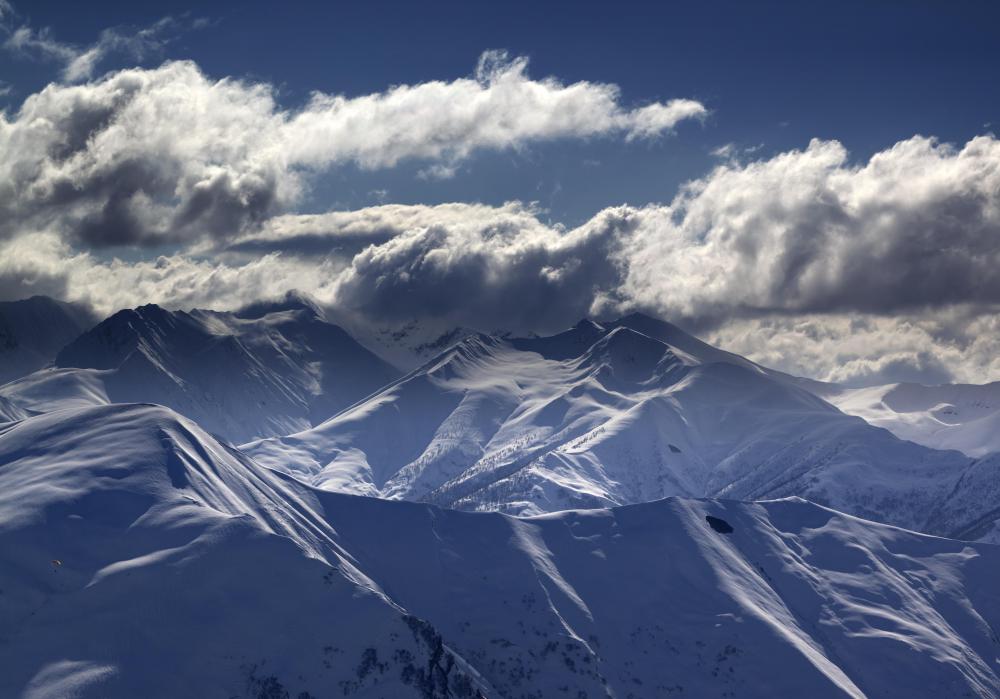
Most observers have noted clouds clinging to mountains, especially famous peaks like Fuji and Kilimanjaro. Mountains also experience more severe weather in the form of rain, sleet, and snow on their windward sides. These landforms do not so much attract clouds as cause them to form, in a well documented meteorological phenomenon. They are, in fact, a very important factor in meteorology — without mountains, the Earth's climate would be very different.
Air currents are constantly traveling across the surface of the Earth, usually in patterns that remain consistent. In the United States, for example, the prevailing winds run West to East. As air travels, it picks up water molecules in vapor form, which remain vaporous in the higher pressure at low elevations. When the air encounters mountains, however, it is forced to rise.

The increase in elevation and drop in pressure cause the water vapor to cool until it reaches the dew point and condenses in the air into water droplets. These droplets are visible as cloud formations. The air may continue to cool and condense until it forms rain or snow, which will fall on the windward side of the mountain. As the cloud sinks along the lee side, the air will warm and the water droplets forming the cloud will turn back into vapor.

This often causes cloud formations to look as though they are stationary and clinging to the peak, because new droplets condense into water as old ones return to a vapor state. These clouds that constantly reform lead people to say that mountains have a pall of cloud at their peaks. This type of cloud is known as an orographic cloud, because it is caused by the forced elevation of an air current by a topographical feature.

Large mountains often form their own microclimates, with extreme variations in weather depending on whether the observer is on the windward or lee side and what the elevation is. Fuji, for example, is famous for being very hot at the base, while still being cold enough to snow at the top. Many people can be endangered by this, because they don't realize the highly changeable weather that occurs around these landforms. When hiking or climbing, it is a good idea for people to research weather conditions over the entire areas so they don't get caught in the cold.
Frequently Asked Questions
Why do mountains seem to attract clouds more than other landscapes?
Mountains appear to attract clouds due to orographic lift. When moist air is forced to ascend over a mountain range, it cools and condenses into clouds. This process is more pronounced in mountains because of their significant elevation changes, which provide a barrier that air must rise over, leading to increased cloud formation.
Can mountains influence the type of weather in a region?
Yes, mountains can significantly influence regional weather. They act as barriers to air movement, creating wet climates on the windward side due to orographic precipitation, and dry, sheltered areas on the leeward side, known as rain shadows. This can lead to diverse microclimates within relatively small geographic areas.
Do all mountains create clouds and precipitation?
While most mountains can create clouds through orographic lift, not all result in precipitation. The ability of a mountain to generate precipitation depends on factors such as the moisture content of the air, the air temperature, and the mountain's height and shape. Some mountains may simply cause cloud formation without significant rainfall or snowfall.
How do mountain ranges affect cloud formation differently than isolated peaks?
Mountain ranges can create more extensive and persistent cloud cover compared to isolated peaks due to their larger and more continuous barrier to air flow. This can result in more widespread orographic lift, leading to a greater area of cloud formation and potentially more precipitation along the range.
Is there a difference in cloud attraction between taller and shorter mountains?
Taller mountains are generally more effective at attracting clouds, as they force air to rise higher, leading to more significant cooling and condensation. According to atmospheric science, the higher the elevation, the greater the potential for cloud formation and precipitation, assuming sufficient atmospheric moisture is present.
What role do prevailing winds play in mountain-related cloud formation?
Prevailing winds are crucial in mountain-related cloud formation. They determine which side of the mountain—the windward or leeward—will receive more clouds and precipitation. Windward slopes facing the direction of prevailing winds are typically wetter and cloudier, while leeward slopes often experience drier conditions and less cloud cover.
Mary McMahon
Ever since she began contributing to the site several years ago, Mary has embraced the exciting challenge of being a AllThingsNature researcher and writer. Mary has a liberal arts degree from Goddard College and spends her free time reading, cooking, and exploring the great outdoors.
Learn more...
Mary McMahon
Ever since she began contributing to the site several years ago, Mary has embraced the exciting challenge of being a AllThingsNature researcher and writer. Mary has a liberal arts degree from Goddard College and spends her free time reading, cooking, and exploring the great outdoors.
Learn more...AS FEATURED ON:
AS FEATURED ON:









-
![Mountains experience extreme variations in weather.]() By: BSANIMountains experience extreme variations in weather.
By: BSANIMountains experience extreme variations in weather. -
![Hikers must keep a careful watch on any weather that starts to move into a mountain range.]() By: Dudarev MikhailHikers must keep a careful watch on any weather that starts to move into a mountain range.
By: Dudarev MikhailHikers must keep a careful watch on any weather that starts to move into a mountain range. -
![Water molecules cool to form droplets as air rises over mountains.]() By: Ioana Davies (Drutu)Water molecules cool to form droplets as air rises over mountains.
By: Ioana Davies (Drutu)Water molecules cool to form droplets as air rises over mountains.


Discussion Comments
Do the Rocky Mountains have a windward and leeward side? Does this affect the amount of snow that falls on either side of the Rocky Mountains?
@aplenty- That is interesting. I would have never thought that a place like Hawaii would have anything other than a tropical landscape. I have seen pictures of the mountains of Hawaii though, and the forests look beautiful. I have heard that the islands are one of the very few places within the United States where you can see cloud forests. Now I understand why. It takes a high mountain that attracts clouds and moisture to create one of these places.
I used to live on the Big Island of Hawaii, and there is a huge mountain on the island that certainly does create its own micro-climates. The island actually has all of the known micro-climates except arctic and one other (tundra I think). The Mountain, Mauna Loa, is the world's highest mountain if measured from its base below sea level.
The leeward side of the island is completely different from the windward side of the island. On the leeward side of the islands, generally the southeastern side, the islands have a decidedly desert climate. This part of the island is very dry and receives far less rainfall than the windward side.
The windward side of the island is very wet with lush tropical rainforests. This side of the island is beautiful, but can be very wet and humid, especially close to the mountain. On the windward side of the Hawaiian Islands, you will often find that there are beautiful and mysterious cloud forests. There is also a much higher concentration of flora and fauna in the windward environment.
Post your comments