
At EasyTechJunkie, we're committed to delivering accurate, trustworthy information. Our expert-authored content is rigorously fact-checked and sourced from credible authorities. Discover how we uphold the highest standards in providing you with reliable knowledge.
Why do Credit Cards get Demagnetized?
 Mary McMahon
Mary McMahon
Mary McMahon
Credit cards, along with many identity cards and access cards, have a magnetic strip on their reverse side that contains information about the card and card holder. If this strip is demagnetized, the card will become useless in a card reader, regardless as to whether or not it is valid. A number of objects in daily life can demagnetize a credit card, but if it is handled with care, this shouldn't occur. People who do have cards that no longer work will need to get them replaced by the card issuer.
When a person swipes or inserts a magnetized card into a reader, the reader picks up data from the tiny iron particles in the magnetic strip. The information is contained in binary form: each particle aligns along a north/south axis with some facing up and some facing down. With a credit card, the strip contains data like the name of the cardholder, the account number, the expiration, the pin number to access the card, the security code, country in which it was issued, and other such data. When the card is swiped in a terminal, this information is exchanged with a central server, which authorizes the transaction depending on the available balance and whether or not the card has been reported stolen.

Because the information in the data strip is magnetic, it is susceptible to anything else that is magnetic, since being in contact with a magnetic field will erase the information by realigning the iron particles. Common demagnetizing culprits are the pads used to deactivite security devices in new books, CDs, and movies; some security screening machines; and even small magnets, like those used on the refrigerator. Speakers, some cell phones, and magnetic clasps on wallets and purses can also demagnetize a credit card, and cards such as transit passes used on many subway systems are even more susceptible to this problem. Some credit cards have been known to be erased by strong electrical charges as well, which can potentially reverse the polarity of the iron particles.

When a clerk is unable to run a card because it has been demagnetized, it can be an indicator that the card is fake or stolen. For this reason, many credit card companies may request that a clerk call for authorization on the card, to ensure that there is not a problem with the account. If this does happen to a shopper, he or she should not take it personally; the consumer can simply file a request for a new card as soon as possible, and make sure to keep the new one safely stored in a wallet and well away from magnetic material. People can also use demagnetization to their advantage when they dispose of expired credit cards, because if the card is demagnetized, a thief cannot extract that encoded information and use it to steal the person's identity.
Mary McMahon
Ever since she began contributing to the site several years ago, Mary has embraced the exciting challenge of being a EasyTechJunkie researcher and writer. Mary has a liberal arts degree from Goddard College and spends her free time reading, cooking, and exploring the great outdoors.
Learn more...
Mary McMahon
Ever since she began contributing to the site several years ago, Mary has embraced the exciting challenge of being a EasyTechJunkie researcher and writer. Mary has a liberal arts degree from Goddard College and spends her free time reading, cooking, and exploring the great outdoors.
Learn more...AS FEATURED ON:
AS FEATURED ON:









-
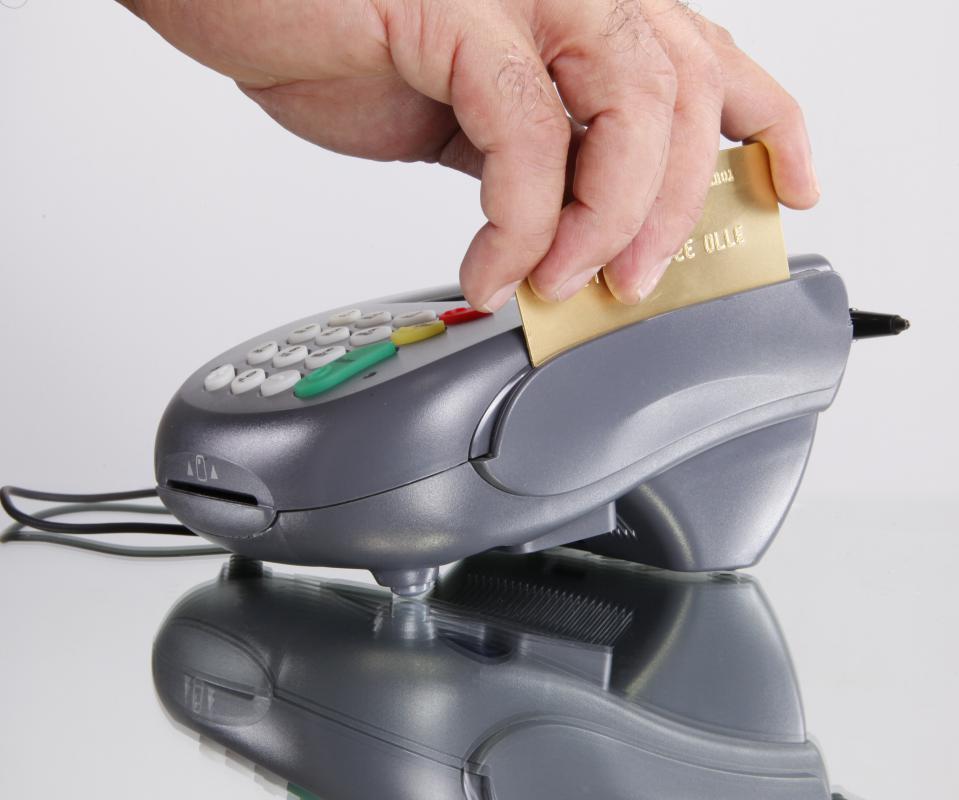
![When a credit card is swiped through a credit card terminal, its magnetic strip is scanned for relevant user data.]()
When a credit card is swiped through a credit card terminal, its magnetic strip is scanned for relevant user data. -
![Even small magnets on a refrigerator can demagnetize a credit card.]() By: Feng YuEven small magnets on a refrigerator can demagnetize a credit card.
By: Feng YuEven small magnets on a refrigerator can demagnetize a credit card. -
![The security demagnetizer at a bookstore can affect your credit card's magnetic strip.]() By: eleThe security demagnetizer at a bookstore can affect your credit card's magnetic strip.
By: eleThe security demagnetizer at a bookstore can affect your credit card's magnetic strip. -
![A credit card's magnetic strip is susceptible to anything that is magnetic.]() By: Claudio DiviziaA credit card's magnetic strip is susceptible to anything that is magnetic.
By: Claudio DiviziaA credit card's magnetic strip is susceptible to anything that is magnetic.


Discussion Comments
I accidentally placed a hot iron on my mastercard this morning. I was wondering if there is a chance it might still work.
What damages keycards other than demagnetizing? Will slight bends to it from being in a wallet damage the card?
All nine credit cards in my wallet stopped working at once. what happened?
How embarrassed I was today! Out eating with family and I couldn't use my card to pay for the meal. I had to ask a family member if she had the $30 to pay for our meals and thank the Lord she had some money on her!
How strong of a electromagnetic field would it take to damage a credit card?
Post your comments