
At AllThingsNature, we're committed to delivering accurate, trustworthy information. Our expert-authored content is rigorously fact-checked and sourced from credible authorities. Discover how we uphold the highest standards in providing you with reliable knowledge.
Why are Rats Used in Animal Testing?
 Michael Pollick
Michael Pollick
Michael Pollick
While laboratory tests involving any animal can be fraught with controversy, the scientific community has been using rats experimentally for decades without much vocal objection. Perhaps the reputation of these animals as unsavory, disease-ridden vermin did not do them any favors. Researchers and scientists rarely use such animals of unknown origin in laboratory tests, however. Carefully bred rats with documented genetic histories are used in animal testing for a number of reasons, including their frequent reproduction, genetic purity and similarities to human biology.
A number of laboratory tests performed on rats involve the safety of chemicals, whether used in medicines, food products or cosmetics. Because they are mammals, their systems should react to these chemicals in a similar way to those of a human test subject. In order to be considered safe enough for human consumption or exposure, a new chemical compound must first be tested on other mammals. Laboratory rats are often fed extremely high amounts of a new food additive or injected with large doses of a new chemical compound. Theoretically, if the test product is completely safe for humans, it shouldn't matter if they ingest two hundred times the recommended levels.

Another reason laboratories use rats is genetic consistency. Those raised for animal testing are tested for any genetic defects that may affect the results of the experiments. Only animals with known genetic histories are candidates for testing. Since rats tend to breed frequently, their offspring can also be tested for any genetic abnormalities possibly caused by exposure to the test product. Since the researchers would know of any genetic predispositions towards weight gain or cancer formation, for example, they can safely eliminate these factors as related to the test product.

Because rats reproduce quickly and tend to have large litters, researchers do not have to wait long to evaluate test results in generations. The grandsons and granddaughters of original test animals could appear within months, not the years it would take in human subjects. When looking for potential health hazards, examining various generations of a test subject all at once can provide more definitive proof of a product's safety or potential threat. Overseers such as the Federal Food and Drug Administration (FDA) require this level of proof before even considering human clinical trials. Although the issue of animal testing remains controversial, there can be no doubt that the use of rats in laboratory studies has provided a number of advances in the medical, food and cosmetics industries.
Frequently Asked Questions
Why are rats specifically chosen for animal testing over other animals?

Rats are chosen for their genetic, biological, and behavioral similarities to humans, which make them valuable models for studying human diseases. According to the National Institutes of Health, rats share many physiological and genetic similarities with humans, which helps researchers predict how human bodies might react to various treatments and substances.
How does the size of rats contribute to their use in laboratories?

The small size of rats makes them easy to house and care for, allowing for the management of large numbers of animals in a laboratory setting. This is crucial for statistical analysis, as it provides a larger sample size for more reliable results. Their size also means they require less space and resources compared to larger animals.
What types of research are rats commonly used for?

Rats are commonly used in biomedical research, including studies on genetics, disease progression, medication efficacy, and toxicology. They are particularly useful in cancer research, neurological studies, and for developing new drugs. Their rapid reproduction rate allows for the observation of several generations within a short time frame, facilitating genetic studies.
Are rats considered good models for human diseases?
Yes, rats are considered excellent models for many human diseases due to their physiological and genetic resemblance to humans. They have been instrumental in the development of treatments for conditions such as diabetes, hypertension, and heart disease. Their short lifespan also allows researchers to observe the progression of diseases and the effects of treatments over a condensed period.
How does the reproductive biology of rats make them suitable for testing?
Rats have a high fertility rate and short gestation period, which allows for the study of multiple generations in a relatively short time. This is particularly useful for genetic research and for studying the effects of substances across different life stages, from prenatal development to adulthood, providing comprehensive data on potential risks and benefits.
What ethical considerations are taken into account when using rats in research?
Ethical considerations are paramount in animal research. Guidelines such as the 3Rs (Replacement, Reduction, Refinement) are implemented to minimize animal use and suffering. Researchers aim to replace animals with alternative methods when possible, reduce the number of animals used, and refine procedures to alleviate or minimize potential pain and distress.
Michael Pollick
A regular AllThingsNature contributor, Michael enjoys doing research in order to satisfy his wide-ranging curiosity about a variety of arcane topics. Before becoming a professional writer, Michael worked as an English tutor, poet, voice-over artist, and DJ.
Learn more...
Michael Pollick
A regular AllThingsNature contributor, Michael enjoys doing research in order to satisfy his wide-ranging curiosity about a variety of arcane topics. Before becoming a professional writer, Michael worked as an English tutor, poet, voice-over artist, and DJ.
Learn more...AS FEATURED ON:
AS FEATURED ON:









-
![Brown rat.]() By: Ilia ShcherbakovBrown rat.
By: Ilia ShcherbakovBrown rat. -
![Genetic consistency is one reason rats are used for testing.]() By: eabffGenetic consistency is one reason rats are used for testing.
By: eabffGenetic consistency is one reason rats are used for testing. -
![Some cosmetics companies are formulating increasing numbers of products that are cruelty free.]() By: arminaSome cosmetics companies are formulating increasing numbers of products that are cruelty free.
By: arminaSome cosmetics companies are formulating increasing numbers of products that are cruelty free. -
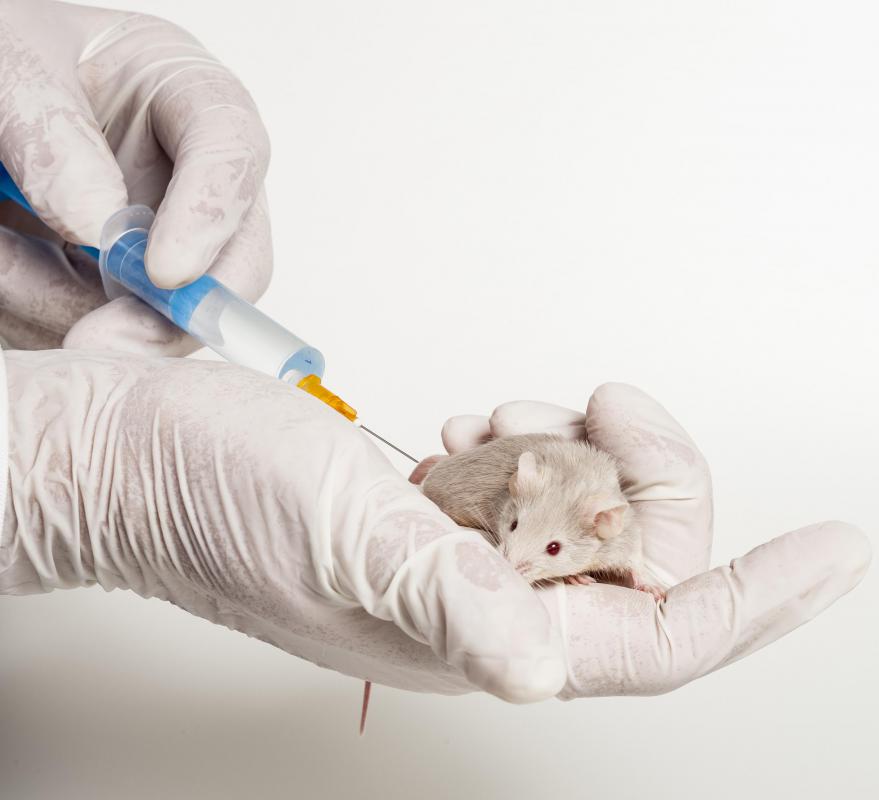
![Drugs and vaccines are often tested on rats and mice.]() By: Vera KuttelvaserovaDrugs and vaccines are often tested on rats and mice.
By: Vera KuttelvaserovaDrugs and vaccines are often tested on rats and mice. -
![Cosmetic companies have seen controversy over some of their R&D methods.]() By: aviemilCosmetic companies have seen controversy over some of their R&D methods.
By: aviemilCosmetic companies have seen controversy over some of their R&D methods.



Discussion Comments
Rats are tiny and have mistaken identities. They are being killed or they get very sick just so humans can have life. Wouldn't you rather rats die than humans? I definitely would. They are saving us from cancer and other types of illnesses. We should thank them and not always scream and shout when we see one. They are God's creatures and we should respect that.
It's shocking to think that some people actually believe that "God" put rats on the earth for laboratory testing in drug development. Surely if he knew, the millions of years ago when he apparently put them on the earth, that they would be used to test for levels of toxicity and pharmacokinetics, that he would have given us the knowledge to test on them a little earlier?
Labs don't lift rats off the street and breed them; they are carefully selected, genetically profiled rats bred and selected especially for pre-clinical testing. In other words, they are not lifting a half-starved rat off the street and giving it a home with food and health care in a lab. Scientists force them to breed and breed within a lab setting, so that they can find out if future generations of rats will be affected by the ancestor receiving this drug. At the end of testing, the rats are killed so that they can be cut open and examined internally.
And people still haven't copped that none of this inherently proves that the drug will be safe for humans, as rats are genetically similar but not identical. Why not test on rapists and murderers on Death Row? They've done far more to harm society than the common rat, and have more of an obligation to give something back.
I firmly believe in animal testing. I believe in helping people to live. I want cures for my loved ones. I do not want to see humans suffer. I do not believe random people should be tested on, as some people have posted. I wonder how many of these people who are so against animal testing have ever used a product or medicine that has help improved or saved a life. It's hard to believe, for example, that if they or a loved one got cancer, they would not go in for any treatment, because it was tested on animals. Especially with one out of two men and one out of three women are expected to get cancer in their lifetime.
I have a hard time understanding people and why they are so against animal testing. I wonder how much it has to do with how you were raised growing up.
The way I see it, people were brought up with either a religious background or a scientific background. For example, the old "how was the Earth created" Big Bang or by God. I was brought up with limited religion, but more science. That being said, I respect people's opinions, but I believe that testing on animals is more beneficial for all human kind, and I would rather see my children and grandchildren etc, grow up healthy with alternatives to our population dying out, and overall less suffering, than the world overcome with happy rats.
My daughter is currently in high school, and she is planning to go to college to study genetics and DNA. She wants to help find cures, especially cancer as three out of her four grandparents have had/died from it, and we have been thankful for the treatments, but want more and better results.
I hate how people think that just because a lot of people don't like rodents that it is okay to hurt and test and kill them. People are heartless.
Why are these tests done on these/those animals?
The end of animal testing will be a long and slow process. Rome was not built in a day. A better process not using lab animals will not just happen within a blink of an eye.
I don't care. I just do not care. If rats were smarter than us, they they would escape the prisons that hold them and prison is better than real life. You don't pay taxes, you get fed actually really good food and you have doctors to take care of you for free.
If people are so against animal testing? Then why are they reading a webpage taking about animal testing?
Personally,I believe that animal testing is very, very wrong. I have been told it happens because we are a superior species. OK, just hypothetically, say aliens landed on earth tomorrow and they were far, far, superior to us and saw us like we now see animals. They blinded us, gave us drugs that made us really sick, cut off our limbs, burned us etc. Would those who think the concept of superiority of species, would still be a justifiable reason for such research.
In addition, animal research is a waste of billions of money each year. But don't take my word for it. Read "Sacred Cows and Golden Geese" or just look up doctors against animal research.
God cares about what he created, so he gave us rats to test on so us humans wouldn't die.
Some of these comments are funny. People obviously don't know anything about rats and their intelligence levels. We are not superior to any animals, and we need to use our knowledge to help others, not kill them. It's not justifiable. Power is what kills!
If people are against testing cosmetics on animals, then why do we openly welcome the use of rats in scientific experiments bound to cause more damage than cosmetic defects? Is it because they are dirtier than most animals? They aren't. Is it because they carry more diseases? They really don't.
I really do not understand humans sometimes, like all of you whining about testing rats or animals in general. The homes we live in, the education we can get, the cars we drive, the jobs we have and our ability to communicate verbally is what makes us different from all the other species and superior.
A long time ago, we didn't have any of that and we were a bunch of stupid humans getting killed everywhere. Go into the jungle in the middle of Africa and tell me what lion is going to start a committee to stop their cubs from mangling your face off. Go deep into the ocean, and tell me what shark will stop themselves from tearing you apart for lunch.
I was watching Animal Planet the other day and this animal ate one of its own just because it was going to be winter. In order to survive they needed to kill one of there own to use its fur for themselves. It was pretty funny, yet totally ruthless, but understandable.
Although animals can't communicate, we all share one purpose: survival. If they could use us for bait, animal testing, food or clothing they would. These animals don't care about us. They usually don't even care about each other unless they travel in flocks or packs. If they could talk, create a government and do all the things we do, they'd probably do worse to us than we ever could to them. People should be grateful we have out smarted all species because we could easily still be running around wearing leaves and carrying spears in our hands, looking for our next meal just like them.
Amen to language, and the supermarket. Think about it: if we don't test them, who do you prefer them to test? We humans? I wonder how many members of PETA are willing to test a new drug out for "trial purposes" or a vaccine for the next CDC crisis. I promise you none would. At the end of the day you really should know if the tables were turned these animals would care less. We would be on sale as a coat for 2k at Henry Bendel too. We'd be the chicken legs at their supermarkets. We'd be their lab rats.
If you're so against animal testing then why don't you volunteer yourself? Stop calling everybody else a coward and do something. Because it's just "so wrong".
For you people who say god created them for this, why would God create you? Angels are saviors, not killers like you. God cares about all he created. If he created them for this reason, then what were you created for? What's your purpose in life? Who are you to say what God intended us for? Who are you to speak God's will without his say? Who do you think you are?
Animal testing is incredibly wrong and inhumane, and I don't believe we should continue it. If knowing that rats are like heroes dying, why don't you treat them like heroes?
I say if we want to find cures, test on those humans with the problems, disabilities or sickness, or don't even test. I mean, I think it's cowardly how we're to scared to try something so we make the animals who have no freedom do it for us. It's awful.
You people who say its for the good of men are just selfish cowards. If you think this testing is so important put yourself in their place. Go let people test on you try it out, I dare you, and tell me how you feel afterward.
These rats are probably like several taken from the streets and then they've just been bred over the years. There are still thousands of rats in the world.
And can we please stop involving God in this! I'm sure he loves the notice you're giving him, but I think he's getting a little sick of you all continuously mentioning him for the sake of argument. *sighs*
The use of rats and mice is far more useful than using untested products on humans. For you God-fearing individuals, I also am a believer but I believe that he allows us to use these more minor creatures for this purpose. If he did not intend this then why would he give them such short life spans, weak nerve responses, and high rates of reproduction?
While it may not be completely ethical, it is the best we have and we should take advantage of that until we find something better. That is all.
testing animals is wrong, but when it comes to saving a life and bringing those in who are having to tell their family that they don't have much time to live and spend every moment with them before they go is way worse.
look at like this: i lost a grandma to cancer and it hurt because she raised me while my parents had their habits so knowing that testing a rat to save one loved one is like a hero because they gave theirs to save another, like a army does for its country. i
I'd rather see a family saved than go what i went through. --louisville ky
I think animal testing is cruel, although it helps humans be prevented from illnesses. I feel sorry for the rats because they are having stuff injected into them.
rats are nice animals. they should not be used for animal testing.
The practice of animal testing is just wrong so you need to get your act together and stop making it sound like a rat's life has no meaning.
God made rats for a reason and that reason was not for them to be tested on in such inhuman ways. If people want the product then they buy it at their own risk!
I am sickened with the thoughts of being so mean to animals!
Good to know that rats help us in a way that can save our lives. but, shouldn't there be a limit on the number of rats used to occur animal testing? Of course, we discover new things every day, so therefore new medicines are discovered as well. But rats are very important to our environment and our biosphere, and other animals depend on rats' survival besides us.
What would happen if a company reports a lower amount of rats that died from injections?
I'm finding it difficult to find out,"how many rats it would take to create one horse power?". If you know anyone or know yourself could you please let me know. Thank you. Reggie
Post your comments