
At WiseGEEK, we're committed to delivering accurate, trustworthy information. Our expert-authored content is rigorously fact-checked and sourced from credible authorities. Discover how we uphold the highest standards in providing you with reliable knowledge.
What Should I Know About the Netherlands?
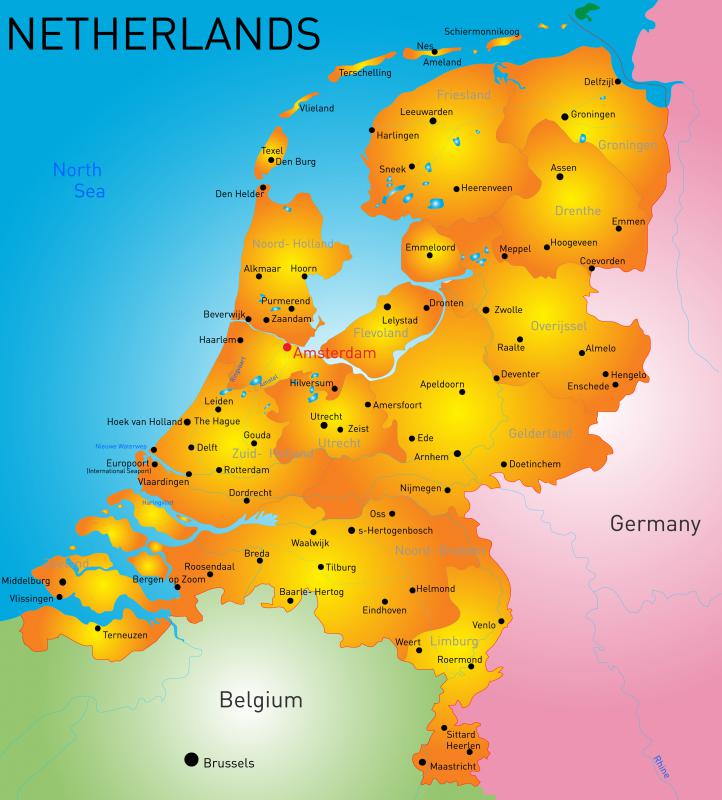
The Netherlands is a small country in Western Europe. It covers 16,030 square miles (41,530 sq km). The country shares borders with Belgium and Germany, and has coastline along the North Sea.
The region has been inhabited for roughly 10,000 years, with permanent agricultural settlements springing up sometimes in the 6th or 5th millennium BCE. The Netherlands were settled in the 6th century BCE by various Germanic and Celtic tribes. Around the same time the region became much more wealthy with the discovery and exploitation of iron resources.

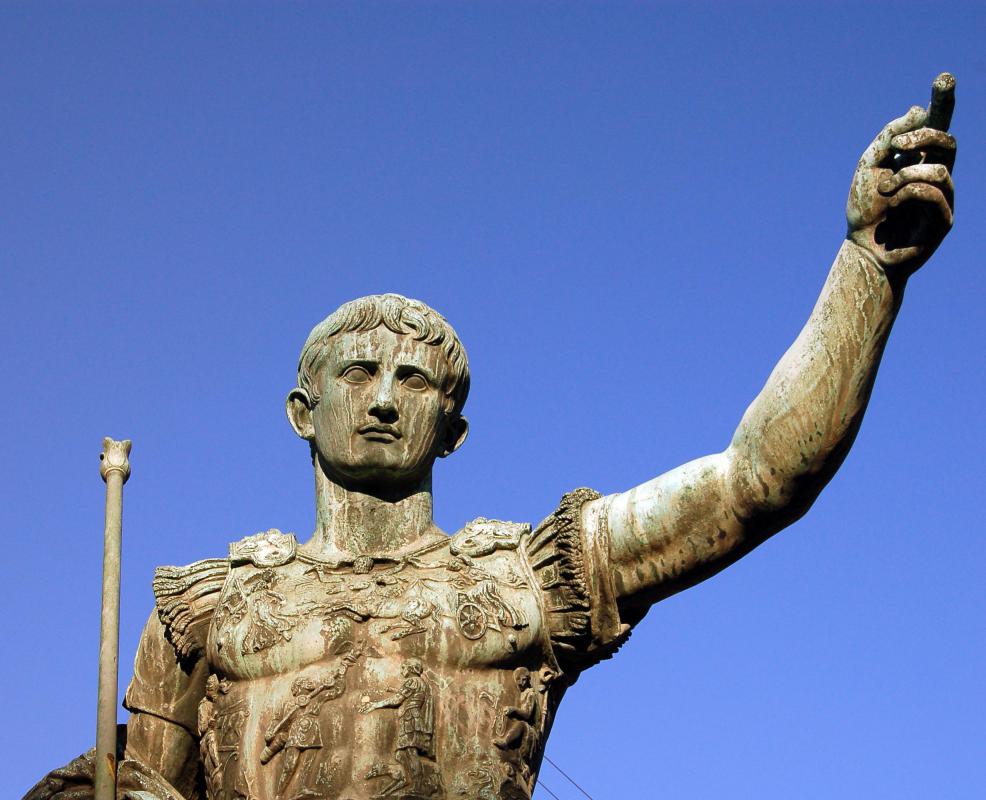
In the 1st century BCE Julius Caesar conquered much of the area for Rome, and the Rhine served as the northern border of the Empire for some time. The Romans developed the part of the Netherlands that they controlled substantially, building large cities and introducing new culture and technologies. Various Germanic tribes ultimately pushed the Romans out, claiming the Low Country for their own.

The Netherlands were split for the next few centuries, with the Franks controlling the south, and the Frisians controlling the north. When the Frankish Empire split into three parts, the Netherlands became a part of the middle region, later the region fought over by Germany and France. The Vikings invaded in the mid-9th century, seizing much of it in the midst of France and Germany’s fighting.

Germany eventually reclaimed the region from the Vikings in the early-10th century, and when King Otto was crowned emperor, the Netherlands became a part of the Holy Roman Empire. In the early-11th century farmers began to settle in the western part, draining the swamps and establishing independent farms in the region, forming what would eventually come to be known as Holland.

Although nominally under the control of the Holy Roman Empire, most of the Netherlands was in a feudal state, with various lords and nobles having complete control over their section of land. These various states fought with one another constantly, with the balance of power shifting from year to year.
In the first half of the 15th century, the region was conquered by the Duke of Burgundy, who united the disparate states. Under Burgundian rule, Holland grew to become a major trading power, with a strong navy backing it. By the mid-15th century, Amsterdam had become one of the major ports of Europe.
The Habsburgs eventually came to control all of the Low Countries during the 16th century, and in the middle of the century Emperor Charles V had declared the Netherlands distinct from both France and the Austro-Hungarian Empire. The struggle for full independence began in 1568, following a crackdown by the Catholic ruler Philip on the Reformists in the region. In 1581, the country declared its independence, and in 1648, the Eighty Years’ War finally came to a formal end with recognition of the country.
The Netherlands continued to prosper as a trading hub for the next few centuries. The Dutch colonized extensively, even seizing major Portuguese territories. Slavery added a new source of wealth, and by the 17th century the country’s coffers were flowing over.
The nation briefly lost its sovereignty after being occupied by Napoleon, but regained it after his defeat, in the process transitioning from a surprisingly democratic government to a more traditional monarchy. In the 19th century, the Netherlands began to liberalize its government, as well as to expand its territorial holdings throughout the world.
The country remained neutral during World War I, and declared neutrality in World War II before being overrun by Germany. The Dutch territories in what is now Indonesia were taken over by the Japanese. Following the war, Indonesia declared its independence, and over the next few decades, most of the colonies were granted independence.
There’s a large amount to do in the Netherlands, and activities can be found for everyone, especially in Amsterdam, with streets dripping with history, liberal laws regarding vice, and an amazing array of parks. The Van Gogh museum is one of the highlights of the country, featuring 200 paintings by the master. The Keukenhof Gardens are another favorite, holding the distinction of being the world’s largest gardens.
Amsterdam’s Schipol Airport is one of the world’s largest air hubs, and flights arrive daily from airports throughout the world. Trains and busses connect the Netherlands with the rest of Europe, and ferries run between Amsterdam and Norway and Britain.
AS FEATURED ON:
AS FEATURED ON:









-
![The flag flown by the Netherlands.]() By: prezoomThe flag flown by the Netherlands.
By: prezoomThe flag flown by the Netherlands. -
![Julius Caesar conquered much of the Netherlands, and developed the parts that they controlled.]() By: faberfotoJulius Caesar conquered much of the Netherlands, and developed the parts that they controlled.
By: faberfotoJulius Caesar conquered much of the Netherlands, and developed the parts that they controlled. -
![The Netherlands declared neutrality in World War II before being overrun by Germany.]() By: Sergey KamshylinThe Netherlands declared neutrality in World War II before being overrun by Germany.
By: Sergey KamshylinThe Netherlands declared neutrality in World War II before being overrun by Germany. -
![The Netherlands is a small country in Western Europe that shares borders with Belgium and Germany and covers over 16,000 square miles.]() By: Ruslan OlinchukThe Netherlands is a small country in Western Europe that shares borders with Belgium and Germany and covers over 16,000 square miles.
By: Ruslan OlinchukThe Netherlands is a small country in Western Europe that shares borders with Belgium and Germany and covers over 16,000 square miles.


Discussion Comments
I'm dutch and i have dark brown hair and blue eyes! I'm dutch, irish, indian, german and a lot more. you bet your bum we are good people!
@chenonceau: That dutch are mostly blond and blue-eyed is something of the past. The majority has brown hair now, or really dark blonde hair.
I'm dutch, was born and raised here as for my family and there hasn't been any foreign influence into my bloodline, but still my father's family have mostly black hair and green eyes. I have naturally black hair and and brown eyes, but 100 percent dutch.
Anyway, it's not Schipol, it's SchipHol.
The Dutch are a beautiful people and quite friendly as far as I know. Their indigenous population is mostly white, fair or blonde-haired,blue-eyed and tall and sort of clumsy when it comes to dancing. They are tall too. I remember two Dutchmen I fought with. They were pretty tall. However i managed only due to my athletic ability and quickness! Overall Dutch people are good!
Post your comments