
At WiseGEEK, we're committed to delivering accurate, trustworthy information. Our expert-authored content is rigorously fact-checked and sourced from credible authorities. Discover how we uphold the highest standards in providing you with reliable knowledge.
What Should I Know About Jordan?
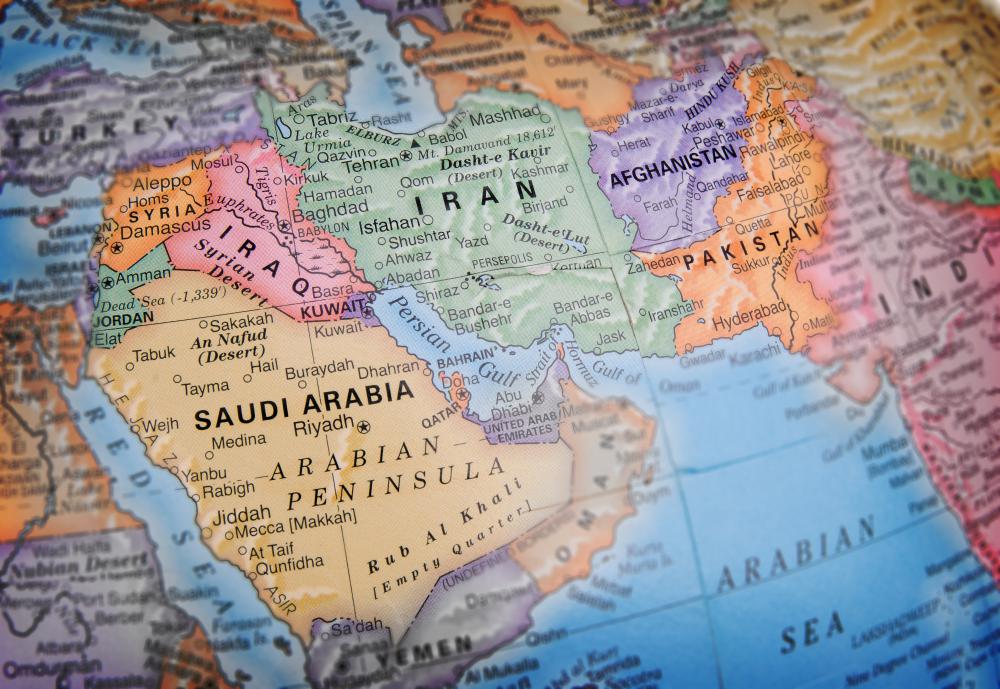
Jordan is a fairly large country in the Middle East. It covers 45,500 square miles (about 118,000 sq km), making it just a bit smaller than the state of Indiana. It is bordered by Iraq, Israel, Saudi Arabia, Syria, and the West Bank. It is part of what is often referred to as the Fertile Crescent, where a number of early civilizations sprang up.
The country is a monarchy, ruled by King Abdullah II, who has many of the same powers and roles as the president does in the United States. The king appoints judges, signs laws, has veto power, declares war, and is the commander of the armed forces. He also approves constitutional amendments, and appoints governors over the various provinces of Jordan.

The region was first settled tens of thousands of years ago by early man. During the Neolithic period, the area was home to some of the earliest permanent settlements of humans, as well as some early examples of crop domestication. Human development continued to progress in the area that is now Jordan, with the introduction of pottery, bronze technologies, and eventually writing.

Modern Jordan can trace its origins back to the collapse of the Ottoman Empire at the end of World War I. A great portion of the area given to the British as British Palestine was to the east of the river Jordan, and was known as Transjordan. In the early 1920s the British ceded a great deal of autonomy to this region, vesting power in King Abdullah I, a Hashemite. Independence was achieved in 1946, at the request of the British. King Abdullah I continued to rule the independent state until he was assassinated in 1951.
The borders of the country continued to shift over the next couple of decades, both by voluntary land exchanges with Saudi Arabia, and by annexation and loss of land to Israel following armed conflict. Small pockets of militant Palestinian refugees from the West Bank began to operate within Jordan, eventually posing what was perceived as a credible threat to the government, which reacted militarily, eventually driving these fedayeen from the country.
Jordan is one of those hidden gems for tourists willing to make a bit of extra effort. The country is home to some absolutely amazing scenery, with epic deserts that seem as if they came straight from the pages of the Arabian Nights. There are lost cities in those deserts, and many of the most well-known stories from the Bible took place in the area. It is not visited by many tourists because it is lumped in with the many Middle Eastern countries consistently plagued by violence. On the whole, however, the country is quite peaceful — and indeed, safer in many regards than most European nations. While the possibility of random terrorist acts does exist — and travel along the borders of Iraq and Israel is always dangerous — for an intelligent traveler, Jordan offers little risk.
Flying into the area is not too difficult. Flights arrive in Amman fairly regularly from most major hubs, and daily flights leave and arrive from the other major cities around the Middle East, such as Cairo, Beirut, and Damascus.
AS FEATURED ON:
AS FEATURED ON:









-
![A map of the Middle East, including Jordan.]() By: TRITOOTHA map of the Middle East, including Jordan.
By: TRITOOTHA map of the Middle East, including Jordan. -
![When militant Palestinians began to operate in Jordan, the Jordanian military drove them out.]() By: Nomad_SoulWhen militant Palestinians began to operate in Jordan, the Jordanian military drove them out.
By: Nomad_SoulWhen militant Palestinians began to operate in Jordan, the Jordanian military drove them out.

Discuss this Article
Post your comments