
At WiseGEEK, we're committed to delivering accurate, trustworthy information. Our expert-authored content is rigorously fact-checked and sourced from credible authorities. Discover how we uphold the highest standards in providing you with reliable knowledge.
What Should I Know About Gibraltar?
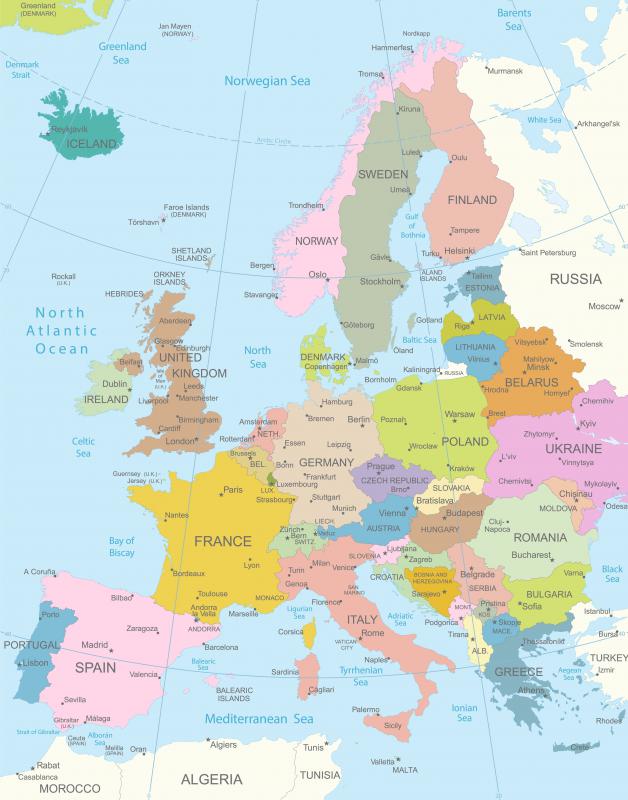
Gibraltar is a tiny British territory on the Mediterranean. It covers 2.5 square miles (6.5 sq. km), making it the fourth-smallest nation or territory in the world. The territory also has a population of just around 28,000 people, making it the fifth most densely-populated nation or territory in the world. It shares a border to the north with Spain. The most famous geographical landmark in the area is the Rock of Gibraltar, after which the territory is named.
People have inhabited the region that is now Gibraltar for many thousands of years. The Carthaginians, the Phoenicians, the Romans, and the Vandals all knew of the rock and seem to have visited it relatively frequently, and the Romans established a semi-permanent colony there.

The territory is often identified as one of the Pillars of Hercules, with the other being somewhere in Africa across the Strait of Gibraltar, although where exactly is a matter of some contention. This identification comes from the Greek myth of the Twelve Labors of Hercules, in which Hercules smashed through the mountain of Atlas, connecting the Mediterranean and the Atlantic. For many years it was thought that the Strait effectively marked the end of the world, and that any ships who passed through the strait would fall off the edge of the Earth. Passing through the Strait was often associated with traveling to regions beyond the known world, such as mythic locations like Plato’s Atlantis or Dante’s Purgatory.

The Vandals eventually seized control of the area from the Romans, and later it was absorbed into the Visigoth Kingdom of Hispania. In the early-8th century the territory was taken as part of the Muslim invasion of Spain, and the Moors eventually established a permanent military colony there. In the mid-15th century it was taken back from the Moors, and briefly became an independent haven for Sephardic Jews before becoming a part of Spain.

The British and the Dutch seized Gibraltar in the early-18th century, during the War of the Spanish Succession. When the war was ended a decade later, Britain was granted sovereignty of the territory by treaty. The British built up substantial defenses in the area to guard against frequent military incursions by Spain.
In the late-18th century the territory was blockaded by the Spanish during the American Revolutionary War, but the blockade was broken after four years. When the Suez Canal opened, Gibraltar's importance to Britain increased enormously, helping to connect Britain with its colonies in Australia and India.
During World War II the Germans made numerous attempts to capture Gibraltar, but none succeeded. Following the war Franco began strongly claiming ownership of the territory for Spain, and severed connections between the two regions. In the late 1960's Gibraltarians were asked whether they would prefer to remain under British control or to join Spain. The results were overwhelmingly in favor of remaining with Britain, and shortly thereafter Britain granted a great deal of autonomy to the region.
In the mid-1980's Spain reopened the border to Gibraltar as part of their joining the European Union. Spain continued to assert its right to sovereignty over the region, but relations between the two regions improved steadily.
The Rock itself is the most impressive tourist attraction in the territory, and the entire top is taken up by a beautiful nature preserve. A museum also highlights the fascinating history of the region, displaying military and architectural points of interest. English is the primary language spoken in the territory, the Euro is the accepted form of currency, and the tourist infrastructure is well developed, with plenty of lodging and dining opportunities in a range of prices.
Planes arrive daily in Gibraltar from Britain, and a handful of other airports. Buses come frequently from Spain to a town on the Spanish side of the border, and cars can cross the border, although long waits usually make it worth simply walking from the Spanish side. A ferry also crosses the Strait from Algeria once a week.
AS FEATURED ON:
AS FEATURED ON:









-
![Great Britain was granted sovereignty of Gibraltar in the 1800s.]() By: lukas555Great Britain was granted sovereignty of Gibraltar in the 1800s.
By: lukas555Great Britain was granted sovereignty of Gibraltar in the 1800s. -
![During World War II the Germans made numerous attempts to capture Gibraltar, but none succeeded.]() By: Sergey KamshylinDuring World War II the Germans made numerous attempts to capture Gibraltar, but none succeeded.
By: Sergey KamshylinDuring World War II the Germans made numerous attempts to capture Gibraltar, but none succeeded. -
![The Strait of Gibraltar separates Spain from Morocco.]() By: EklerThe Strait of Gibraltar separates Spain from Morocco.
By: EklerThe Strait of Gibraltar separates Spain from Morocco.


Discuss this Article
Post your comments