
At HomeQuestionsAnswered, we're committed to delivering accurate, trustworthy information. Our expert-authored content is rigorously fact-checked and sourced from credible authorities. Discover how we uphold the highest standards in providing you with reliable knowledge.
What Makes a Fuse Blow?
 Michael Pollick
Michael Pollick
Michael Pollick
For those who still enjoy the charms of glass or ceramic fuses, there's rarely a good time to blow a fuse. It usually happens at the end of an exciting football game or just before the killer in a mystery is revealed. When you blow a fuse, the search for a replacement overrides everything, but what causes a fuse to blow in the first place? The short answer is heat from an overloaded electrical circuit, but there's more to it than that. That blown fuse may have saved the rest of your house from burning down.
Electricity enters the average home at a certain strength, which electricians measure as voltage. For best results, that electrical current should flow through your house and back to the outside line without unusual high resistance. When you plug all of your electrical appliances into the sockets, however, you create a certain amount of resistance on the wires. How much actual electricity a particular device uses is measured in terms of amperage. A clothes dryer with a large electric motor and heating element requires more amperage than a toaster, for example.

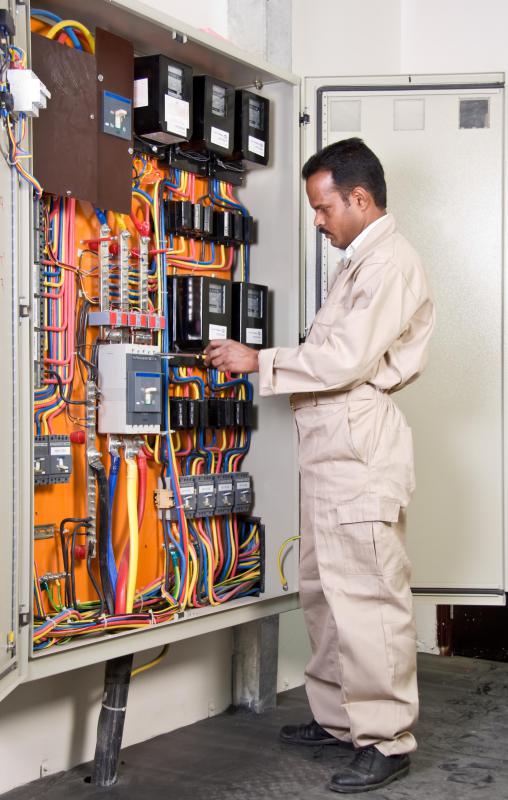
Electricians want to prevent the electrical wires from becoming overheated, so they install safety devices called fuses in a centralized box. Each fuse is designed to withstand a certain amount of amperage, but the wire inside the fuse melts when it becomes overheated. When you blow a fuse, the wire usually snaps in two, and the power running through that circuit is immediately cut off. The excess heat buildup occurs whenever appliances draw more amperage than the circuit can handle. If the fuse is rated for 25 amps, for example, and a user plugs in a 75 amp clothes dryer, the excessive amperage will blow the fuse.

Sometimes, a series of temporary overages can weaken the fuse's filament, which means you could still blow a fuse without exceeding the amperage rating. Some fuses are designed to withstand a number of brief overloads before blowing, but others snap quickly after one sustained power surge. When you blow a fuse, it is important to unplug all of the appliances and devices from that circuit before installing a new fuse. The energy required to restart those devices may cause yet another blown fuse.

If you continually blow a fuse when using a high-amperage appliance, you may need to change the rating of the fuse itself. The fuse rating should exceed the amperage demands of the appliances it protects, so you may have to buy bigger fuses to avoid future problems. While getting a more robust fuse can solve your problem, it won't always necessarily be the case. The circuitry connecting the power to the fuse still has to be able to handle that amperage. Increasing the fuse rating to something higher than the wiring can accommodate can cause you bigger problems than just a blown fuse. In the US, a normal house outlet generally has anywhere from a 15 to 30 amp fuse rating (i.e., 15 amps in bedrooms, 20 amps in kitchens, and 30 amps in laundry rooms), so increasing your fuse rating to something above this could cause problems. When in doubt, play it safe and call a professional.
Michael Pollick
A regular HomeQuestionsAnswered contributor, Michael enjoys doing research in order to satisfy his wide-ranging curiosity about a variety of arcane topics. Before becoming a professional writer, Michael worked as an English tutor, poet, voice-over artist, and DJ.
Learn more...
Michael Pollick
A regular HomeQuestionsAnswered contributor, Michael enjoys doing research in order to satisfy his wide-ranging curiosity about a variety of arcane topics. Before becoming a professional writer, Michael worked as an English tutor, poet, voice-over artist, and DJ.
Learn more...AS FEATURED ON:
AS FEATURED ON:


-
![A glass fuse.]() By: Willee ColeA glass fuse.
By: Willee ColeA glass fuse. -
![Fuses in a fusebox.]() By: George KellyFuses in a fusebox.
By: George KellyFuses in a fusebox. -
![A household fuse.]() By: Willee ColeA household fuse.
By: Willee ColeA household fuse. -
![Electricians want to prevent the electrical wires from becoming overheated, so they install safety devices called fuses in a centralized box.]() By: Sudheer SakthanElectricians want to prevent the electrical wires from becoming overheated, so they install safety devices called fuses in a centralized box.
By: Sudheer SakthanElectricians want to prevent the electrical wires from becoming overheated, so they install safety devices called fuses in a centralized box. -
![Today, circuit breakers are more commonly used than fuses in home construction.]() By: auremarToday, circuit breakers are more commonly used than fuses in home construction.
By: auremarToday, circuit breakers are more commonly used than fuses in home construction.



Discussion Comments
We just bought a house and all we have done is replace the receptacles with new receptacles. We bought 15 amp receptacles which is what were there originally. However, these new receptacles blew four fuses. What might have caused that?
High resistance does not blow fuses, low resistance does. Things that heat up like dryers and toasters have very low resistance, allowing a lot of current to flow. A short in the wiring is essentially 0 resistance, not high resistance, and blows the fuse.
can i use a 30a fuse when the one that blew was 15?
I am a little concerned about last night's events.
We have had rat problems in the house (probably still ongoing, but with all internal holes sealed and no access to the only part of the building which can be their entrance, we cannot tell for sure), meaning that rats have been gnawing behind the plaster boards of walls and ceilings.
Last night after we got home, we switched the lights on in the lounge and all bulbs blue along with all the other rooms' bulbs which were on the same circuit. We could just see all balls flash up at once -- very scary experience.
We had a look at the switch board and (out of three) and one of the circuit breakers was down. We then put it back up, but haven't got the chance to test if the lights work, and to be honest, we are both a little worried to do so, as we do not want to burn the house down.
The property in question is a rented terraced, and I know we need to inform the owner about this as soon as possible, but we fear there is not much that can be done over christmas and new year period.
Could you please help me find out if it can be due to rat activity, and whether it is safe to try and use the lights again? Many thanks, and happy Christmas to all.
Why do filament light bulbs sometimes blow the fuse when the bulb fails? the filament breaks though long use, as it does not touch earth why does it blow the fuse, if you leave the bulb in place and mend the fuse or reset the circuit breaker, it will not blow again, Why? thanks.
Here is an interesting thing: the back part of our brownstone unit is on its own fuse. For the stove, fridge, and some of the back of the house lights, and bathroom light. i had unplugged everything, and every time i put a fuse in downstairs the fuse just pops and sparks. I think that might be a fuse socket issue, right? This would be a 20 amp fuse socket.
i know this isn't what your article posted above is about but i am into car audio. i have a 2400 watt amp. it is a kenwood x1r. it comes with three 25-amp fuses but they keep blowing out even if my subs aren't up that loud. i was wondering if it would be OK to go up to 30 or 35 amps. it is running at 1 ohm if that's necessary to know.
I was wondering why our main power would blow when nothing really is on? When we go to sleep we turn everything off, of course things stay plugged in and I know that does cause a small draw, especially with things that have lights, but would that really be enough to blow the main power?
It's been popping a lot lately and I'm wondering if maybe it's because it's old? I know it's hard to say without knowing more information about wiring and what is plugged in, but do you think you could give me a solution to the problem based on what I've stated?
Thanks in advance.
My number one fuse governs only 2 sockets and a light switch in my kitchen. The light is a fluorescent tube that is on 24/7. The socket is only used for a kettle and has been used as such for 30 years with no problem until very recently - it has started to blow the fuse when switched on. It doesn't blow every time! I can push the fuse to reactivate it and use the kettle again. I can use the kettle on another circuit with no problem. Seems to me that if the circuit is shorted, the light wouldn't work and if the kettle is faulty, it would blow a fuse on another circuit. What is going on here?
This is to the two previous posts basically - It's stated plain and simple in the 3rd to last sentence, that "Increasing the fuse rating to something higher than the wiring can accommodate can cause you bigger problems than just a blown fuse."
You're basically pointing out the obvious. The main oversight lies in determining your current load capacity inside your walls. I have a 100 y/o house that has 3 different types of wiring running through it in what I like to refer to as 10 different systems (8 fuses and 2 large capacity breakers). The big question for me is, will 30amp suffice for 60 year old wiring or should I drop it to 20 or maybe 15amp to keep the heat down? Most of the house seems to operate fine with 20amp, however, sometime during the day (with nothing on) 1 of the systems popped.
I will say, that this did answer one of my questions about why the replacement fuse popped as soon as I put it in... everything was still plugged in - when I go to replace it a second time (tomorrow) and it DOES pop, then I'll know there's something else wrong in the house.
I echo the comments of the first poster. It's a very, very bad idea to use a fuse rated higher than the circuit was designed to handle. Simply upping the fuse rating defeats the purpose of the fuse in the first place. Bad advice to follow.
I had a friend years ago that decided to have a stereo installed in his car. After a few days of use he started blowing fuses, the place that installed it recommended that he up the fuse rating and he did. Well, about a day later he turned on the system and smoke went everywhere. When it finally cleared we found that the power line had literally melted from the back of the car to the front. The only thing that was left untouched was... the fuse. Simply put, when he upped the rating on the fuse he exceeded the current capacity of the wire and nearly burned up his vehicle in the process...
you say that if you continually blow a fuse with a high-amperage appliance, you need to put a larger fuse in, you see, for example, if you are talking about something designed for a 20 amp circuit and you are running it on a 16 amp circuit, so then you are going to install a 20 amp fuse, thereby overheating the wiring in the walls and starting a fire, because the fuse won't blow.
If you continually blow a fuse with an appliance, the appliance is either faulty or it needs a dedicated high-amperage circuit with the correct wiring and outlet.
Post your comments