
At DelightedCooking, we're committed to delivering accurate, trustworthy information. Our expert-authored content is rigorously fact-checked and sourced from credible authorities. Discover how we uphold the highest standards in providing you with reliable knowledge.
What is Wine Vinegar?
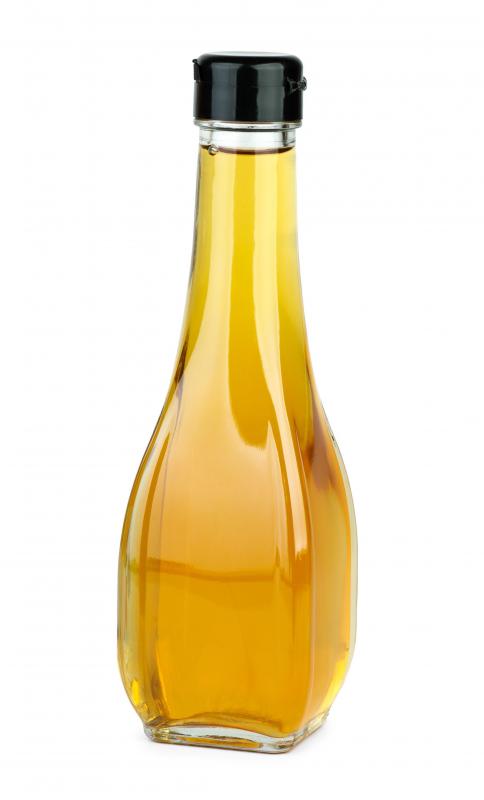
Wine vinegar is an acetic liquid made from wine that has been secondarily fermented and aged over time. Nearly all wines are themselves fermented with yeast during their production. Vinegar goes a step farther by focusing fermentation on the wine’s alcohol. This secondary fermentation typically happens with the help of acetic acid bacteria. The final product is frequently used in cooking, often as a salad dressing or flavoring agent to a number of different meat and pasta dishes.
Varieties

Nearly any sort of wine can be turned into wine vinegar, though the most common kitchen staples are often simply labeled “red” and “white.” Fancier or more gourmet varieties will actually specify the type of wine from which they derive. Merlot vinegar, chardonnay vinegar, or Champagne vinegar are but a few examples.
Different varieties often carry slightly different tastes, particularly when it comes to red and white. Just as different wines pair better with certain foods or flavors, so too do their corresponding vinegars. Red wine vinegar is usually used to season more robust dishes like red meats and tomato-based pastas, while white versions are often best for flavoring lighter fishes or grilled poultry dishes.
Common Uses

Wine vinegar is used almost exclusively as a seasoning and flavoring additive. Unlike the alcoholic beverage that gives it its name, wine vinegar is unsuitable for consumption all on its own, as it has a very bitter, acetic taste that is often unpleasant in large quantities. When used appropriately, however, it can add a lot to a food or dish. Wine vinegar is the base for many different salad dressings and dips, and can also be sprinkled on a number of different foods to help accentuate the flavors.
It can also be used as a preservative for vegetables or herbs. Soaking and storing fresh produce in vinegar has a pickling effect that can lend a distinct — and often pleasing — flavor.
How It is Made

Making wine vinegar is usually very straight-forward, as the only needed elements are wine and some sort of acetic acid bacteria culture. Starter cultures are available from many home cooking stores, as well as from specialty kitchen shops. In most cases, the bacteria is simply added to the wine, tightly sealed, and left to rest for a number of days or weeks.

The longer the wine sits, the more acetic it will become — but only up to a point. Once the bacteria has consumed all of the wine’s alcohol, the process is over. Depending on how much bacteria was used, trace amounts of alcohol may be present in the finished vinegar, though concentrations are rarely high enough for the vinegar itself to qualify as “alcoholic.”
Commercial Production

Much of a wine vinegar’s quality and ultimate taste is a direct result of how it was fermented and stored. Most of the commercially produced versions available in standard markets are fermented in large quantities, often in metal vats. Excess or rejected wine from vineyards usually serves as the base — vintages that are a bit too tart or sweet for sale as wine are often diverted to vinegar production.
In most cases, the quality of the underlying wine has little to no impact on the quality of the finished vinegar. The wine will influence the overall flavor, but not profoundly. It is for this reason that cheaper or leftover wines are typically used in vinegar fermentation. Most vintners consider it a waste to turn quality drinking wines into vinegar.
Smaller and “Gourmet” Production
Smaller batches of vinegar are often produced by independent outlets and family-operated small businesses. Many of these take care in identifying the types of wine being used. It is not uncommon for a limited-run wine vinegar to be fermented in a barrel, for instance, which allows the liquid to take on some of the flavor of the wood as it ages.
Homemade and Do-it-Yourself Options
Some wine drinkers attempt to make vinegar out of leftover or over-aged bottles of wine that they have around the house. Many wine connoisseurs know that an over-aged wine often tastes slightly of vinegar; this is because the alcohol will start to break down on its own over time. Do-it-yourselfers typically need to do more than simply wait it out, however. Without the help of bacterial cultures, the wine can spoil long before it turns to useable vinegar.
Shelf Life and Storage Considerations
Nearly all wine vinegars are stored in glass once the fermentation process is over. Tinted bottles are often best, as they both regulate internal temperature and prevent the sun’s rays from altering the taste or flavor structure. Vinegars that come in clear bottles should usually be stored away from direct sunlight, though refrigeration is almost never necessary.
Commercially-prepared vinegars usually come with a “best by” or “sell by” date printed on their label, though many view this as but a formality. Vinegar is typically freshest if used within a year of so of opening, but it will often last indefinitely, depending on how it was fermented and whether any other preservatives have been added.
AS FEATURED ON:
AS FEATURED ON:


-
![Red and white wine vinegar.]() By: GeoMRed and white wine vinegar.
By: GeoMRed and white wine vinegar. -
![Gourmet wine vinegar may be aged in wooden barrels.]() By: Brad PictGourmet wine vinegar may be aged in wooden barrels.
By: Brad PictGourmet wine vinegar may be aged in wooden barrels. -
![Champagne vinegar.]() By: Roman IvaschenkoChampagne vinegar.
By: Roman IvaschenkoChampagne vinegar. -
![Red wine vinegar can be used for cooking in a variety of ways.]() By: quaysideRed wine vinegar can be used for cooking in a variety of ways.
By: quaysideRed wine vinegar can be used for cooking in a variety of ways. -
![Wine vinegar can be used to create salad dressings or used on its own.]() By: valery121283Wine vinegar can be used to create salad dressings or used on its own.
By: valery121283Wine vinegar can be used to create salad dressings or used on its own.




Discussion Comments
where can i buy wine vinegar?
My husband had an attack last year and taken angiography. One of my relations suggested me to the following:
Lemon juice, ginger juice, garlic and apple vinegar and also advised for preparation of method. I have searched some of the department stores for apple vinegar, but it is not available and plain vinegar is available.
I would like to know what is apple vinegar and where it is available and also mentioned above for heart patients, should I use apple vinegar or plain vinegar for the above preparation. I am residing at Coimbatore. So please let me know in which stores it is available. Seeking your favorable reply. Thanking you. --yhx
How much alcohol is in wine vinegar? I've had some people say none, but I am an alcoholic (recovering) and need to watch it.
What is the floating film in the vinegar bottle?
How long does wine vinegar remain good?
It usually takes months to make wine vinegar. I have read though that a device, called acetator, can reduce the time it takes to make vinegar down to a day.
Post your comments