
At TheHealthBoard, we're committed to delivering accurate, trustworthy information. Our expert-authored content is rigorously fact-checked and sourced from credible authorities. Discover how we uphold the highest standards in providing you with reliable knowledge.
What is White Matter?
The central nervous system is comprised of many factors, but most important are the brain and spinal cord. White matter makes up parts of the brain and spinal cord and facilitates communication between gray matter and the rest of the body. It can be found in inner layers of the cortex, optic nerves, and central and lower portions of the brain as well as the spinal cord.
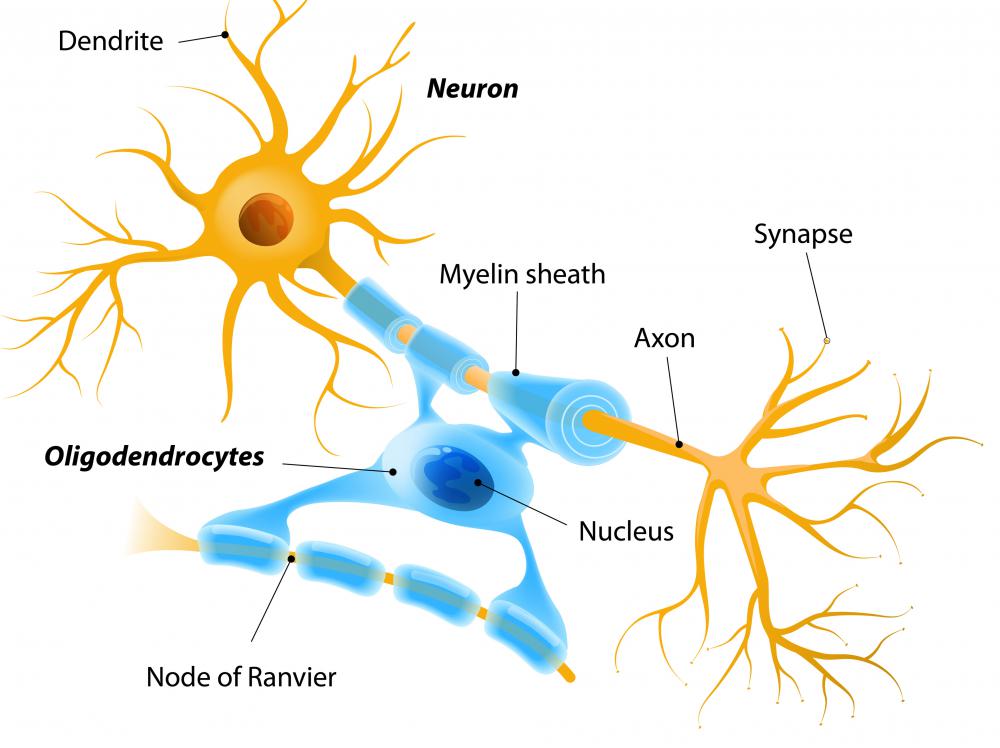
White matter is made up primarily of axons of nerve cells and full of myelin, which is a whitish fatty material. It derives its name from its color appearance, which is white when exposed. It works with gray matter, a non-myelinated part of the brain responsible for sending sensory and motor stimulus to the central nervous system to create a response. An analogy of how the two types of matter work together is similar to how a computer’s central processing unit and cables work together. In this analogy, gray matter is the CPU and white matter the cables connecting the CPU to other parts.

Until recently, medical scientists and researchers did not place a great deal of emphasis on white matter. However, as conditions such as dementia and Alzheimer’s became more apparent, it became of interest to researchers. Diseased white matter can impair the central nervous system, just as broken or shorted cables would create problems with a computer network.
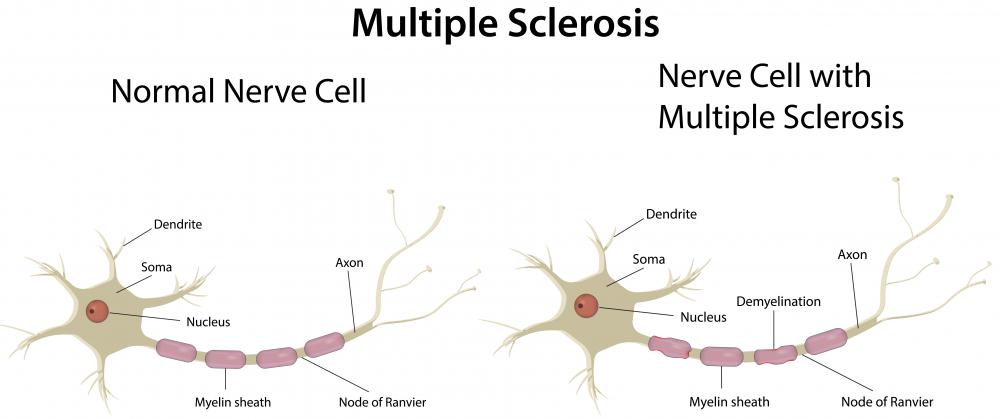
One disease that is predominantly associated with white matter is Multiple Sclerosis (MS). The majority of lesions associated with MS occur because of inflammation that causes destruction of the myelin surrounding the axons.
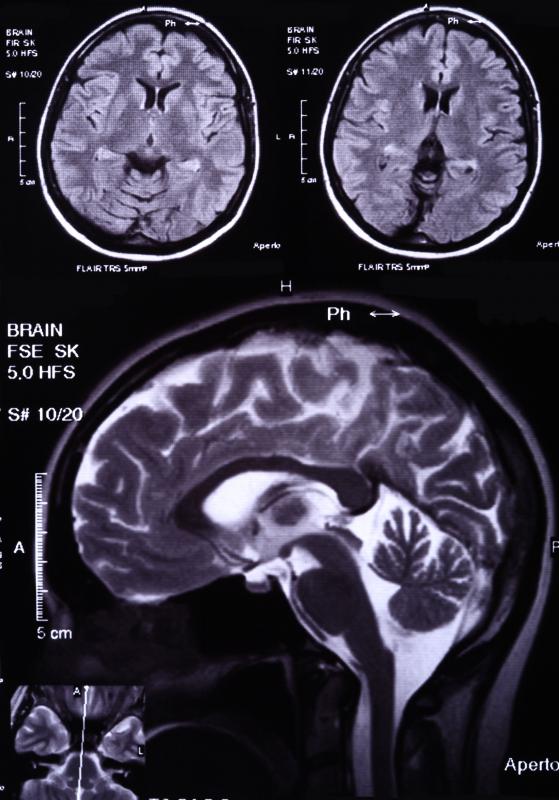
Though much is still unknown about the brain and many neurodegenerative diseases, advances in medical imaging are gradually improving the ability to study white matter and find broken connections and damage or disease these regions of the brain.
AS FEATURED ON:
AS FEATURED ON:


-
![The myelin sheath that surrounds the optic nerve is made up of white matter.]() By: kocakayaaliThe myelin sheath that surrounds the optic nerve is made up of white matter.
By: kocakayaaliThe myelin sheath that surrounds the optic nerve is made up of white matter. -
![Axons of nerve cells and the fatty material myelin make up white matter.]() By: Mikhail BasovAxons of nerve cells and the fatty material myelin make up white matter.
By: Mikhail BasovAxons of nerve cells and the fatty material myelin make up white matter. -
![White matter lesions may be symptomatic of Alzheimer's disease or other type of dementia.]() By: riccardo bruniWhite matter lesions may be symptomatic of Alzheimer's disease or other type of dementia.
By: riccardo bruniWhite matter lesions may be symptomatic of Alzheimer's disease or other type of dementia. -
![White matter helps to make up parts of the brain and spinal cord.]() By: nerthuzWhite matter helps to make up parts of the brain and spinal cord.
By: nerthuzWhite matter helps to make up parts of the brain and spinal cord. -
![White matter is made up primarily of axons of nerve cells and are full of myelin, a whitish fatty material.]() By: designuaWhite matter is made up primarily of axons of nerve cells and are full of myelin, a whitish fatty material.
By: designuaWhite matter is made up primarily of axons of nerve cells and are full of myelin, a whitish fatty material. -
![Diseased white matter may impair a patient's central nervous system.]() By: Photographee.euDiseased white matter may impair a patient's central nervous system.
By: Photographee.euDiseased white matter may impair a patient's central nervous system. -
![Advances in medical imaging have improved the ability to study white matter.]() By: NobiliorAdvances in medical imaging have improved the ability to study white matter.
By: NobiliorAdvances in medical imaging have improved the ability to study white matter. -
![White matter lesions associated with multiple sclerosis occur because of inflammation that causes destruction of the myelin surrounding the axons.]() By: joshyaWhite matter lesions associated with multiple sclerosis occur because of inflammation that causes destruction of the myelin surrounding the axons.
By: joshyaWhite matter lesions associated with multiple sclerosis occur because of inflammation that causes destruction of the myelin surrounding the axons.





Discussion Comments
@ellafarris - There was an article in the paper the other day about that! It said that actually, every part of our brain is active all the time, just not all at the same time, and that if we lose any portion of the brain it decreases our functionality of that particular area.
It really got me thinking -- how would evolution have occurred without the other 90 percent of the brain? We would be comatose if we only used 10 percent of our brains. All parts of the brain have done something in every 24 hour period.
@goldensky - The old myth that you only use ten percent of your brain is losing credibility. Scientists are making new discoveries every day, especially about the white matter. I guess since the white matter of the brain is buried deep inside and maybe that's part of the reason behind the myth.
So I know that the grey and white matter of the brain are sort of the hardware, or connectors if you will, but how does that fit in with the fact that we only use ten percent of our brains? How can that be possible?
One of the many myths still circulated about general brain function is that humans only use about 10 percent of their brains. Not only is this not true, it things like white matter show that the parts of our body which go into our function and, ultimately, our memory and thought might be even more complex than just our brains themselves.
Post your comments