
At HomeQuestionsAnswered, we're committed to delivering accurate, trustworthy information. Our expert-authored content is rigorously fact-checked and sourced from credible authorities. Discover how we uphold the highest standards in providing you with reliable knowledge.
What is Wet Sanding?
Wet sanding is a cleaner alternative to regular sanding of drywall mud from remodeling and repairs. It requires a special sanding sponge that replaces the traditional drywall sanding screens and blocks. The sponge is used barely damp and requires frequent rinsing and wringing during sanding process.
Wet sanding is a great alternative to dry sanding when repairs have been made to damaged drywall or plaster, as well as in remodeling that occurs in or near lived-in areas of the home. In wet sanding, the sponge is damp enough to significantly reduce the amount of sanding dust that becomes airborne. For this reason, persons with allergies living through a remodel or repair may well appreciate this alternative technique. In high-use areas of the home such as kitchens or baths, this method can significantly decrease the mess that normally accompanies drywall repair.

When properly executed, wet sanding does not alter the number of coats of drywall mud required, but the process does take longer than dry block sanding. This is mostly due to the number of times the sponge must be rinsed and wrung out, and depending on the size of the area, the water may need to be changed as well. You can reasonably expect to sand about a 3-foot square (about one square meter) section before needing to rinse and wring your sponge.

Keeping a bucket of water next to you to rinse your sponge is recommended, but you must change the water when it becomes too murky to see into. You can use different grain sanding sponges for wet sanding, such as coarse or fine, depending on which coat of mud you are sanding. Wet sanding sponges are slightly larger than a typical kitchen sponge and are available at most large home improvement stores. When working on an area, work in circles with a steady amount of pressure. The sanding sponge should be only slightly damp — if water is dripping from the sponge when you apply steady pressure during sanding, the sponge is too wet.

After sanding a coat of mud, allow the area to dry for about an hour before continuing with a second coat of compound or before painting or priming if the final coat has been sanded. Combining wet sanding with traditional sanding is also an alternative for home repair projects. Perhaps the first coat can be sanded with a traditional screen or block sander to expedite the process, but wet sanding can also be applied in the final coat so clean up can be performed sooner. Though it takes more time to complete a project with this method, it is definitely the cleanest process.
AS FEATURED ON:
AS FEATURED ON:


-
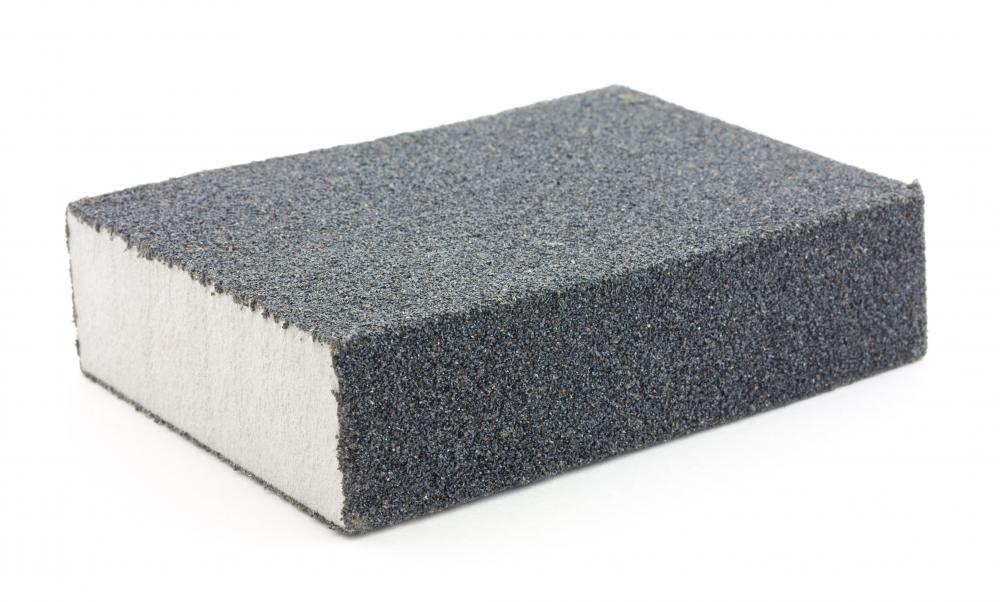
![A sanding sponge is used for wet sanding.]() By: Bert FolsomA sanding sponge is used for wet sanding.
By: Bert FolsomA sanding sponge is used for wet sanding. -
![A wet sander may be used for finishing drywall.]() By: Kristina BenterA wet sander may be used for finishing drywall.
By: Kristina BenterA wet sander may be used for finishing drywall. -
![Sanding may be used to prepare a surface for painting.]() By: RobSanding may be used to prepare a surface for painting.
By: RobSanding may be used to prepare a surface for painting.


Discussion Comments
I am new at the sponge sanding method! I would like to know if I clean all of the excess drywall compound on the wall around the patch holes?
george, I haven't had the best of luck with sanding sponges. I'm going to try your method today! thanks!
When i wet sand, i use a regular sponge, wet the mud, then trowel out smooth. In doing this you're only wetting enough mud to smooth out the edges and rough spots. This is done after the mud dries for a day. i could actually make joints almost invisible. George
I read the article on the difference between two stroke and four stroke engines, and thought it was a good article, though I am sure it glosses over some details. I then read this article, and bookmarked the website. Next I read the one on how to soundproof a room. I am glad this article did not have so much need for correction, as it was why I came to the site to begin with. And since an anonymous user made sufficient suggestions on soundproofing, the bookmark stays. Off to Lowe's to buy a sanding sponge :)
Post your comments