
At TheHealthBoard, we're committed to delivering accurate, trustworthy information. Our expert-authored content is rigorously fact-checked and sourced from credible authorities. Discover how we uphold the highest standards in providing you with reliable knowledge.
What is Water on the Knee?
 Tricia Christensen
Tricia Christensen
Tricia Christensen
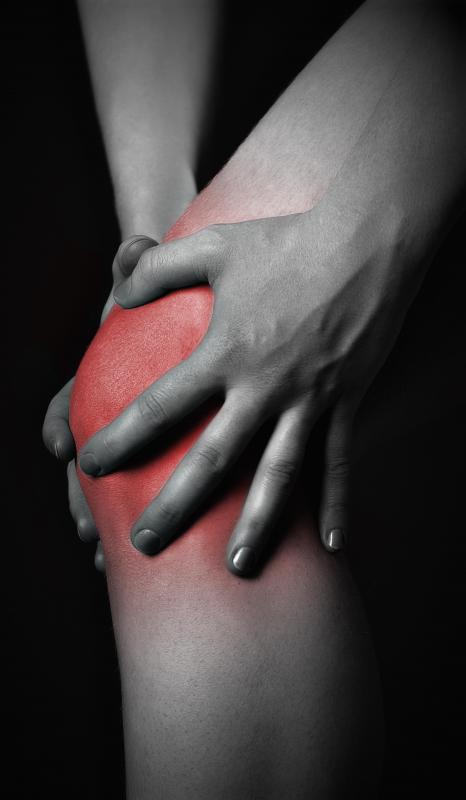
Water on the knee is a kind of vague term that may be used to describe fluid that can build up around the kneecap. This fluid may be water retention but is more commonly fluid produced by the joints, called synovial fluid. It can be a painful condition that may limit ability to move the knee fully, to bear weight on the knee or even to walk unhindered, and it has a variety of causes. Depending on cause, swelling, stiffness, and bruising may also be present.
Causes for water on the knee include knee injury, gout, certain infections, some types of arthritis, and occasionally cysts or tumors. Knee injuries that may result in fluid buildup include overuse injuries, blunt injuries, and broken bones. Usually, if you have a significant knee injury you’re likely to notice this before the buildup occurs.

If you have a painful or swollen knee, you should have it checked out by a healthcare provider. A medical professional may perform a variety of tests, including taking a small amount of fluid from the knee to figure out the cause. More often, they may use x-rays or other types of imaging to determine root cause, particularly if you have injured your knee recently. Injured knees frequently need medical attention.

Since causes can differ, water on the knee may be treated in a variety of ways. If gout is the cause, it will be treated. A bacterial infection would need antibiotic treatment. Various injuries to the knee could require different steps to help the knee recover. Arthritic conditions may benefit from anti-inflammatory medications. Overuse or serious injury of the knee joint may require surgery to clean out the knee or to replace the joint, though knee replacement is usually not a first option.

Given differing causes, water on the knee may get better after a few weeks or a few months. Some people will have residual swelling around both knees, but a tiny amount of swelling may not cause great problems. When treatment is not resolving the problem and it is still difficult to move around or the knees are always painful, check with your healthcare provider to see if your treatment is adequate.

Fluid buildup resulting from injury can sometimes be prevented if you take good care of your knees. Joints do wear out over time, and the knees are particularly vulnerable because they bear our weight. A person who is overweight may wear out knee joints sooner and be more vulnerable to injury. Getting plenty of exercise, stretching beforehand, and maintaining a healthy weight through life can help protect these valuable joints.
Tricia Christensen
Tricia has a Literature degree from Sonoma State University and has been a frequent TheHealthBoard contributor for many years. She is especially passionate about reading and writing, although her other interests include medicine, art, film, history, politics, ethics, and religion. Tricia lives in Northern California and is currently working on her first novel.
Learn more...
Tricia Christensen
Tricia has a Literature degree from Sonoma State University and has been a frequent TheHealthBoard contributor for many years. She is especially passionate about reading and writing, although her other interests include medicine, art, film, history, politics, ethics, and religion. Tricia lives in Northern California and is currently working on her first novel.
Learn more...AS FEATURED ON:
AS FEATURED ON:


-
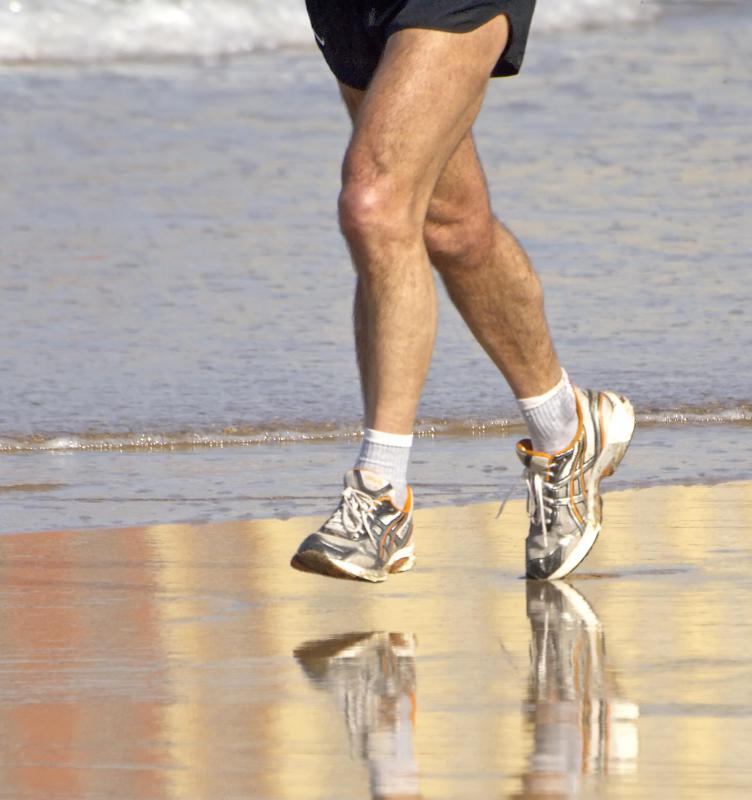
![Water on the knee may interfere with a person's mobility.]() By: Marco Antonio Fdez.Water on the knee may interfere with a person's mobility.
By: Marco Antonio Fdez.Water on the knee may interfere with a person's mobility. -
![Arthritis may cause water on the knee.]() By: evgenyatamanenkoArthritis may cause water on the knee.
By: evgenyatamanenkoArthritis may cause water on the knee. -
![Being overweight may increase one's chances of experiencing water on the knee.]() By: whitestormBeing overweight may increase one's chances of experiencing water on the knee.
By: whitestormBeing overweight may increase one's chances of experiencing water on the knee. -
![Medication may be helpful in treating water on the knee.]() By: totojang1977Medication may be helpful in treating water on the knee.
By: totojang1977Medication may be helpful in treating water on the knee. -
![Pain medication can help with knee pain.]() By: underdogstudiosPain medication can help with knee pain.
By: underdogstudiosPain medication can help with knee pain. -
![X-rays are commonly used to identify the root cause of water on the knee.]() By: Distinctive ImagesX-rays are commonly used to identify the root cause of water on the knee.
By: Distinctive ImagesX-rays are commonly used to identify the root cause of water on the knee. -
![Overuse may cause fluid buildup on the knee.]() By: ShakzuOveruse may cause fluid buildup on the knee.
By: ShakzuOveruse may cause fluid buildup on the knee. -
![Injured knees frequently need medical attention.]() By: .shockInjured knees frequently need medical attention.
By: .shockInjured knees frequently need medical attention.




Discussion Comments
Massage can be an effective water-on-the-knee home treatment to help in reducing swelling around the knee joint. Moving the skin over the knee with a circular motion can stretch the connective tissue. It is in this area that you find a large number of lymph vessels.
Continue to massage the knee and extend the massage to the hip joint. This process should be done with a light touch for better results and so as not to cause any additional pain.
In less serious cases, water on the knee and knee pain treatment can be as simple as taking a rest. The knee is susceptible to injury because of how often it is used and the movements it is required to make. Twisting, bending, rotating and straightening of the knee joint can lead to considerable stress on the joint.
When the knee becomes damaged and swelling reaches a point where it needs to be relieved quickly, a doctor may suggest that a patient have the knee aspirated.
During the aspiration procedure, a doctor will insert a bore needle into the knee and slowly draw back the plunger to draw out the excess fluid from the knee joint. The doctor may also move the knee about to coax out as much fluid as possible.
Some patients have enough fluid in their knees to fill more than one syringe. An anesthetic is used during the procedure. Otherwise, as you can imagine, it would be extremely painful for the patient.
Post your comments