
At DelightedCooking, we're committed to delivering accurate, trustworthy information. Our expert-authored content is rigorously fact-checked and sourced from credible authorities. Discover how we uphold the highest standards in providing you with reliable knowledge.
What is Wasabi?
When most people think of wasabi, they think of the fiery-hot, greenish paste served with their sushi or sashimi. But they're probably eating extra hot Western horseradish, mixed with some soy sauce, hot Chinese mustard and a little green food coloring. Real wasabi is notoriously difficult to find, and expensive when it is found.
Wasabi is sometimes called Japanese horseradish, and its taste is very similar. Real wasabi, called wasabia japonica, is a relative of the watercress family and an elusive little root. Like horseradish, it is a root, or rhizome, and it is grated or sliced for use in cooking. It is difficult to find because it is difficult to grow. It is expensive to buy because it is expensive to grow.

This plant has to be nurtured and brought carefully along. It takes about 18 months to reach its mature height of about 14 inches (36 cm). It requires a constant stream of cool water, but not too cool; shade, but not too much shade; and a mild climate. Thus, the United States is not ideal country for growing this plant, except in the Pacific-Northwest, where growers have had some success. It is also grown successfully in New Zealand, as well as in Japan.

Sticker shock may seize anyone who buys a genuine wasabi root. A single root may cost $8 to $10 US Dollars (USD), and roots run about $70-$100 USD per pound, depending on where they're grown. Some Asian markets in larger cities may have fresh, genuine wasabi roots for sale, and a shopper will know he has the genuine article by the price tag.
When the root is finally secured, it is prepared for eating raw by washing it, trimming any bumpy or scaly parts off with a sharp knife, and then grating it in a circular motion. A fine metal grater, such as a lemon zester, may be used, but gourmands insist on a sharkskin grater, which they say produces a velvety grind. The grated wasabi is gathered into a ball and left to sit for a couple of minutes, to allow the heat and flavor to develop, then it is eaten. The traditional use is to eat it with sushi or sashimi, but it also may be used to flavor mustard or mayonnaise, as a meat sauce, or in salad dressings.
For those who simply cannot afford the genuine root, most cooks say the wasabi powder available in supermarkets will work nearly as well as the wasabia japonica.
AS FEATURED ON:
AS FEATURED ON:


-
![Real wasabi is made from the Wasabi root.]() By: matinReal wasabi is made from the Wasabi root.
By: matinReal wasabi is made from the Wasabi root. -
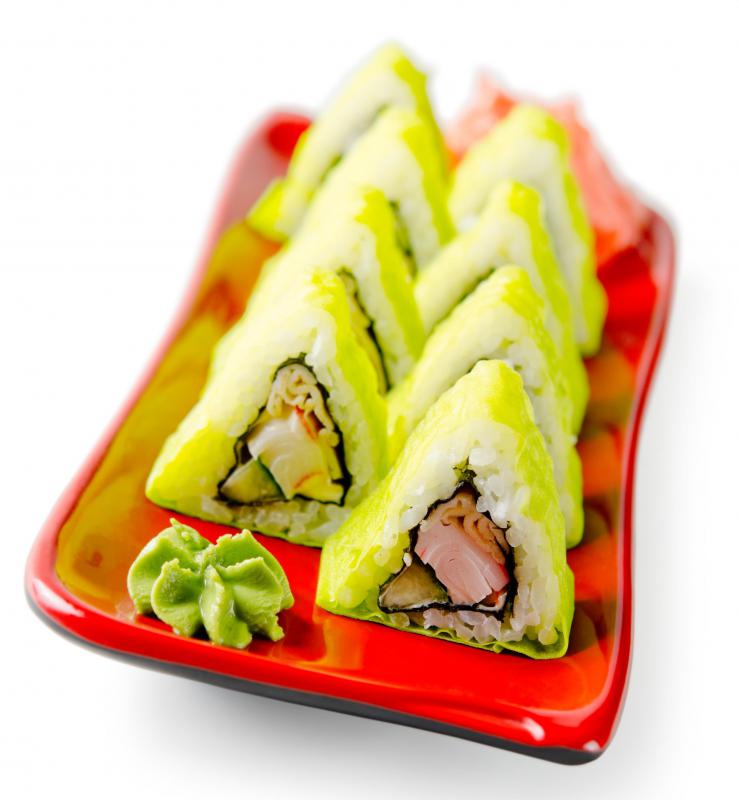
![Wasabi is often served with sushi rolls.]() By: Denis IvatinWasabi is often served with sushi rolls.
By: Denis IvatinWasabi is often served with sushi rolls. -
![Nigiri sushi assortment.]()
Nigiri sushi assortment. -
![Grated wasabi may be used to flavor mustard.]() By: karandaevGrated wasabi may be used to flavor mustard.
By: karandaevGrated wasabi may be used to flavor mustard.



Discussion Comments
I think it's an over-exaggeration that all the wasabi in the US is fake. If it's not very cheap, it's real. The wasabi at all high-end Japanese restaurants is also real. If you want to confirm it, ask for your wasabi freshly grated. Avoid cheap wasabi powders at stores if you can.
@kilorenz-- It is noticeable. Real wasabi tastes a little different and once you've eaten it, you can tell them apart.
Also, real wasabi is not a bright green paste. It's a pale green and if it has been recently grated, it's apparent.
I can't believe I've been fooled all this time about wasabi. How can they label horseradish as wasabi?!
Are those wasabi peas and nuts made from horseradish too? I love those snacks.
Where can I find the real stuff?
@dautsun - I think most people probably don't know that the wasabi served in sushi restaurants isn't "real" wasabi. It's labeled wasabi on most menus, so how would anyone know that unless they had eaten the other kind of wasabi before? I imagine it would be a big disappointment though, if you were expecting "real" wasabi and got the American version.
@bigblind - Thanks for explaining that! I'm a huge fan of (what I thought was) wasabi. I like it on sushi, but I also like edamame wasabi. It's so funny because I'm not usually a fan of spicy food, but the first time I tried wasabi I just loved it! I feel like it's almost a different kind of spiciness than other spicy food we serve in the US.
It's so funny that all this time I've really been eating flavored horseradish with food coloring. I'm so glad I know what actual wasabi is, because I had no idea before I read this article.
@kilorenz – There is quite a significant difference actually. Given that they are completely different foods (real wasabi is made form a grated root and the fake stuff is horse radish and dye), they have a very different character. Real wasabi is not nearly as intensely spicy as ‘western wasabi’. Instead, the spiciness is very temporary and quickly turns to a more floral, vegetable-like flavor. While fake wasabi still goes well with sushi and other things, the real thing compliments the flavor of raw fish in a truly unique and irreplaceable way. Although it is quite expensive in America, the real thing is definitely worth it if you can afford it.
Anyone know how noticeable the difference in taste is between real wasabi and the fake stuff that’s made from spicy American horseradish?
Post your comments