
At SmartCapitalMind, we're committed to delivering accurate, trustworthy information. Our expert-authored content is rigorously fact-checked and sourced from credible authorities. Discover how we uphold the highest standards in providing you with reliable knowledge.
What is VIX, the Volatility Index?
VIX, created by the Chicago Board Options Exchange (CBOE) in 1993, is the Volatility Index. It measures the market's expectation of near term volatility as reflected in the options prices of S&P 500 stock index.
Implied volatility is an estimate of how much the price of a security is likely to move over a given period of time. VIX is constructed by using the Black-Scholes option pricing model to calculate implied volatilities for a number of stock index options. These are combined to create an overall measure of the market's expectations for near term volatility. The index was originally constructed using the S&P 100 index, but in 2004, CBOE switched to the S&P 500 to capture a broader segment of the overall market. To ensure continuity, the older calculation continues to be published under the name VXO.
The Black-Scholes model assumes market movements can be expressed as a normally distributed probability function, better known as the bell curve. Visually, VIX is a measure of the height and width of the curve; a low number implies a highly peaked shape, while a high one implies a short, wide shape. Mathematically, it is expressed as an annual percentage. A VIX of 15, for example, means the market is expecting a 15% change in price over the next year.
Professional options traders often choose to express VIX and other implied volatilities as a daily percentage. Because they are continuously adjusting their positions based on market conditions, the largest risk to them is when markets are closed and adjustments cannot be made. Calculated as a daily percentage, VIX provides an estimate for how much the market might change between closing and reopening. The daily score can be approximated by dividing the annual number by 16.
A great deal of market lore has sprung up around on VIX. It is sometimes referred to as an "investor fear gauge" because it has a tendency to rise sharply when markets are under stress. It is important to note, however, that the index does not measure sentiment, it only measures implied volatility. Since implied volatility is most significantly affected by changes in actual volatility, its riseduring periods of market stress is not due to investor sentiment, but to the increase in actual volatility.
AS FEATURED ON:
AS FEATURED ON:









-
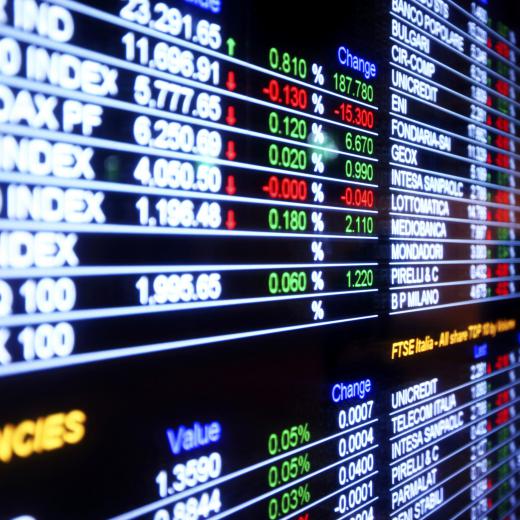
![Volatility Index measures the market's expectation of near term volatility as reflected in the options prices ofS&P 500 stock index.]() By: yellowjVolatility Index measures the market's expectation of near term volatility as reflected in the options prices ofS&P 500 stock index.
By: yellowjVolatility Index measures the market's expectation of near term volatility as reflected in the options prices ofS&P 500 stock index.

Discussion Comments
While the VIX measures the volatility index, the VXN of the Chicago Board of Trade measures the Nasdaq market volatility index.
You read both the VIX and VXN as you would any other stock chart. If you use charting to help you with your trades, you would treat these the same way. Understanding how the volatility of the market works can be helpful when you look at the overall market conditions.
@anon89544 - The VIX chart is just like any other stock market chart-it expresses investor sentiment, whether it swings to extremes of fear or high confidence.
I haven’t done a lot of options trading myself but I did look at these charts to learn how they work. Basically they track the S&P 100 index on options to reflect market volatility. In a nutshell, when the chart swings low it’s good, when it swings high it’s not.
Some people apply these numbers as gauges against the broader market to get a good sense of whether things are going well or not for stocks in general. As with all charts, take them with a grain of salt.
It does not seem to be effective. Since the VXX over the past three months has dropped in spite of some serious volatility. The VXX is supposed to track the VIX. How is it that the volatility is not reflected in the VXX?
Post your comments