
At WiseGEEK, we're committed to delivering accurate, trustworthy information. Our expert-authored content is rigorously fact-checked and sourced from credible authorities. Discover how we uphold the highest standards in providing you with reliable knowledge.
What is Urban Sprawl?
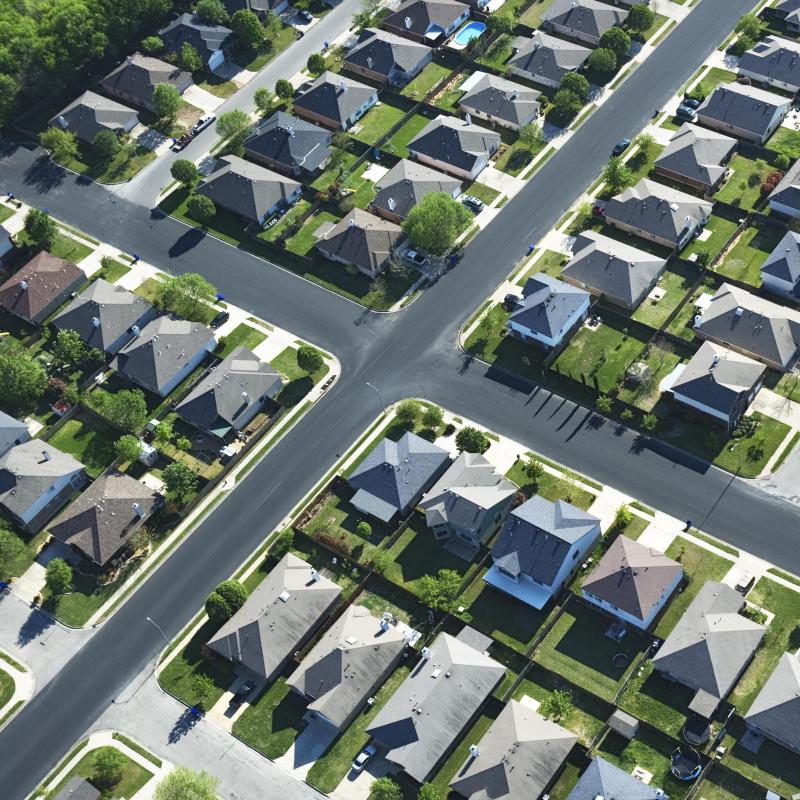
Urban sprawl is the spreading of a city or its suburbs. It often involves the construction of residential and commercial buildings in rural areas or otherwise undeveloped land at the outskirts of a city. Most residents of typical sprawl neighborhoods live in single-family homes and commute by car to their jobs in the city. Concerns over this phenomenon and its consequences have been raised and largely focus on negative consequences for residents and the local environment. On the other hand, some argue that it illustrates positive growth of a local economy.
The term urban sprawl is generally used with negative connotations. Because people in sprawling neighborhoods tend to drive more than those who live in the city, it is sometimes associated with increased air pollution. It has also been linked to obesity since walking or bicycling usually are not viable commuting options for those commuting from the outskirts of a city into town.

Traditional cities, like many small and mid-sized cities in modern-day Europe, were typically oriented in a compact and efficient way. Preferences of many people, especially in the United States, have led to suburban development — accommodating for the development in an outward instead of upward manner. Developments such as shopping malls, fast food chains, strip malls, and housing subdivisions are especially typical of urban sprawl. Subdivisions are often cited as primary examples of a less efficient use of space that characterizes sprawl. These layouts often only have a few places to enter and exit, causing main roads to have more traffic at these points.

Urban sprawl often happens quickly, as opposed to gradually. Another key characteristic is its low-density land use, where the amount of land consumed per capita is much higher than in more densely populated city areas. Wide streets, large lawns, and landscaping are typical in this pattern.
Single-use zoning is also a common part of this phenomenon. This city planning approach separates residential, commercial, and industrial areas from one another, usually by a distance that is not conducive with walking thereby increasing the importance of vehicles. While public transportation is typically available in the suburbs, most of these areas are highly dependent on cars. Though sprawl is common in developed countries, it is not limited to them. Many cities in developing countries, such as Mexico City, experience it as well.

While the term urban sprawl typically is used with negative connotations, the economic growth that supports it is viewed as a positive thing by many. In addition, many support the community structure of a suburb as opposed to a city as the pace of life is typically slower and space is not at such a premium. Additionally, suburbs are often, though not necessarily, said to be safer, and as a result these areas are often places people move to to raise their children.
AS FEATURED ON:
AS FEATURED ON:









-
![Suburbs take up more land area per a given population than urban areas, however they provide families with greater privacy and safety.]() By: iofotoSuburbs take up more land area per a given population than urban areas, however they provide families with greater privacy and safety.
By: iofotoSuburbs take up more land area per a given population than urban areas, however they provide families with greater privacy and safety. -
![Increased air pollution is commonly associated with urban sprawl.]() By: DanicekIncreased air pollution is commonly associated with urban sprawl.
By: DanicekIncreased air pollution is commonly associated with urban sprawl. -
![Urban sprawl often includes shopping mall developments.]() By: Andris PiebalgsUrban sprawl often includes shopping mall developments.
By: Andris PiebalgsUrban sprawl often includes shopping mall developments. -
![Subdivisions are characteristic of urban sprawl.]() By: Barbara HelgasonSubdivisions are characteristic of urban sprawl.
By: Barbara HelgasonSubdivisions are characteristic of urban sprawl. -
![Most residents of urban sprawl neighborhoods must commute to their jobs by car.]() By: mario beauregardMost residents of urban sprawl neighborhoods must commute to their jobs by car.
By: mario beauregardMost residents of urban sprawl neighborhoods must commute to their jobs by car. -
![Urban sprawl may contribute to obesity because it typically reduces opportunities to walk or bike.]() By: JanMikaUrban sprawl may contribute to obesity because it typically reduces opportunities to walk or bike.
By: JanMikaUrban sprawl may contribute to obesity because it typically reduces opportunities to walk or bike.



Discussion Comments
*Warning!* Completely accurate and unbiased definition that illustrates the destructive effects of urban sprawl and the reasons it is happening quite well.
Urban sprawl is awful. It is ruining our wildlife and plants that keep us alive. We should put an end to it. It it not right to let things keep dying because of us.
This so-called "urban sprawl" is promoted by greedy municipalities who are happy to have increased development for an increased tax base, but don't spend the money for improved roads to handle the extra traffic. You end up with huge traffic jams that create a lot of pollution and frustration.
Looks like a good definition to me.
I'm doing a project on urban sprawl and the effect on the image of super natural britsh columbia! Does anyone have any suggestions or information on the subject?
There are both positive and negative aspects to urban sprawl. As the population grows, there has to be a way of adding living spaces for more people.
In places such as Japan, where there is limited physical space people have to live in urban areas, and the buildings have to go up, however, there is a limit to the upward building.
Countries that have more space can afford to spread out. There are numerous benefits to this kind of life. It seems to me that urban sprawl brings an improved quality of life.
*Warning!* Liberal definition.
Post your comments