
At TheHealthBoard, we're committed to delivering accurate, trustworthy information. Our expert-authored content is rigorously fact-checked and sourced from credible authorities. Discover how we uphold the highest standards in providing you with reliable knowledge.
What is Twilight Anesthesia?
 Mary McMahon
Mary McMahon
Mary McMahon
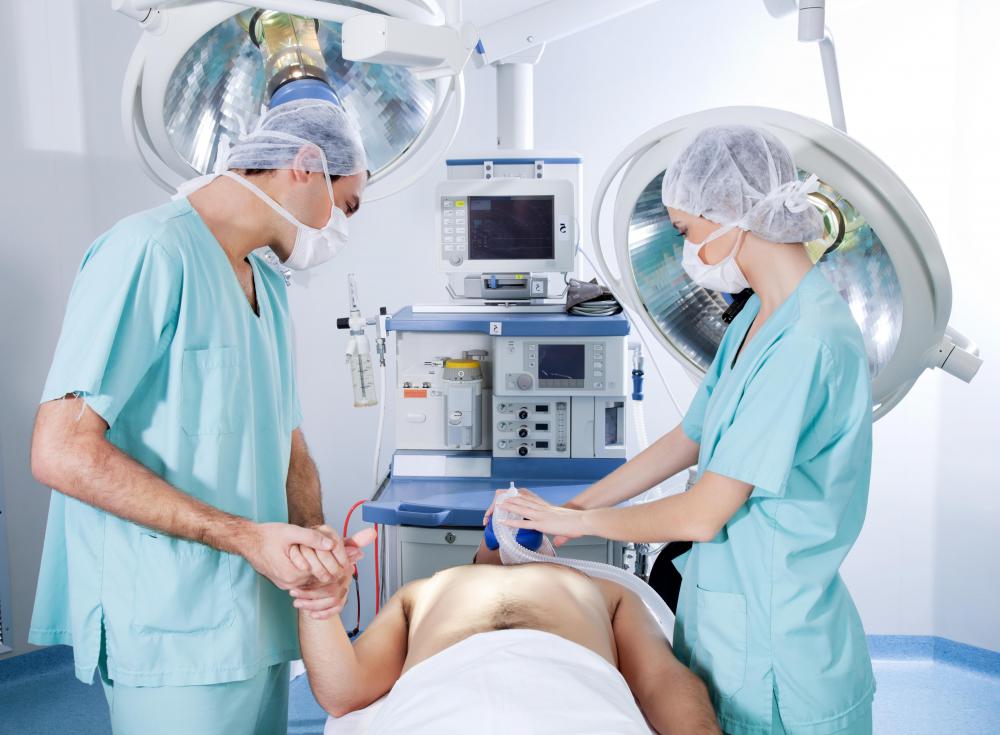
Twilight anesthesia is a type of anesthetic technique in which the patient is sedated but not unconscious. It is used for a variety of surgical procedures and for an assortment of reasons. Just like regular anesthesia, twilight anesthesia is designed to make a patient feel more comfortable and to minimize the pain associated with the procedure being performed. This technique carries fewer risks than general anesthesia, making it a popular choice among patients and surgeons for simple medical procedures. As with any anesthesia, twilight anesthesia should always be performed by a certified anesthesiologist, who will interview the patient before the procedure and monitor the patient's health while he or she is under anesthesia.
Medications Used

This type of anesthesia is also known as twilight sedation, intravenous (IV) sedation and conscious sedation. The anesthesia relieves anxiety on the part of the patient and creates a state of amnesia so that the patient will not remember the procedure later. Many of the drugs used to induce twilight anesthesia are the same as those used in general anesthesia, but the dosages are much lower. Among the drugs that might be administered intravenously are midazolam, fentanyl, valium, ketamine or a type of benzodiazepine. Nitrous oxide, also known as laughing gas, might be administered instead by having the patient inhale it.

A local or regional anesthetic is always applied to the area on which the operation is being performed. This anesthetic ensures that the patient will not feel pain during the procedure. Depending on the level of sedation, the patient might be awake enough to talk with members of the surgical staff, which can be extremely useful for some procedures. In other case, the patient remains in a state of light sleep while the surgery is performed. The drugs used in twilight anesthesia act quickly can can be reversed quickly, so the patient can be woken up in a matter of minutes.
Risks and Concerns

As with any medical procedure, there are risks involved with twilight anesthesia. Some side effects that might be experienced after twilight sedation include dizziness, low blood pressure, nausea and blurred vision. Drug allergies or interactions also might cause an unfavorable result. This is why it is important for a patient to pay attention during the pre-surgical interview and to submit to blood work so that medical professionals can look for potential problem areas. People who experience extreme anxiety or claustrophobia should make this known to the anesthesiologist, who might choose to use a deeper level of sedation on these patients.

Patients who are interested in twilight anesthesia should discuss it with their surgeons. As a general rule, if a procedure is eligible for twilight sedation, the surgeon will recommend it. There might be a reason why twilight anesthesia is not suitable for a particular surgery. When this is the case, the surgeon or anesthesiologist will discuss the available options with the patient.
Mary McMahon
Ever since she began contributing to the site several years ago, Mary has embraced the exciting challenge of being a TheHealthBoard researcher and writer. Mary has a liberal arts degree from Goddard College and spends her free time reading, cooking, and exploring the great outdoors.
Learn more...
Mary McMahon
Ever since she began contributing to the site several years ago, Mary has embraced the exciting challenge of being a TheHealthBoard researcher and writer. Mary has a liberal arts degree from Goddard College and spends her free time reading, cooking, and exploring the great outdoors.
Learn more...AS FEATURED ON:
AS FEATURED ON:


-
![An intravenous drip dispensing anesthetic.]() By: JudexAn intravenous drip dispensing anesthetic.
By: JudexAn intravenous drip dispensing anesthetic. -
![A twilight anesthesia-inspired sedation technique is often used for patients who are fearful of oral procedures.]() By: KadmyA twilight anesthesia-inspired sedation technique is often used for patients who are fearful of oral procedures.
By: KadmyA twilight anesthesia-inspired sedation technique is often used for patients who are fearful of oral procedures. -
![Twilight anesthesia allows patients to remain awake and responsive.]() By: Andres RodriguezTwilight anesthesia allows patients to remain awake and responsive.
By: Andres RodriguezTwilight anesthesia allows patients to remain awake and responsive. -
![Today, the most common use of twilight anesthesia is during medical testing.]() By: Tyler OlsonToday, the most common use of twilight anesthesia is during medical testing.
By: Tyler OlsonToday, the most common use of twilight anesthesia is during medical testing. -
![Administering laughing gas in a lower dose can cause twilight anesthesia.]() By: WavebreakMediaMicroAdministering laughing gas in a lower dose can cause twilight anesthesia.
By: WavebreakMediaMicroAdministering laughing gas in a lower dose can cause twilight anesthesia.




Discussion Comments
I am about to have my gallbladder removed tomorrow. The doctor explained the procedure to me today. And said I was going to be put under twilight anesthesia. I have no idea what to expect. So yeah I'm 15 and not ready for this. Someone help.
I just had all four wisdom teeth removed with sedation and it was great! I had n pain or memory of procedure-- none! I was quite nervous, so I wasn't sure how the sedation would take. I am now lounging on the sofa with my gauze and ice pack with little discomfort.
I'm sure once the numbness and drugs wear off, that will change a bit, but boy, has this experience exceeded my expectations so far! Good luck to anyone about to have this done. You will be fine!
I was just put in twilight sleep for a lengthy surgery and it was one of the most pleasant, serene experiences I've ever had. It was amazing. No pain whatsoever, no memory of the docs, just a fanciful happy little world I was in.
I received conscious sedation and there was no one around to see how I was taken care of. I was out like a light and have no idea how my body was treated. I will never put myself in this position again.
The fact that these amnesiac drugs are used to help the patient is untrue. They are used solely for the convenience of the medical personnel to make the patient more compliant and easier to work with. They do not reduce pain; they merely make the patient forget it afterwards. They can also have severe side effects. Never allow any form of amnesiac drug to be used.
I received the same anesthesia recently during my ankle surgery in Delhi. It was a good experience, no pain at all, I was awake during surgery and talking to doctors.
The effects of this anesthesia lasted until three hours after surgery, but the real release I got was after 24 hours when I was able to move my leg without it feeling heavy.
After surgery I observed on the monitor that my BP was low throughout. It was 95/65.
I can say that after this twilight sedation that no one should worry about the pain they may suffer during surgery, because you will feel nothing.
The last thing that a patient undergoing surgery or a procedure needs to hear is that their "anesthesia" is sub par. So-called twilight or conscious sedation usually works on most patients (the amnesic effects of Versed cloud their memories of a painful procedure-usually), but for many patients (an estimated 10 percent) they end up thrashing in pain and beg the endoscopist to stop a painful procedure. They usually will not get more drugs unless an anesthesiologist is there to administer them.
I have heard too many patients screaming during procedures under "nurse anesthesia" -- including cna's -- to ever recommend any kind of sedation or anesthesia unless it's provided by an anesthesiologist (not an anesthetist, which is a nurse with some anesthesia training -- hardly the person you want in charge of your sedation or anesthesia).
I have had too many patients undergo procedures such as colonoscopy where the sedation was done by a nurse/crna and they have had a terrible experience. I no longer recommend colonoscopy or other potentially painful procedures for my patients unless an anesthesiologist (MD/DO) will personally do the case.
I just had a colonoscopy, something that I have to do yearly due to my bad history of colon cancer. I'm not a physician, just a researcher at the local university in theoretical physics. I mention this because I'm addressed as "doctor," which is appropriate in the academic setting, but not in the medical world. My students and friends (almost everyone) addresses me by my first name – Gary. For my colonoscopy, I had a CRNA who tried to convince me of the manifold advantages of so-called "conscious sedation.” I politely declined. I do not want the sometimes long-term amnesia and previous reaction including hives, PTSD and anger issues that often follow administration, often an amnesic benzo (versed) and a small dose of a narcotic (usually fentanyl). I have seen too many patients literally screaming during their colonoscopy, begging for the endoscopist to stop, to ever allow this chemical patient abuse to be used on me or any member of my family.
I requested a drug-free exam and the endo center "agreed". But on the day of my colonoscopy, they did everything possible to make me accept sedation. No dice. Everyone stopped being nice once I made it clear that I wasn't going to sign the sedation consent. The CRNA could have cared less that "sedation" for a previous procedure almost killed me (hives, anyphalixis, difficulty breathing) all from a drug that they gave me saying: "it's to relax you.” Yet, because of the inattention of a nurse/CRNA, I almost got a drug that almost killed me. I didn't complain; I just refused to sign the sedation consent. The CRNA then informed me, "You won't get anything for pain unless you sign a sedation consent.” At this point, I was going to leave without having the colonoscopy performed. Luckily, the endo nurses assured me that they would give me any amount of fentanyl that was safe to reduce any pain (without the CRNA being present). At that point, I told the colonoscopy doctor that I was refusing any and all meds (not even an IV) because of the CRNA's behavior. The endo doc agreed and said that she's objecting to an unsedated exam because she won't get paid for anesthesia services. Wow. I guess patient care means nothing. The CRNA is only interested in her paycheck, not my safety or comfort.
The endo doc was obviously shocked by the CRNA's behavior. At any rate, I was wheeled down the hall for the colonoscopy by one of the endo nurses. The CRNA appeared and took over pushing my litter! As politely as possible, I tried to tell her that I didn't want any anesthesia services and I certainly did not want her involved in my case. She was apologetic and said that she was out of line insisting that I consent to sedation she promised to "take great care of me.” When we arrived in the endo suite, she tried to start an IV and I jerked my arm away and asked the endo doctor to tell the CRNA to leave. She did so, adding, “Your antics have caused this patient to refuse a recommended course of anesthesia care. He's right in refusing your services.” I interjected that I was probably a problem patient (certainly not true) and asked the endo doc to start the procedure without any sedation. Rather than leaving the endo suite, the CRNA asked me to forgive her previous comments (OK, no big deal). I said no hard feelings, just please make sure that you are not involved in my case, nor do I want you in the room during my colonoscopy.
Be very careful about having twilight sedation with midazolam (also known as versed). There are lots of horror stories about people who have long-term memory problems or other nasty side effects from it. I would never have the stuff.
I am depressed, anxious and dizzy after wisdom teeth surgery. Also due to the amoxicillin.
I had a colonoscopy yesterday. I was give 8mg of midazolam and 200 mcg of fentanyl. I made it clear to everyone involved I didn't want to feel anything. The procedure was very painful and I was screaming for them to stop. I remember everything. I won't do it again.
I suspect that the skin contusions were not from the drug but from struggling. I had one administration of twilight sleep recently for a colonoscopy and it only reduced my anxiety but did not cause loss of memory or consciousness. I remember the procedure and it was only mildly uncomfortable.
The technician said I was resistant to the drug and I mentioned that I can't be hypnotized either, so I think its a release-of-control issue in the presence of strangers.
I am about to have periodontal surgery done (gum grafting) and I'm super nervous. They told me I would be on an IV with a "twilight sedation" and not under full anesthesia.
First off, I really don't like needles. Second, I really want to be asleep for the entire procedure. The periodontist made it sound like I would go to sleep, but after reading some comments of other people's experiences, I'm worried I will be awake but just out of it. Is it normal to go to sleep while under "twilight sedation"?
i have to get a biopsy done and they said they would give me twilight anesthesia. I am afraid I will spaz out though, because I have anxiety issues.
Yesterday I had four wisdom teeth removed under IV sedation. The laughing gas administered made no noticeable difference on my awareness or behavior, although it may have reduced my heart rate.
Once given the IV sedation, I began hallucinating in less than ten seconds and was conscious for the entire procedure, but unaware of what was going on. Extreme visual hallucinations were incorporated into the distorted sounds which I believe to have been the operating noise.
The next thing I remember to be real was being wheeled out into a post-op room and a girl was next to me, clearly in the same state I was in and I kept trying to tell the nurse how awesome I was tripping. It gradually wore off on the car ride home, but I immediately fell asleep after taking a vicodin.
The nurse and doc at my procedure said I was kicking my legs, my head was going and I was itching. They gave me something related to versed. This was for an injection i need in my back. All I remember was them hooking me up to the monitors and tapping my finger and then I was out like light. They said an hour and I was out for at least two. They gave me a different twilight med because I said I itched from demerol and was kicking and doing other stuff from that drug. Apparently, I might be allergic to twilight meds. That was from an ercp.
I just had a defibrillator put in my chest. While under twilight, my blood pressure dropped so they had to wake me up. I was awake for the whole 90 minute procedure - it was horrible. I did get knocked out with a different anesthesia the last 5 minutes because they had to test the device and didn't want me to experience the test. I want to be totally out next time I have surgery tube down the throat etc.
I had it yesterday for a gastroscopy, or maybe it's called an endoscopy. It totally knocked me out, but i remember resisting them and being pinned down.
Today i have popped blood vessels all over my face which is why i was seeking out info online to see if this is common. So far, I see nothing. Wondering if it was from the resisting (last time i got these was during childbirth).
I had it when I had surgery on my ankle. I was only 13, and apparently i told my doctor (who was foreign) to go back to India and called a nurse a moron. I don't remember anything else!
I was put under twilight anesthesia today for a colonoscopy, my 3rd one. The other two were simple, didn't feel or remember a thing. Apparently over the last year, I became completely immune to whatever they use, because this time I never even got tired, I felt everything, and I remember everything. Not a good time.
I was talking the whole time, telling them it wasn't working and they pumped the max amount of whatever drug it was, apparently my BP dropped way down, but I was completely aware and immediately after the procedure I got up and walked to the waiting room to change.
I could have driven myself home easily. I never felt any change, and I'm pretty pissed off at the surgery center right now. I'll have very specific requirements for the anesthesiologist next time.
I would like to know what the drug is they use. Anyone know?
No, the eating drinking rules are the same.
Twilight Sedation was used on me for my colonoscopy.
I don't remember a thing about the procedure.
The last thing I remember was the nurse saying to me this stuff works pretty fast -- and I was out.
The next thing I know I'm in a recovery area, and the nurse is asking me if I want sprite or ginger ale to drink?
The procedure began at 8 a.m., and I was in my home by 10:30 a.m.
I did take a long nap after getting home. but for me this was the way to go.
No side effects, just a little groggy, and they were right, because I don't remember a thing about the actual procedure.
If it's available to you, it's definitely the way to go. One thing: you do need someone there to take you home afterward. They won't let you leave without assistance from someone, and they make you sign paperwork. No driving yourself. They won't even let you take a cab home alone. You need a family member or friend to take you home.
Post 1: The rules are the same with twilight sedation: No eating or drinking prior to the procedure. Post 2: Anything allegedly said while sedated is inadmissible. That's why all consents are signed prior to anesthesia.
I had this for a colonoscopy. I didn't like it at all. I went into a deep sleep. I was hard to wake up. My blood pressure dropped to 68 over 30 and it took awhile for it to come up.
The next day I sent to work and was just out of it. My thinking was not clear. I couldn't remember things. I couldn't remember where I had just sat a paper down.
I called my doctor and they said it was probably a drug hang over. No thank you! I will never do that again. Scary stuff for me!
I just had hernia surgery under twilight. All I remember was being moved from the table to the operating table and waking up and getting dressed. It was like a normal nap. No pain, no remembering the procedure. No side effects afterward. Great stuff.
Toady, I got four wisdom teeth removed. After strapping me down, they applied the twilight anesthesia. I have complete amnesia, I remember being told the light would begin to waver and I remember them transferring me to a stretcher to move me into another room until my ride arrived.
I prefer twilight for many reasons. I feel way less groggy after it, I feel much more comfortable that some part of me is aware and in control.
I'm wondering how long this effect wears on though?
I just had twilight sedation today to remove all four of my wisdom teeth and I had a very positive experience. I had complete amnesia as to what was happening. I only remember the very beginning when the oral surgeon was mentioning how long my roots are and an accident he once had on his bicycle =S or I may have very well hallucinated all that. =P
I recently had a procedure and this drug was administered. I was awake the entire time, I vary much aware of what I was saying and doing. I remember everything and felt some pain during the procedure but not any amount that was intolerable. But what I was wondering why I visually hallucinated under this drug. Did it just have an adverse effect on me, and why wasn’t this mentioned in the article?
Doesn't matter what you say or do. You could be completely making stuff up while you're sedated. When I was a young child, I was sedated and apparently yelled at the doctors, saying I would take their jobs away.
I think it would be more akin to being drunk than being administered with a truth serum.
i am wondering what twilight is for the reason when i was 16 i gave birth to a baby boy. the dr who i had chose to give me twilight. he said no one could come back there with me because i might do and say things i normally wouldnt do. i remember nothing but looking down at my body. i was screaming with my back arched and i remember looking down my throat that's all i remember. the dr said that i got up and tried to skip around the room so they had to restrain me. i do not remember that or even giving birth to my son.
i am curious what the effects to my child would be. he came into this world healthy, now is very small. does it stunt the child's growth? it was like i had, the best way i know to describe is, an out of body experience.
someone please help answer the questions. i'm 27 now and still need to find out what really went on, thank u
The rules are the same.
Since twilight anesthesia has the ability to induce amnesia, I am concerned that the medical staff questioned me while under twilight anesthesia. My procedure was a workers compensation claim. What are the chances of the doctor interrogating the patient to discover any fraud and reporting it to the insurance provider?
Are the rules for eating and drinking before surgery different with twilight anesthesia?
Post your comments