
At TheHealthBoard, we're committed to delivering accurate, trustworthy information. Our expert-authored content is rigorously fact-checked and sourced from credible authorities. Discover how we uphold the highest standards in providing you with reliable knowledge.
What is Trypanophobia?
 Malcolm Tatum
Malcolm Tatum
Malcolm Tatum
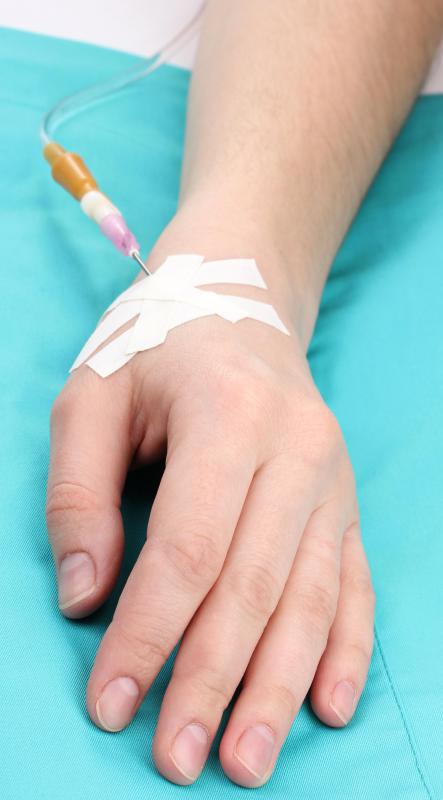
Trypanophobia is an extreme reaction of fear to the use of needles in any type of medical environment. While many people experience some degree of aversion to receiving a shot at the doctor’s office, persons who suffer from trypanophobia tend to take on levels of anxiety that can result in the occurrence of a panic attack. This extreme aversion to needles can lead to serious health issues, as the phobia will motivate individuals to forego medical treatments and tests that involve the use of a need to inject medication or to take blood samples.
While the general concept of being afraid of hypodermic needles has been around for a long time, the actual identification of the situation as a phobia took place in the early 1990’s. The phenomenon is estimated to affect in the range of ten percent of adults living in North America. As with many different types of phobia, the severity of the symptoms provoked by this phobia will vary in severity from one person to the next, as well as vary in strength and intensity from one situation to another.

As with many different types of phobias, trypanophobia is usually associated with some event or series of events that led to the extreme fear of hypodermic needles. The fear may be exhibited after a hospital stay in which the attending medical staff unknowingly caused a great deal of pain while giving injections to the patient. Childhood memories of relatives or friends who were severely frightened of needles can also lead to a lifelong battle with this type of phobia.

Treating trypanophobia can sometimes involve finding ways to desensitize the trypanophobic to the anticipated pain and discomfort associated with the fear of needles. A topical anesthetic cream may be administered prior to introducing the needle to the skin, minimizing the stinging sensation. The use of sedatives in advance such as a small amount of anti-anxiety medication or the administration of laughing gas may ease the fears of the patient sufficiently to allow for the use of needles. Cognitive Behavioral Therapy, or CBT, has been helpful with a number of phobias, including trypanophobia, as the therapy is understood to retrain the brain to not engage neural pathways that lead to the creation of agitation at the sight of a needle.

While trypanophobia can be debilitating, there are ways to manage and even eliminate the phobia. With the help of a qualified healthcare specialist, the most appropriate form of treatment can be identified and administered. Eventually, the trypanophobic can be free of the fear of hypodermic needles and be able to undergo various medical procedures with relative calm and ease.
Malcolm Tatum
After many years in the teleconferencing industry, Michael decided to embrace his passion for trivia, research, and writing by becoming a full-time freelance writer. Since then, he has contributed articles to a variety of print and online publications, including TheHealthBoard, and his work has also appeared in poetry collections, devotional anthologies, and several newspapers. Malcolm’s other interests include collecting vinyl records, minor league baseball, and cycling.
Learn more...
Malcolm Tatum
After many years in the teleconferencing industry, Michael decided to embrace his passion for trivia, research, and writing by becoming a full-time freelance writer. Since then, he has contributed articles to a variety of print and online publications, including TheHealthBoard, and his work has also appeared in poetry collections, devotional anthologies, and several newspapers. Malcolm’s other interests include collecting vinyl records, minor league baseball, and cycling.
Learn more...AS FEATURED ON:
AS FEATURED ON:


-
![Trypanophobia may develop in children who have experienced pain from needle injections in the past.]() By: PhotobankTrypanophobia may develop in children who have experienced pain from needle injections in the past.
By: PhotobankTrypanophobia may develop in children who have experienced pain from needle injections in the past. -
![Extreme fear of needles in a medical environment is referred to as trypanophobia.]() By: diego cervoExtreme fear of needles in a medical environment is referred to as trypanophobia.
By: diego cervoExtreme fear of needles in a medical environment is referred to as trypanophobia. -
![Trypanophobia may make it difficult for a person to have blood samples taken.]() By: JPC-PRODTrypanophobia may make it difficult for a person to have blood samples taken.
By: JPC-PRODTrypanophobia may make it difficult for a person to have blood samples taken. -
![Overcoming trypanophobia makes it easier for patients to endure necessary medical procedures.]() By: Africa StudioOvercoming trypanophobia makes it easier for patients to endure necessary medical procedures.
By: Africa StudioOvercoming trypanophobia makes it easier for patients to endure necessary medical procedures. -
![Those with trypanophobia -- a severe fear of needles -- may be prescribed anxiety medication to take just before getting a shot.]() By: Fernando MadeiraThose with trypanophobia -- a severe fear of needles -- may be prescribed anxiety medication to take just before getting a shot.
By: Fernando MadeiraThose with trypanophobia -- a severe fear of needles -- may be prescribed anxiety medication to take just before getting a shot.



Discussion Comments
I turned 16 yesterday and attempted to donate blood at my church this morning. I have had a fear of needles since i had to do a series of blood work when I was 9. Today, I attempted to get over my needle phobia but after a simple needle prick to check my iron levels, I blacked out for 20 minutes. This phobia has gotten out of control for me and I also have ticklish veins and nerves that make me dizzy when pressure is applying to my veins.
My needle phobia is completely beyond any control. Today is my 31st birthday and I am worse now than when I was a child. Back when I was 10, I was sent to the Medical College of Ohio (now University of Toledo Medical Center) to the children's psychiatric center for 41 days in the summer between my fourth and fifth grade years.
A week before I was scheduled to be admitted, they scheduled my blood tests and I had been terrified of needles ever since being a small child (I was 9 years old at this point.) When the nurses came into the consultation room where I was, I went out of control. Please keep in mind I am only 5'8'' and 150 pounds today, so I was on the small and scrawny side for a 10 year old male.
As soon as I saw the needle, I went out of control and began violent seizing and flying into and off of the walls, screaming and knocking lights, pictures and containers all over the place, while uncontrollably and randomly flying around the room. Several more nurses quickly came in and tried to restrain me and I grabbled the tall floor examination lamp instinctively and began wildly swinging it about -- and shattered one nurse’s leg with the force of the impact. I then bashed another nurse over the head with the lamp pole, knocking her unconscious.
My mother and father ran into the hallway, yelling and crying, while four or five more nurses, males and females, came running down the hall and into the room. By this time I was hyperventilating and still flying around the room. My blood pressure shot so high by that time, blood was gushing out of my nose like a fire hose.
I somehow fought off one of the male nurses and literally sent him headfirst through the drywall wall with his head miraculously plunging between wall studs, missing them by mere inches. He was also knocked unconscious while his head was still lodged inside the wall. (I am really not exaggerating any of this. I am having severe chest pains and difficulty breathing as I type this, recalling the experience.)
Two more nurses lunged for me and I kicked one of the females in the face and broke her nose. By now, blood was still erupting from my nose and a trickle of blood was running out of my right eye from the extreme level my blood pressure had risen to. By now the entire pediatric building was put on code blue/red alert -- whatever it is called -- and several more nurses and two Toledo police officers rushed in to take me down. In total, it took 11 full grown adult men and women to stop me and I sent five of them across the campus to the emergency department due to their injuries.
I lost consciousness and awoke about 12 hours later in a straitjacket in what was literally a white, padded room. Rather than being admitted the following week, I was already in the Kobacher Center where I would remain for a total of 41 days being tested, interviewed and examined by an entire team of doctors and med students. I would undergo blood testing several more times there and each time I was restrained while asleep in the middle of the night while 12-15 doctors and students forcibly drew blood on four more occasions. I have never been able to sleep more than three or four hours a night, even with heavy-duty prescription sleep medications in the 21 years since.
The trauma of it all has wrecked my health and I am now developing heart disease from the endless anxiety and panic attacks, out of control stress hormones and adrenaline, and the inability to have any form of invasive medical procedures. It is literally killing me and my doctors advise me that at this rate I will die of a heart attack before my 40th birthday.
Yet now it is 20 years since that episode and my terror has only increased exponentially. I am terrified that I could someday be in an accident and wake up in a hospital somewhere and instantly go into an uncontrollable rage and end up literally killing many nurses and staff before anyone could stop me.
I am petrified that America will turn on CNN one night and hear, "A man who was injured in an accident today woke up in a hospital emergency room and went into a psychotic rampage, killing more than a dozen doctors and nurses with his bare hands and hospital equipment before being shot and killed by hospital security..."
What the hell am I supposed to do? I have since then been diagnosed with High Functioning Autism (Asperger's. I have a 130 IQ but minimal social awareness. I am constantly told I am just like the character Sheldon Cooper on “Big Bang Theory”), psychotic schizophrenia, clinical depression, chronic insomnia, dissociative personality disorder and Trypanophobia.
My heart is pounding in my chest right now so hard from typing this out. It is very painful and I had to pause for 20 minutes and take another Xanex to get my pulse under control. This episode I have recounted to you left such an impact on all the doctors and staff that day that it was written up in several medical journals in the early-mid 1990's as a case study in the issue of needle phobia years before it was given much mainstream medical consideration.
Seriously folks, what do I do? What can I do? My mother is now in hospital just beginning treatment with chemotherapy and she has a trachea tube in her neck and IV lines in her and I cannot function there. I went to visit her there on her first night in the ICU unit, blacked out and collapsed to the floor within minutes. Thankfully, my mother was conscious and able to write a hastily scribbled message for the staff not to hook up an IV and just get me to the ICU waiting room, where I awoke about 15 minutes later. I cannot deal with this but I am her only child and I need to be able to support her somehow. Please help. Thank you.
@anon337511: Call your doctor and ask him or her to give you a scrip for a couple of Ativan. If you take one the night before, and one on the day of your surgery, it will help you calm down.
I'm not fond of needles, myself, and when I had my wisdom teeth out, my oral surgeon did this and it really did help. I was much calmer and was able to relax more. I also advise you to tell your surgeon about your fear of needles so that when they get ready to do the IV, to tell you so you can turn your head and close your eyes. It's much, much easier if you don't ever see the needle. Then, before you have time to get freaked out, they'll give you the anesthesia and you'll be out like a light.
The nurses will have all the IV lines out before you ever wake up, so by the time you come to in recovery, you'll just have a little bandage where the IV was. Good luck.
I am 15 and though I am a girl, I am still constantly teased for my trypanophobia. This is the first time I have actually researched my condition, and it helps to know that there are others who freak out as much as I do. I can't even look at a needle on a television screen without feeling nauseated.
I am about to get my wisdom teeth pulled and to be put to sleep, I have to get an IV line. When I found this out, it took me an hour to stop hyperventilating and even longer to stop shaking. My hands are still shaking as I type this. I even tried to look up how they do it online, and now I am cursing myself for being such an idiot because I almost blacked out even before they brought up the needle.
I read that the best thing to do is not think about it and not tense up when it happens; just listen to music or recite something in your head. I say that's a load of crap. I can't not think about it, and I still have a week to think about it. It's going to be a long week.
Oh, and to whoever wrote this article, I just wanted to thank you for having a giant needle pop up on screen, because that gives people with this condition a bloody heart attack.
I have had trypanophobia as long as I remember and it has always been a major burden. Being a man I have always been ridiculed for my "overreactions", and as I am currently studying psychology I can affirm that people who say this are know nothing jerks.
I am applying to transfer colleges and heard from admissions that I would need blood work done, and even just thinking about it launched me into a minor panic attack. Luckily, I found an alternative, but many are not so lucky. I haven't been to the doctor in five years and will not even go to get some anti anxiety medication because the doctors are so judgmental and mean (especially here in the dirty south).
I am so glad to have found a bit of a community in this post and thank each of you for your stories and support. Social support is one of the most important aids for psychological disorders and I respect all of you for your courage and perseverance.
I'm 54 and have had it all my life. Even seeing a needle and syringe will immediately put me into defense mode. Fight or flight. Talking about needles will make me tense up. I have avoided nearly all immunizations. All dental work has been without novocaine. I usually have to take something like a valium or xanax just to have blood work done. IVs are nearly impossible.
The odd thing is I can handle sewing needles OK, even with splinter removal, but I have to be the one doing it. No one else. Blood doesn't bother me at all.
Reading some of your posts brought back a lot of bad memories. I too have been told to suck it up, I should be ashamed, you're a guy--take it. When I was a teenager I once threw a nurse across the emergency room floor when she tried to give me a tetanus shot. It took my father and about five nurses to pin me down before I unwillingly got the shot. I was wiry back then. Now I just refuse.
Doctors just don't understand or care. I've had some laugh at me until they saw I was serious and just walked out, vowing to never return. "You don't take me seriously, I don't take you seriously either."
The problem is as I get older, the necessity of medical intervention becomes unavoidable, like the looming cloud of an approaching thunderstorm. You know it's coming. You want to hide.
I also have a severe case of trypanophobia, but no one understands that. Every time I am about to get a shot, I start to feel sick but to my bad (good?) luck I never pass out. During that I am brought to tears, even though I'm a guy!
I just get laughed at and my parents refuse to understand this, even though they are both doctors! Not to mention my country's health care is so bad they don't even recognize this as a phobia.
I get the same crap like, "You are a guy suck it up! My kid isn't afraid of this. You should be ashamed."
I can't avoid getting an immunization without causing a scene. The worst one was when I had my blood drawn. My father's colleague was doing it while he was holding me down. Usually he does my shots so not many people need to witness this.
I haven't missed a shot because I am able to suck it up long enough for it to be done, but it takes more self control than a normal person. Even so I still cry in terror for about an hour, no matter how hard I try to stop, which is embarrassing due to me being a guy.
I'm trypanophobic and have known so for years, but the only reason I knew so if because I had a nurse with a daughter who is the same.
It really annoys me that this isn't more widely known. I learned to sew at school and was good at it. This, along with me having my ears pierced, made people believe I was putting it on when vaccinations came around and i threw a fit. It was only when I was violently ill and was pulled out of school for the duration of the jabs, along with a letter stating I will have them done elsewhere, did they finally get it.
I'm slowly getting better. I have found listening to an mp3 device helps because I can pretend it's not happening. It's not perfect, but means it can be done quicker as I am not curled up in a ball, screaming and kicking.
At the moment I only trust one person to do it. I can have blood taken via a butterfly but that's because I can stick my hand far out and pretend she's painting my nails.
I'm afraid of bugs, even though I can squish and kill them.
But I think a way to help conquer your fear would be to learn how to give injections. People tend to be less afraid of things they completely understand.
And I really hate to break it to you guys, but most butterfly needles are the same size as straight needles; it's just the casing that's different.
I'm am a 12 year old girl and got ankle surgery last month. Before they gave me the IV, I was shaking uncontrollably, my heart was beating really fast, and I was crying. I almost passed out.
When people talk about getting shots or they talk about needles, my heartbeat gets really fast and I feel like I'm going to throw up. I hate even the sight of shots but I don't get like this when I see a push pin or anything, so I'm not quite sure if that has anything to do with anything.
I am 14 and my fear of shots is getting worse. This is the time when I need to get gardasil and hepatitis shots and everything just to be able to go to school. I am currently sitting in my mom's car outside the doctors office because she decided that she would spring a doctor's appointment on me out of nowhere. I just googled a fear of shots and after reading through all of these comments, I am almost positive I have a trypanophobia. I can't even look at needles.
It all started when I got the second gardasil shot (about five months ago) and I passed out and hit my head on the scale. I have low blood pressure so I had to stay at the office under surveillance for every shot I get. At the next doctor visit, I had to get blood drawn. I was strapped down to a table by my doctors and I couldn't keep myself together. I cried my heart out and I was shaking for the next two days. Every time I even go into my doctor's building, I freak out and now I am even starting to freak about needles themselves. I get queasy and feel like I am going to pass out.
I am not sure if this has anything to do with my anxiety, but I only really feel anxiety with time, like I won't have enough time for anything. Writing this makes me feel so much better, but I really wish that my doctor would understand. Thanks so much for everything, guys! I feel like I am not the only crazy one out there anymore. Good luck with everything and I hope it gets better for all of you.
I'm 29, and I think I might have this as well. I can hear about injections talked about formally or casually and can tolerate being in a hospital setting to visit someone (if I don't touch anything they're hooked up to), but when it comes to me being the patient, I feel very anxious. Maybe part of it is that I'm blind so don't see what's going on, but I also know of blind people who are as casual about shots as most other sighted people are, so I know it's not just that.
I used to scream and cry with shots, even as a teen, and I still always have to go to the bathroom especially before getting any injections at the doctor's. Recently, I've hyperventilated at least three times to the point where I felt like I would faint, one of those times being with a finger prick. I really try not to think about it, but as soon as the antiseptic (especially if it's alcohol) goes on my skin, it's hard not to. I try to think that other people have to endure much more than what I am, but that doesn't work; I'd avoid shots altogether if I could.
I'm 20 years behind on my vaccines, and the only reason I'm getting this one is because they've made it a requirement to get the meningitis vaccine; I can't register for the next semester of college without it. Family members tease me about the incidents where I hyperventilated, and many people say they don't like shots either, but I don't think they get how serious this is to me or to anyone else with this fear. It is not normal for a teen/adult to hyperventilate or cry with injections/blood draws, or for them to think of the possibility of getting out of getting a required shot, or to avoid a scheduled doctor's appointment altogether because it might/will require a shot.
I'm scheduled to get my meningitis one today, and it's hard not to feel anxious about it. I'm worried about how I will react (if I will hyperventilate or faint), and I will hate the anticipation of waiting. My doctor did mention a numbing cream they have, so I made sure to ask for that ahead of time, and will remind them of it today also. It won't help with the anxiety, but hopefully knowing I won't feel it as much or at all might help some.
I'm 15 and I've been scared for a long time now. If I even think about it I start shaking and if I'm near one I lose control of my body and cry uncontrollably. Since I'm ill at the moment, the last time they tried to take blood I cried so long the EMLA cream wore off and I have decided to try again with valium, (hopefully it works) but I don't think I'll manage it.
It's completely unfair this is not recognized more widely. If you're a sufferer I recommend looking it up for a few minutes and know that you're not alone. I'm not even sure what I'm scared of. I think it's just everything about it. If your doctor doesn't understand then find someone who will.
I am 18. I never thought I had an actual real phobia until very recently. I knew i was completely terrified of shots and getting blood drawn but I thought I was just stupid. I didn't think I had a phobia because phobias are like severe and irrational. Then I realized, wait, my fear is totally irrational. The descriptions of trypanophobia describe me!
I read all of these posts and the whole time I was thinking "Thank you for understanding!" I feel like no one understands! "It's only a pinch" they're "no big deal" "you'll be fine" yeah, I can think all of that until I actually get to the doctor and enter full on panic mode.
I passed out in the hospital parking lot after i got a PPD and had to go to the emergency room where they proceeded to take a blood sample (because that helps --not!) My dentist got really mad at me because I wouldn't let him in my mouth with a needle. He said he had put something in it first to numb it so it wouldn't hurt. He doesn't understand, though. It's not that it hurts, it's the idea of it. Just thinking about it makes me freak out and I'm not exactly sure why.
When I get a shot, I have to lie down because I freak out so much I can't handle sitting up. And afterwards I have to hang out at the hospital to make sure I'm not going to pass out on the way to the car again. The most frustrating thing is that I can't calm down even though I want to and no one understands that.
I have to get another PPD for college soon. I'm terrified.
I'm 16. I was never really terrified of shots and needles until I was 10 or 12. I hadn't gotten a shot in a while and all of a sudden I couldn't bear it. I started crying in the car when my mom told me we were going to the doctor's to get a shot, but once I was there I got through it with relative ease. But ever since then, the fear's only getting worse.
I started to be unable to think about needles and shots when I was about 13 and when I recently was told I'd have to get some vaccines for a trip to India I was planning, I freaked out and started crying in front of the doctor and my mom and when I got home too. I don't know why it's getting worse, or why it even started. It used to be just a fear, but if this problem continues to worsen, I'm sure I'll have a full-blown phobia.
I'm 18 and for as long as I can think back I've been severely frightened of shots/inoculations. The earliest occurrence I can remember is screaming and running around the doctors office at the age of three prior to probably a rubella shot.
And recently, at MEPS for joining the Navy, when someone took blood from my arm, I almost passed out and had a pale grimace with a shade of green on my face and blue lips. Pricks on the finger for blood tests don't bother me near as much, but they still make me anxious. Maybe it's just the idea of a needle actually forcefully entering my skin that makes me very uneasy.
I'm 17 and I've had a fear of needles practically my entire life. But recently i have had trouble with even the smallest things, such as a metal splinter and the small prick you receive on your finger before donating blood.
I had gone in to donate blood and felt okay with the thought of needles, but as soon as the woman pricked my finger i had passed out within seconds, in front of a roomful of my peers. It was incredibly embarrassing and i cannot explain why this would happen to me.
I've had problems like this for about a year. I'm 17. I'd never reacted when I had blood taken or gotten shots or anything before this one incident:
I was in band class and we weren't doing anything that day so my friend was telling me about how she got her blood taken. She described everything and as she was I started getting dizzy. I said, "Wait, stop, don't say anything else." She laughed and kept talking. Then I passed out and had to be carried to the nurse. It was completely embarrassing and I didn't see it coming. Now when I even think about needles taking blood I feel clammy and woozy.
Next Friday they are having a blood drive in the band room at my school. I'm so terrified of going in there because I know I'll pass out again. I don't know what to do about it. I even freak and pass out when I get my finger pricked at the doctor's now.
Wow. I hate to say this, but it is immensely comforting to see that I am not alone.
I wish I could faint, but I get the flight-or-fight reaction, and I have hurt people who have come at me with needles thinking to force or even surprise me. And you are all right: no one understands it or takes it seriously. There is no way I can "turn my head" -- it's the kind of fear I think I would feel if someone were to hold an axe over my arm and tell me to look away. No, I have to get away, and fast. I hate it.
I'm 43 years old, and the only person who has ever understood was my husband. Others have tried, but they all try to make me feel stupid for being afraid, thinking if I can see how silly I am I will miraculously lose the fear. Even hypnotherapy has had minimal results. It's too expensive to keep going, and the exceedingly slow results aren't worth the cost.
I can have blood drawn now, but they have to use the butterfly needle (a.k.a. the baby needle), and I have to really trust the person doing it. But the finger stick is out. And no way no how can I get something injected under my skin or into my muscle.
I went to an orientation at a vocational college to see about doing medical transcription because I had young children and needed something I could do at home. As soon as I heard I would have to get shots, I dropped out. Later I was in another school and told I had to get my immunizations updated to continue (I was almost done!) and when I went to the health care center to get the shots, I started crying and shaking and the nurse there wrote a note to the school excusing me from taking the shots. She was not nice about it. She was angry and disgusted. And that reaction is very common. No one gets it.
I have not been to the doctor in over 10 years, and I have not been to the dentist in over 25 years. I will never be able to travel. I will have to pass up many opportunities because of this fear. I cannot watch my pets or my children get injections. Every year they show people getting flu shots on the news, and it upsets me so much that I start crying. If they would only give some warning that they were going to show it, I could prepare for it or leave the room. But no one understands, because it is an "irrational" fear. Even though it's irrational, it is still very real and painful and humiliating.
When I was three, I fell off the operating table thing and hit my head. Then the nurse got the needle lodged in my arm and had to get tweezers to remove it.
Over the years, I've had blood tests many times and always cry/scream/have to come back again.
This year I had four attempts of a blood test and my veins collapsed (probably anxiety). I'm not up to date on my shots and when the girls got the HPV shot I was the only one left in the class and my teachers kept asking why I didn't go and get it!
And when I'm at the hospital they always ask what I'm doing in the children's ward! It's humiliating. I even got offered a group therapy thing with six year olds.
When I was a young child, I had several diseases that required me to be on an IV and in the hospital at least six times. Once, the nurse had just put in the IV needle, and went she got up to get tape the doctor holding it in let it pop out of my arm. Blood spurted, and they had to do it all over again.
I also received an immensely painful shot in a school vaccine center. Perhaps all those times in the hospital caused my phobia, and I have had several mild panic attacks just thinking about needles. My parents, however, think that I'm only letting my thoughts run wild, and it's all in my head.
I've had it differently from everyone else. I don't know when I became afraid.
I know when I was eight I was fine, but then a few years later, I was too afraid to get my ears pierced, and it took about an hour.
Now I freak out and find it hard to breathe, and I also try to attack the people holding me down. However, most people are very sympathetic, like my parents, friends and nurses.
It was a nurse who told me to look this up after she mentioned a needle. Maybe I'm just lucky with the people I meet. I'm 16. I think it may stem from my ears, which were pierced wrong the first time and I ended up with an infection and because I had to have pins in my arm and I saw them being pulled out by accident.
I understand completely. When I was seven, I got an oral herpes diagnosis, and it took nine people to hold me down. And because I was struggling so much, they stuck me seven different times trying to get it right. And ever since then, I can't even begin to tolerate syringes.
anon25741 has it right. Those of us with the most severe form cannot be treated. I have been through therapy, I cannot be hypnotized, and there is no way on God's earth I can submit to any needle in my skin, whether a pin price, injection, blood draw, or IV without causing severe psychological damage.
I had a shot last year due to stepping on a nail, which I got through but suffered nightmares, anxiety, and extreme anger for months.
When I had surgery, they had to do gas induction before inserting the IV and then had to remove it before I came to. I have even threatened to kill people who approached me with a needle.
Trypans, we need to unite. 1. Health providers need to acknowledge this condition and develop effective methods to work with us. 2. We need to insist on these methods and not give in to their nonsense. 3. We need to educate health care providers and let them know what we can and cannot tolerate. 4. Treatment protocols need to be formalized that allow gas induction, heavy doses of anti-panic meds, or anything else that works. 5. Most of all, we need a public relations campaign so people understand this is real, it needs to be accommodated, and that continued exposure to unwanted procedures simply makes us progressively worse.
Time to stand up for ourselves and acknowledge that we are the patients and we decide what we can and cannot tolerate. If a medical provider won't respect this, they can shove their needles somewhere else!
I am 23 and I have had a very severe fear of medical needles since I can remember. The odd thing is that my fear does not project to piercings, tattooing, cuts, blood or anything that most with trypanophobia come with.
However when I have to get a shot or get my blood drawn, i go into a full on panic attack. when i was 10, I attacked a nurse who tried to hold me down. I try to tell myself I'll do it, i just won't look, but the second i sense the needle. I freak out and cannot control it. i cry, hyperventilate, get dizzy. I have not passed out but have gotten close, and i throw up almost every time. just a couple of weeks ago i was in the hospital for something that is potentially life threatening and the doctor decided that he needed to take blood but did not inform me before sending in the tech.
The tech came in and told me she'd be drawing blood. Immediately i started sweating and crying, asking if there was another test they could do. I know i completely embarrassed my boyfriend and he was so calm, he tried to cover my eyes and hold my head down kissing my forehead telling me it would be all right but i couldn't stop. I got dizzy and felt like i was going to puke and i couldn't breath. The tech actually called me a baby and stormed out of the room.
I really don't know what is wrong with me. I've had 15 piercings in my life and one tattoo and they were never a problem. I still don't know whats wrong with me. i still have horrible pains and the other symptoms, and the docs just gave me pain killers that don't work and they refuse to give me anything for anxiety to calm me down.
I've tried meditating, I've tried closing my eyes or distracting myself, and I've even tried biting my lip to the point of bleeding to take my mind of the needle. the problem is that it is not the pain. It is a psychological disorder and i have no control over it. Hopefully some day i will be able to get over it or get some treatment for it. But for now i just pray every day that there is not something horribly wrong with me that my fear will not allow me to fix.
The problem is that even health care providers don't understand that a phobia is a very severe mental condition. It is not just a fear that can be overcome like a kid who is afraid of the dark. It is more like a mental disorder like bipolar disorder. it is uncontrollable without help. you cannot just stop a phobia; it must be treated.
I know exactly what you guys mean. It got bad like last year, but I've always had it in some form. Now this year, during my physical, i fainted because of the finger prick. I hyperventilated so bad that i passed out cold.
Just thinking about it makes my upper arms ache and my body go weak. i feel like a noodlegirl.
My mom and sister say its only a pinch, but to me it hurts so much i can't take it. It's so terrifying. Mom tried to desensitize me by teasing me about it and i think it helped make it worse.
Just please, anyone, help me. I have full on panic attacks about it and I'm sick of passing out.
I've had an intense phobia of needles since I had an orthodontic surgery and the doctor failed to find a vein and tried to locate it roughly seven times in each arm. I now feel extremely nauseous and start to cry (and sometimes hyperventilate) to hear about shots and needles. At least the doctor doesn't make fun of me for it, although everyone else does.
I've had a fear of needles my entire life - probably due to surgery I had at a day old - and I'm now 53. Because of it I avoid dentists, doctors, and can't even watch my dogs get shots.
I've managed to conquer most blood tests taken from the inner elbow by taking myself into a trance "elsewhere". Nurses have told me I've scared them because I appear to be in shock when I do it. I don't know how I do it - it's like an "over the top" meditation.
One suggestion for anyone needing to get multiple vials taken (I needed 12 last fall), is to ask them to use a butterfly valve - the needle doesn't move in your arm because there is no changing of vials in the syringe.
I have had this phobia my entire life. The worst experience I had was a few years ago, when I was thirteen. I'd found out that I was getting my blood drawn, and I sat in the waiting room, sobbing. When it was finally my turn, I sat down and even let them wrap the band around my arm, but then I snapped.
The nurse told me, "My daughter is only nine and she got her blood drawn last week! She said it's no big deal." She didn't say it in a light, amused way; she was genuinely ticked off at me for clutching my arm to me and crying.
In the end, five guys had to carry me into a room across the hall, strap me to a bed, and draw my blood. I was only about ninety pounds at the time, and you wouldn't think that I would be as strong as I was, because I was able to resist them for so long. In truth, I probably could've gotten out of the test altogether, except I refused to hit anybody. The whole struggle getting me into the room took more then five minutes--all because I kept dogging and ducking and wriggling my way out of arms.
I have to get a shot tomorrow, and I am now seventeen years old. Because of the traumatic experience I had in seventh grade, I'm no longer a pacifist.
The only advice I can give is to bring something to distract you like music, a book you like, hand held video games, something like sudoku, or a friend (or a combination of things).
If you aren't as aware of the procedure it hopefully won't bother you as much. Also, try not to look at the needle and try to find a nice doctor some doctors are so much more accepting and forgiving about things like this (and even helpful).
I've had needle phobia since my surgery when I was seven and I am nineteen now so I've missed a lot of important shots and procedures. These strategies helped me through the ones I did manage to go through with.
My husband has a needle phobia. He hates them. I'm not particularly fond of needles myself, but since I have bloodwork every so often, I have to deal with it.
Here are some practical things you can do. If you're having blood drawn, ask to lie down. Turn your head completely away from the tech and close your eyes. I've found that not seeing the actual needle makes a big difference. Same if you need an injection. Ask to lie down, turn your head away and cover your eyes.
Don't watch the tech do the preparations, such as filling the syringe. Just close your eyes the whole time. It makes a huge difference if you never see the needle.
If you can't lie down, then turn your head and close your eyes throughout the whole procedure.
You might also bring a cool, damp washcloth in a plastic bag with you.
Don't be afraid to sit in the doc's waiting room or in your car with your cloth over your forehead, or on the back of your neck, until you're feeling better.
Maybe these tips can help someone. I do hope so.
My twin and I have had needle phobia as long as we can remember. Everyone always says "It's not big deal." Or "Stop acting like a baby." Or my favorite, "My son/daughter who is only four can do it." They just don't understand!
It's more than a fear. We can't even watch movies with blood or needles. We get squeamish and weak just thinking about it. My doctors don't understand or care. We feel like there is no one out there with the same phobia. We feel alone.
My mom is starting to understand it but she keeps saying we need our shots. We are 16 and haven't gotten them since we were 8.
Our doctor's record says something about us being bad with needles, fun.
i have never been afraid of needles until grade six when we had the cervical cancer needle. i got severely weak and dizzy and passed out, and i recently had to get the h1n1 needle, and i calmed myself down so i wasn't afraid,and yet again i got so sick!
My blood pressure dropped extremely low and i couldn't even lift my head up! next year in grade nine we have to get like four needles, and that's going to be hell.
and I'm not even worried about the pain of the needle going in, or burning, because that's nothing. It's just that i always get dizzy and faint, throw up, pass out, and my blood pressure goes way down. That's what i worry about.
I can't stand the sight of needles. I can't even watch someone get their finger pricked without feeling faint. I have to go outside and wait till it's my turn. My mom thinks I am ridiculous and immature but I really can't help it.
to anon61569: I feel the same way as you, like for real everything you said is how I feel about this phobia.
I totally understand your pain, and it gets me so angry that people think like ohh just suck it up, it's just a needle. I mean if i would, I could! But I don't want to faint every bleeping time I get it!
yeah i agree with the one girl. my mom has always thought it was a phase but as soon as i see any needle i flip hysterics. i've actually had panic attacks before shot and every time i see a needle i want to cry. mind you, i'm 16 so many of the nurses think i'm really strange.
i know mine is so bad that when i severely broke my arm. they tried to restrain me to give me a shot. i broke free and tried to set my arm myself to keep from having to get the shot.
I am in grade 10, and as long as I can remember, I have been afraid of needles. I remember taking a blood test, and they had to have two nurses hold me down. I saw it go in my skin and I screamed my head off.
It feels as if nobody cares. my parents joke about it, but I end up crying. They think it's just a phase, that I will get over it but I know I won't.
My friends think it's silly so I don't bother them.
In biology, we had recently watched a movie about genetics, and every so often there would be a scene of needles and injections. I felt so helpless, so I sat there and cried at my desk.
I feel humiliated because it feels like I'm the only one in the whole world with this problem.
i am pretty sure that i have this. i am in grade 9, and the last time i actually got a needle was in grade 3. they literally had to have two nurses and my dad hold me down (i was having a blood test. not sure why) and wrap me in a blanket. then, they had to do the other arm as well because my muscles were so tense that they couldn't get enough blood.
before they did this, they were actually chasing me around as i screamed (with people watching). to this day i still cannot take a needle. i was supposed to get hep b shots in grade 7 and the cancer one in grade eight, and i did try, but as soon as i saw the needle i freaked out. they tried to hold me down, but i was stronger than i had been in grade three so they couldn't.
So many times i have tried to take these needles, but i start to feel weak and dizzy, and my heart beats faster than you would think was possible without having a heart attack.
The really bad thing is that no one takes it seriously. they always say "oh, it doesn't hurt. it's like being pinched". But, of course, to me it's not like that, and they seem incapable of understanding that.
I am thirteen and have had Trypanophobia or Belonephobia as it is called even more commonly. This fear is initially from an experience I had as a young child where they used the wrong needle for a physical. I can't seem to overcome it. Any ideas to help me cure it? Thanks!
I started suffering trypanophobia suddenly in tenth grade. Every shot I've had since then has resulted in extreme nausea and loss of consciousness - without fail! I've grown terrified of most medical procedures (even a pap smear caused me to have the same reaction). It's a legitimate condition for which I've received no more than a dismissive comment or two from doctors and friends.
The medical community acts like they do not even care about this problem. Last time I had a blood test I sweated out my clothing, threw up,and my blood pressure rose so high they had to call Emergency. My provider has no solution other then "close your eyes". I wonder if the lab person would have fun drawing my blood with a spider on his/her head and they were deathly afraid of spiders? I avoid these tests now to my own peril. Bummer, huh! They have a new method where 90 percent less blood is drawn. When I asked my Health provider they did not have this service. darrrrrr! Good luck! Erich.
The most severe forms of trypanophobia are not treatable other than full sedation administered via gas prior to and during any needle procedure. I know, mine has not been treatable despite numerous attempts at therapy.
If the medical profession is serious about addressing this condition, it needs to expand its thinking to include alternatives (such as the one suggested) in the most severe cases.
Post your comments