
At Sports&Hobbies, we're committed to delivering accurate, trustworthy information. Our expert-authored content is rigorously fact-checked and sourced from credible authorities. Discover how we uphold the highest standards in providing you with reliable knowledge.
What is Train Spotting?
 Niki Foster
Niki Foster
Niki Foster
Train spotting is a hobby that involves collecting sightings of trains. A train spotter will typically focus on a certain set of trains or moving stock — such as all cars of a certain model or all moving stock belonging to a particular company — and try to "spot" as many in that category as possible. Train spotters share information about the movements of trains with others and usually carry a data book in which they mark off the railway equipment they have spotted.
In addition to a data book, train spotters carry a notebook and pen or a tape recorder to note their sightings. Some also carry cell phones or pagers in order to communicate to other train spotters regarding the movement of trains. Some railway enthusiasts enjoy photographing trains as well.
In the modern world, the Internet has come to have a role in train spotting. Railway fans may maintain electronic records of trains they have spotted, and railway information can be kept up to date and made available to the community at large through the Internet. Websites allow fellow railfans to exchange information and cross reference sightings. The Internet has also made possible virtual train spotting, in which online pictures of trains are collected.

Train spotting requires a lot of patience and is often considered boring or pointless by outsiders. Railway workers may consider train spotters a nuisance, and law enforcement may view them as a security threat. Even other railfans, who indulge their love of trains through different methods, may deride train spotting.
Nevertheless, train spotting continues to be a popular hobby, with many websites, magazines, and other publications devoted to it. Train spotters are able to bond over their shared love of an activity that others do not understand, and some argue that they are beneficial to the railway system, as they may be able to spot problems on the track and prevent an accident.
Niki Foster
In addition to her role as a Sports&Hobbies editor, Niki enjoys educating herself about interesting and unusual topics in order to get ideas for her own articles. She is a graduate of UCLA, where she majored in Linguistics and Anthropology.
Learn more...
Niki Foster
In addition to her role as a Sports&Hobbies editor, Niki enjoys educating herself about interesting and unusual topics in order to get ideas for her own articles. She is a graduate of UCLA, where she majored in Linguistics and Anthropology.
Learn more...AS FEATURED ON:
AS FEATURED ON:


-
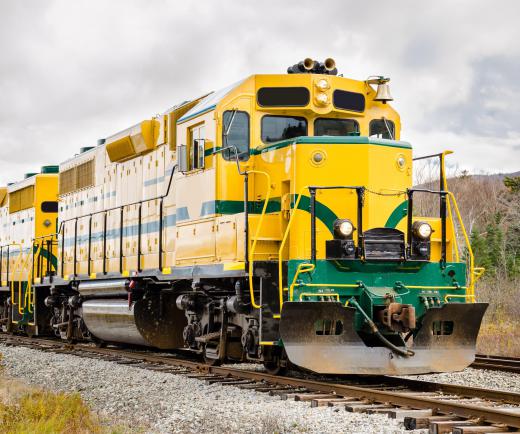
![Train spotters focus on identifying or cataloging the sightings and movement of specific trains or pieces of rolling stock, such as locomotive engines.]() By: alpegorTrain spotters focus on identifying or cataloging the sightings and movement of specific trains or pieces of rolling stock, such as locomotive engines.
By: alpegorTrain spotters focus on identifying or cataloging the sightings and movement of specific trains or pieces of rolling stock, such as locomotive engines. -
![Individual pieces of rolling stock, such as tank cars that carry liquefied natural gas, can be tracked by trainspotters using the numbers that are stenciled on their sides.]() By: Dmitriy SladkovIndividual pieces of rolling stock, such as tank cars that carry liquefied natural gas, can be tracked by trainspotters using the numbers that are stenciled on their sides.
By: Dmitriy SladkovIndividual pieces of rolling stock, such as tank cars that carry liquefied natural gas, can be tracked by trainspotters using the numbers that are stenciled on their sides. -
![Train spotters may be able to spot problems on a track and prevent an accident.]() By: Mikhail UlyannikovTrain spotters may be able to spot problems on a track and prevent an accident.
By: Mikhail UlyannikovTrain spotters may be able to spot problems on a track and prevent an accident.


Discussion Comments
Watching and obsessing over sports is just as pointless, but millions and millions of people do it. Trainspotting is a hobby geared more towards introverts, however, and people are often suspicious of such.
Anybody have any idea where a massive train spotter would love to go for the night? I am unsure where to start when planning a day trip for my boyfriend who loves trains. Any help please.
But do any of them actually get to touch the train's buffers? Apparently, it is not officially classed as a 'sighting' unless you lay your hands on the buffers. Sounds weird, but allegedly true.
It's like fishing, birdwatching or being in a relationship.
Oh, for heaven's sake, guys, leave them alone! They're not doing any harm. So what if someone wants to head along to their local station and sit watching the trains go by? So what if they want to keep a record of what they've seen and have a challenge with trying to find all trains of a certain type? If they want to do that, then that is their choice.
Of course they don't get paid to do it. Many 'spotters' do their hobby in their spare time. Many are retired, so they don't need to work. Trainspotting gets people out the house and in the fresh air. They meet up with friends and spend time just enjoying their hobby.
All in all, it may seem boring or sad to many people, but to them it is a hobby and they enjoy it.
I love train spotting. I have been following trains since I was a lad. I usually head down to the local station with my notebook, pencil, camera, a spam sandwich and flask of coffee and get comfy for a day of spotting, as I like to call it.
I find this the most non-productive pastime 'entertainment' there is. How can this be of any benefit to the person him/herself? However, being a hobby, I suppose, being 'purposeful' does not come into it. Do they do these things during their holiday, because it must take a lot of time to wait for the trains, and do they travel from town to town? A very intriguing hobby. --RMS
It's a hobby. For example, some people enjoy soccer and some think it's boring. It's all a matter of taste. Don't belittle someone else's interests just because they do not appeal to you. Rude and negative remarks only reflect your close-mindedness and possible immaturity.
So I was having lunch at an airport (small, local, private) today and a group of six guys (nerdy looking, English accents) came in with binoculars around their necks and pen and notebook in hand. They were looking at planes, jotting down info in their notebooks. So? What do you think? Terrorists or plane spotters?
Don't knock it 'til you try it. Subjectivity can mean that negative views are held on any pastime. Get out of your negative mind sets guys. The definition of train spotting in this article hardly does it justice.
Trainspotting seems like the most boring, most pointless, time-wasting hobby ever. Do they get paid or something, because how could they spend so much time not earning any money? i'm guessing good trainspotting means a lot of time and no work done!
Let's not pretend that Trainspotting is a dedicated pursuit of those that have some specialist hobby or gift to humanity. Trainspotting is a term or reference used for people that have far too much spare time on their hands, and have the ability to draw on useless information that seems relevant at the time. Thank God for trainspotters that have an ability to amaze, yet bore the heck out of most people.
Carlos. NZ
Post your comments