
At WiseGEEK, we're committed to delivering accurate, trustworthy information. Our expert-authored content is rigorously fact-checked and sourced from credible authorities. Discover how we uphold the highest standards in providing you with reliable knowledge.
What is Toughened Glass?
Toughened glass is created with uneven heating that causes the cooling glass to form layers instead of a solid sheet, making it much more resistant to impact than "annealed" glass. It isn't indestructible, but when it does give way, this glass comes apart in a spray of cube-like pellets rather than jagged shards.
The patent for this type of glass was first filed around the beginning of the 20th century, but its popularity has increased in recent decades because of its use in the automobile and construction industries, as well as in microwaveable glassware. Among the most common current uses are for side and rear windows and windshields in automobiles, display cases, patio doors, and shower doors.

The technique used to create toughened glass involves heating glass objects to beyond the annealing point of 1,112°F (600°C). How far beyond determines the varying grades of "toughening" — it can range from twice as strong as annealed glass to as much as six times the tensile strength. Once the glass is heated, the outside is rapidly and artificially cooled, usually by jets of cool air. This method solidifies only the outside, leaving the interior molten and fluid. That's what creates the various layers within the glass.
Because of its layering, the surface of this glass is more resistant to impact. The same thrown object that would create a single hole in a pane of annealed glass would likely bounce off a comparative pane of toughened glass. The downside is that, because the glass has more unity in its tensile strength, it would be more likely to explode completely if enough force was applied. This is sometimes a security concern, since once a window is breached, there are no glass shards to discourage entry. This glass is also more costly to produce, because of the extra step needed to cool the exterior. Curiously, it also has a softer surface that is more prone to scratches.
AS FEATURED ON:
AS FEATURED ON:









-
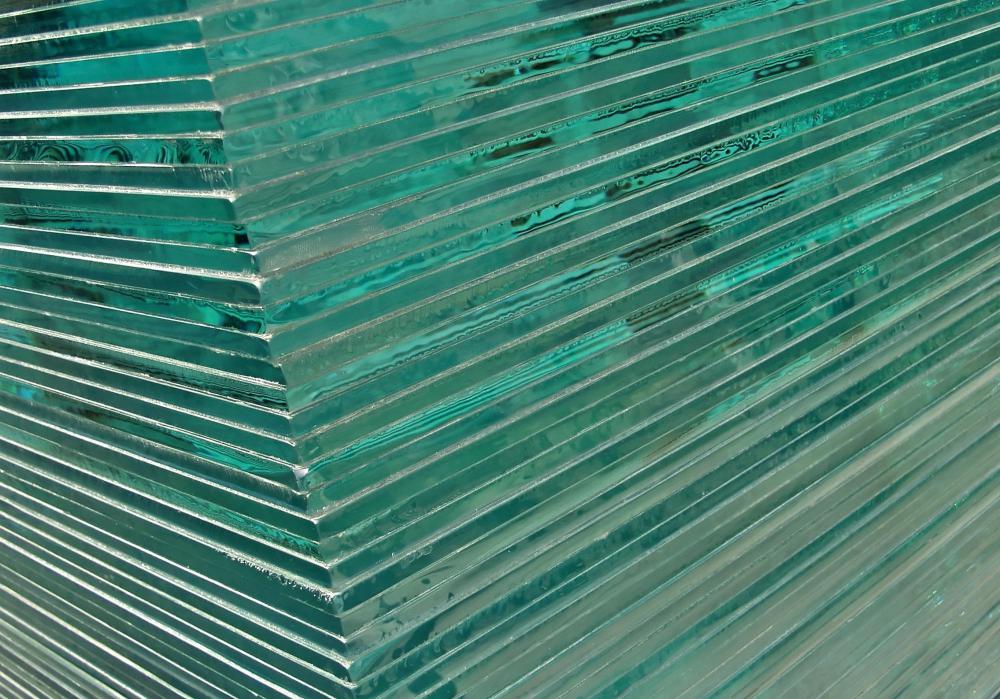
![Toughened glass.]() By: laurent dambiesToughened glass.
By: laurent dambiesToughened glass.
Discussion Comments
What could be the reasons for a toughened glass(used as a wall in an office space) to break on its own?
I was putting in a glass shower panel, and the bottom of the glass clipped the floor, and several slivers of glass broke off. Should this happen to toughened glass?
@bala221: This might happen due to problems during the toughening procedure. As a result, glass then has uneven stress around its surface and might break without any apparent cause.
tempered and toughened glass are the same, just different terminology.
The main reason for toughened glass to break on its own normally would be an impact on its edge but it can also break if it contains nickel sulphate which when it heats up it expands forcing the glass to break, also if there is too much thermal difference in the glass for example a window that is partly shaded but partly in the sun can expand at different rates and explode.
What is the difference between tempered glass and toughened glass?
can toughened glass be untoughened?
What could be the reasons for a toughened glass(used as a wall in an office space) to break on its own?
Post your comments