
At EasyTechJunkie, we're committed to delivering accurate, trustworthy information. Our expert-authored content is rigorously fact-checked and sourced from credible authorities. Discover how we uphold the highest standards in providing you with reliable knowledge.
What is Touch Typing?
 Mary McMahon
Mary McMahon
Mary McMahon
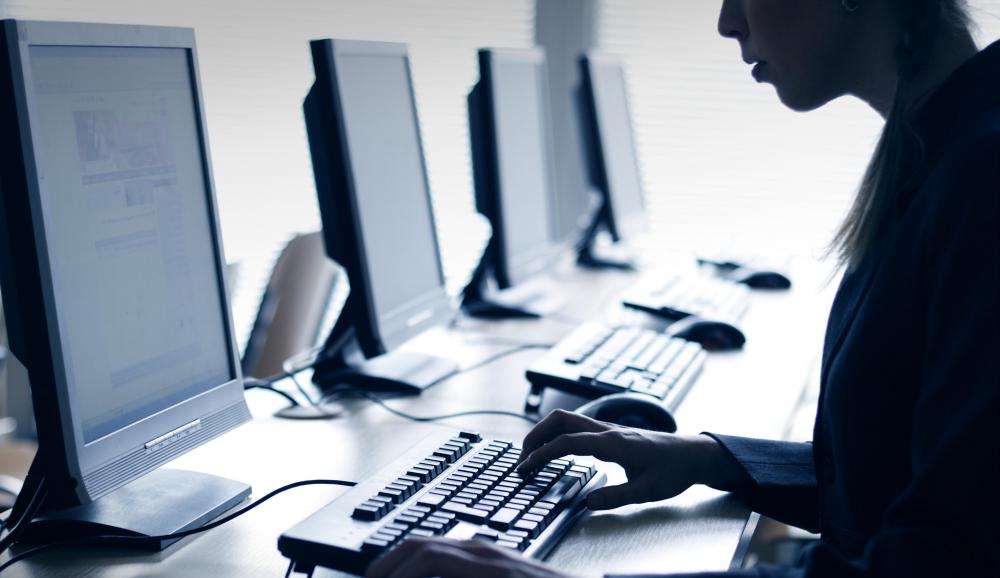
Touch typing is a typing technique in which people navigate the keyboard by touch alone, without looking at it. Typists rely on muscle memory to know that their hands are in the right place. This typing method is generally preferred by professional typists, and employers often ask secretaries and other people who will be working regularly with computers or typewriters to demonstrate such typing skills.
The development of touch typing appears to date back to the 1800s. Several different keyboard layouts can be used, with the QWERTY and Dvorak layouts being especially popular. In this method, the typist keeps his or her hands on a “home row” in the middle of the keyboard, reaching up or down with the fingers as needed to reach keys that lie outside the home row. People usually learn this style of typing by being shown a keyboard layout, and then asked to practice, with the typist eventually covering his or her hands and the keyboard so that the keys cannot be seen; experienced typists may periodically do this as a refresher to keep their skills sharp.

Learning touch typing is usually a fairly rapid process, and people can quickly achieve high typing speeds. This is in contrast with the so-called “hunt and peck” technique, in which people look at the keyboard to seek out the keys they need, activating them with their index fingers. This technique is much slower, and it can also create more strain on the hands.

Many high schools offer touch typing courses, and people can also learn online or with software, with the program providing typing prompts and tips that will help people pick up the skills quickly. The best way for individuals to learn is to practice diligently, and to make a habit of doing some typing every day to train the muscles so that they will remember the keyboard layout. Some people find that it helps to work with a different keyboard layout, as some layouts are more intuitive than others.

Touch typists can also work with stenography machines and other types of keyboards. Some typists are extremely fast, thanks to years of work experience and training, with world typing records approaching 200 words a minute. Typing speeds can also vary depending on the kind of material being typed, and the working conditions; it is easier to type quickly at an ergonomic desk, for example, and in a room with adequate lighting levels that are appropriate for the conditions.
Mary McMahon
Ever since she began contributing to the site several years ago, Mary has embraced the exciting challenge of being a EasyTechJunkie researcher and writer. Mary has a liberal arts degree from Goddard College and spends her free time reading, cooking, and exploring the great outdoors.
Learn more...
Mary McMahon
Ever since she began contributing to the site several years ago, Mary has embraced the exciting challenge of being a EasyTechJunkie researcher and writer. Mary has a liberal arts degree from Goddard College and spends her free time reading, cooking, and exploring the great outdoors.
Learn more...AS FEATURED ON:
AS FEATURED ON:









-
![The QWERTY keyboard layout is very popular.]() By: Dmytro ShevchenkoThe QWERTY keyboard layout is very popular.
By: Dmytro ShevchenkoThe QWERTY keyboard layout is very popular. -
![Typing courses are designed to help people pick up the basics of typing quickly.]() By: dellTyping courses are designed to help people pick up the basics of typing quickly.
By: dellTyping courses are designed to help people pick up the basics of typing quickly. -
![Touch typing is much more effective than the "hunt and peck" technique of typing.]() By: antiksuTouch typing is much more effective than the "hunt and peck" technique of typing.
By: antiksuTouch typing is much more effective than the "hunt and peck" technique of typing. -
![Typists rely on muscle memory to know that their hands are in the right place.]() By: KurhanTypists rely on muscle memory to know that their hands are in the right place.
By: KurhanTypists rely on muscle memory to know that their hands are in the right place.



Discussion Comments
Interesting list, thank you. But I think that in our time we can use online typing tutor. For example, Ratatype to Typing Club
This article is really good. I tested my typing speed many times!
I looked for any sites with typing tests and found interesting one. There are many interesting texts in typing tests and there are competitions!
My son is a pretty fast typist even though he is not very good about using the home row. Even when he was learning how to type in school he would get in trouble for not keeping his fingers on the correct keys.
I think once you are used to learning something like this, it can be hard to re train yourself to do it the correct way. He can type as fast or faster than many people who touch type without looking at the keys, so I don't see him making any changes.
I have been doing a lot of typing for as long as I can remember, and always remember being taught to use the home row when typing. This makes it so much easier and quicker.
I know my husband gets quite frustrated because he never really learned how to type correctly, and it takes him a long time to even send an email. He is constantly searching for the right keys.
This is something that doesn't take long to learn, and once you learn it the right way, you will be amazed at how much more efficient you are.
Sometimes I will find an online site where I can take free touch typing tests to see how fast I can type. There are many sites available like this, and you know what your score is right away.
I think that the ability to learn touch typing must stem from the same place as the ability to play the piano. Both can be programmed into the brain so that you can do them without looking.
After much rehearsal time, I can play a piece from memory without ever looking down. I don’t even need the sheet music. I don’t know how this happens, but it’s much in the same way that a blind person can be great at the piano.
Touch typing involves the same involuntary processes. Once you learn, it just comes out of your fingers without effort.
My dad is a computer genius, but he never learned how to touch type. They didn’t teach that back when he was in school, and he had to quit after 10th grade to help the family pick cotton, anyway.
He went to technical school and learned how to build, repair, and program computers. I can ask him anything about them, and he has the answer. However, it is ridiculous how much faster I can type than he can.
I often forget that he doesn’t know how until I see him picking at the keys like a chicken at corn. It is strange to see a man so knowledgeable struggling to type.
I type up manuscripts for an author for a living, and touch typing methods are invaluable to me. I’ve really gotten quite quick at it, and I can’t imagine not knowing how to do it.
Currently, I am typing several chapters a day on his fiction novel. It is 500 pages long, so I try to pace myself. I have a soft wrist rest pad that goes along the front of my keyboard to make typing easy on my joints.
I have one of those older keyboards with the raised keys that need to be pressed more than modern ones. I prefer this type to the keys that are so easy to press that you often can make mistakes by just a slight slip of the finger.
I am one of those people for whom touch typing just comes naturally. In high school, my typing class was my favorite class of all. We memorized QWERTY, and from there, it was a cinch.
I do remember using plenty of white-out to erase mistakes along the way, because this was back in the day when we used actual typewriters instead of computers. Mistakes had to be factored into words per minute. You subtracted them from your total to get your speed.
I believe I remember averaging about 60 words per minute in that class. Today, I’m sure it has increased significantly, because I type extensively at my job.
@GlassAxe - If you are looking how to learn how to type you should search for free software online that has typing instruction. Most is available as a quick download, and some programs even work via the Internet and are Flash. There are so many programs to choose from that you may want to read some online reviews before you settle on one.
If you aren't able to find software online that you like most unemployment offices offer free classes for skill upgrading. Last time I was in one they had typing classes and open computes that already had learning software installed. Most cities are well prepared for those who become unemployed, so you should go into your local unemployment office and see what skill upgrading they offer.
Thinking back to high school I remember how much I dreaded typing class. I can still picture them covering your hands with a piece of paper so you couldn't look down and cheat on your typing tests.
Luckily for me around the time I was preparing for my final typing exams instant messaging online started to really gain popularity.
For myself, I never learned how to type in the 'proper way', but I can now fully touch type thanks to spending so much time chatting online. I really wanted to be able to respond to my friends quickly, so memorizing the keys just started to come naturally. Luckily for me our test was more on accuracy and speed than where I was positioning my hands. I passed my typing test with flying colors all thanks to ICQ.
@Chicada- Your tips make a lot of sense. I never think about the keyboard when I purchase a laptop. I always look at the features, hardware, and aesthetics, even if the aesthetics can make the computer less comfortable to use. I learned to type at a young age, but I find that I am always hitting the delete or backspace key. I wonder if this is because I am using a keyboard that is not good for efficient typing. Thank you for the tips.
My advice to anyone learning to touch type is to find a laptop or keyboard that is comfortable with well-defined keys. As @framemaker stated in an earlier post, a poor keyboard layout can have a huge impact on typing speed.
For those with larger hands, it may be easier to type on a wider keyboard. This might mean opting for a larger keyboard, or using a smaller laptop without a number pad. A split keyboard can also help a person learn because it allows a person to hold their hands more naturally. This puts less strain on the hands, making for less hand adjusting.
@Glassxe- If you perform an internet search, you can find all kinds of free resources for touch typing software. I would recommend that you download the software form a reputable site like CNET, so you are not downloading malicious software. Beyond that, you can find programs that will have you typing like a pro in minutes.
After a few months of practice, you will be flying through the key s on your keyboard without even looking down. I used to landscape, but now I work in an office, so it is possible to improve your computer literacy.
Does anyone know of any touch typing tests or lessons that I can take free online? I lost my manufacturing job, and I need to improve my computer skills. I am not quite a poke and peck typist, but I am not very fast either. I always find myself looking back and forth between the keys and screen. I would be very grateful to anyone who can point me in the right direction. I need to improve my clerical skills so I can find a job. I thought this might be a good way to improve my skills while I am looking.
I could not imagine writing 200 words per minute. I could not even imagine my fingers moving that fast. That is something like 800-1200 keystrokes per minute, faster than most SLR cameras can take continuous shutter photos. Typing at those speeds is like typing one word in the blink of an eye.
I write for work, and I still cannot touch type 100% of the time. I usually spend about 60%-70% of the time looking at the screen, and the rest looking at the keyboard.
If I change the computer I am using, I also spend more time looking at the keyboard. I have found that different keyboards are different sizes, and the keys are slightly different shapes. Furthermore, some keyboards do not have space between the keys, making it nearly impossible to figure out where my hands are on the keyboard.
I wonder if I would be a better touch typist if I used a desktop instead of a notebook.
Post your comments