
At HomeQuestionsAnswered, we're committed to delivering accurate, trustworthy information. Our expert-authored content is rigorously fact-checked and sourced from credible authorities. Discover how we uphold the highest standards in providing you with reliable knowledge.
What is Tie Dye?
Tie dye is a technique for dying natural fabrics that results in interesting, colorful patterns. The technique involves crumpling, pleating or folding the fabric into various patterns, then tying it with string, which is what gives it its name. The tied fabric is dipped into vats of dye, then wrung out and rinsed. Tied areas accept dye unevenly amidst the folds, creating varied patterns in the finished product.
It is important for individuals to select natural fabrics to tie dye, as synthetics generally do not readily accept dye. Cotton is an excellent choice, making tie dyed T-shirts a favorite. People can also use this technique on silk scarves, bed sheets, blouses, skirts, and pants.

People commonly use three colors in the process, though they can use more or fewer, if desired. When using multiple colors, it's important for the crafter to choose those that will blend well to make interesting secondary colors in areas where the dyes fade into one another. Dye vats are prepared ahead of time in buckets or plastic tubs. Pots might be used to heat dye mixtures on the kitchen stove or a backyard grill.

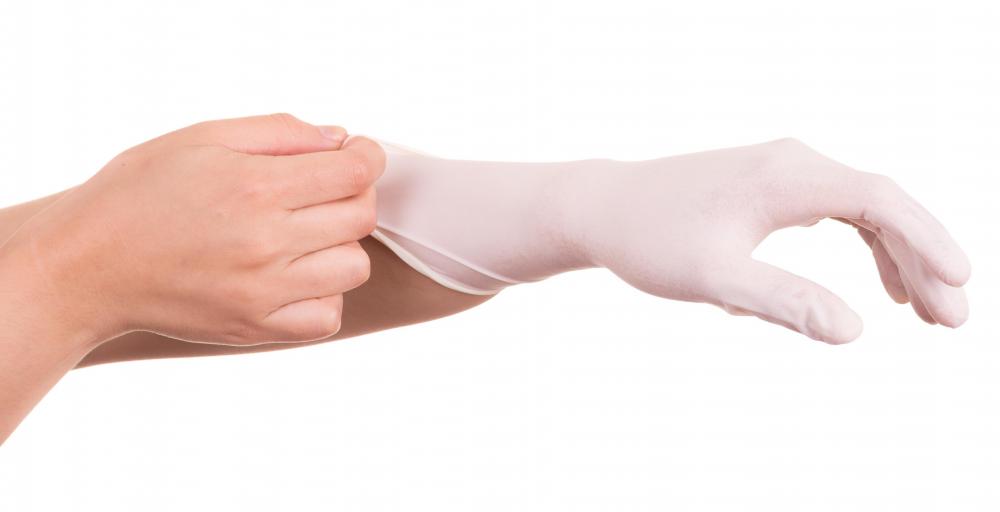
The first step in the tie dying process involves soaking the material to be dyed in soda ash. Crafters should wear protective gloves to protect their skin, choosing those that fit well, such as latex surgical gloves. About 0.5 cup (151 g) soda ash should be added to 1 gallon (3.79 liters) of water. The crafter can then immerse the fabric in the mixture for five to ten minutes, occasionally agitating the material. When finished, it should be wrung out to remove excess water, but the material should not be allowed to dry out.

Folding techniques determine resulting patterns in tie dye. Various books instruct the novice on how to create spirals, stripes, donuts and starbursts, among many other patterns. People can also experiment with their own techniques to get completely unique results. Once the fabric is folded, it’s time to bind it. Strings or rubber bands will do.
With the article tied, it’s ready to dip into a hot vat of dye, starting with the lightest color first. The fabric is left in the dye for four to seven minutes, then rinsed thoroughly with warm water before moving on to the next color. The hotter the vat and the longer the fabric stays in it, the deeper the color. Depending on the desired pattern, material may only be partially dipped into a particular color. If so, only the portion that was dipped needs to be rinsed.

When the crafter is finished dying the material, the tied article should be rinsed with warm water that is slowly cooled. The garment should be rinsed repeatedly until the water runs clear. Once this is done, the material can be untied and washed in a washing machine on gentle with a mild detergent, warm wash water and a cool rinse. The garment can be hung to dry or placed in a dryer. For routine care, tie dye items should be washed by themselves in cool water, although silk and other delicate fabrics can be dry cleaned as required.
AS FEATURED ON:
AS FEATURED ON:


-
![Choose complimentary colors when tie dying.]() By: nongpooChoose complimentary colors when tie dying.
By: nongpooChoose complimentary colors when tie dying. -
![A finished tie dye project.]() By: bellemediaA finished tie dye project.
By: bellemediaA finished tie dye project. -
![White cotton T-shirts are the simplest to tie dye.]() By: Thomas SztanekWhite cotton T-shirts are the simplest to tie dye.
By: Thomas SztanekWhite cotton T-shirts are the simplest to tie dye. -
![Soda ash, which is used in tie dyeing.]() By: Aaron AmatSoda ash, which is used in tie dyeing.
By: Aaron AmatSoda ash, which is used in tie dyeing. -
![Crafters should wear protective gloves to protect their skin, choosing those that fit well, such as latex surgical gloves.]() By: Sunshine PicsCrafters should wear protective gloves to protect their skin, choosing those that fit well, such as latex surgical gloves.
By: Sunshine PicsCrafters should wear protective gloves to protect their skin, choosing those that fit well, such as latex surgical gloves. -
![With practice, tie dye can be used to make beautiful, art-inspired designs.]() By: Natalya Solovyeva-KoWith practice, tie dye can be used to make beautiful, art-inspired designs.
By: Natalya Solovyeva-KoWith practice, tie dye can be used to make beautiful, art-inspired designs.



Discussion Comments
What is a disadvantage of tie dye?
Can you explain the history of tie dye and what people use it for?
Americans call it Tie dye, the Japanese call it Shibori and in India it's Bandhni. Bandhni was practised in India way before the Chinese did theirs.
does anybody know the advantages and disadvantage of tie dye? thanks.
I love tie dye but i am sick of researching it because I research it every single weekend for my art project.
no one know who first used tie dye. 2000 years ago, chinese used the tie dye method. in the Tang dynasty it is commonly used. japan keeps a tie dye work that was made in Tang dynasty of China in their palace and it is nationally precious.
I find it difficult to believe that anyone would post a reprimand for *not* advising people on the possibilities of Latex allergies.
One would imagine that someone with a Latex allergy might be aware of it and those that aren't allergic to latex (or don't know that they are) wouldn't pay much attention to such a warning anyway.
Isn't it bad enough that we live in such a litigious society already? Where does self-responsibility start? Do we no longer have to think for ourselves and use our common sense?
I personally don't believe it should be necessary to warn people of the perils of all, unless anon18317 would have us advising of the possible side effects of soda ash, warm water, fabric ... the list goes on and we can easily reach the ridiculous.
Thanks for a very informative article; my question has been answered despite warnings of latex use.
tie dye is thousands of years old for south Africa.
Do you think it is responsible advising people to use Latex Gloves and not warning them about the risk of having a Latex allergy and the serious consequences that it can cause.
In extreme cases a person can die from a Latex Allergy.
does anybody know when tie dye was first used?
Post your comments