
At WiseGEEK, we're committed to delivering accurate, trustworthy information. Our expert-authored content is rigorously fact-checked and sourced from credible authorities. Discover how we uphold the highest standards in providing you with reliable knowledge.
What Is the Warmest Time of the Day?
The warmest time of day depends to some extent on precise geographic location, but in most places it’s somewhere between 3:00 and 6:00 p.m., and the daily high temperature is usually recorded between 5:30 and 6:30 p.m. This is not usually the time of day when the sun is most intense, but intensity and high temperatures don’t always go hand in hand. In most places it takes a few hours for the sun’s rays to be absorbed into the environment, a phenomenon known as “thermal response.” People who are planning to spend a lot of time outdoors during the warmest time of day should typically drink a lot of water to stay hydrated, and avoiding strenuous activities is usually recommended as well.
Understanding Thermal Response

Nearly all parts of the Earth have the greatest amount of sun exposure during the early afternoon hours, but it takes time to actually heat the surface. The delay between maximum sun exposure and the warmest time of the day is called thermal response. How long it takes depends on latitude and the time of year, which means that different places will have different warmest times, often by as much as a few hours. Locations on or near the equator often experience peak warmth in the early afternoon, for instance, while those closer to either pole tend to get warmest much later.
UV Rays

As a general rule, it takes about three to four hours after the moment of highest solar intensity to achieve maximum warmth. In most places the sun is most intense somewhere between 10:00 a.m. and 2:00 p.m. People usually run the greatest risk of sunburn and skin damage during this window since the concentration of ultraviolet rays tends to be highest, but heatstroke and exhaustion are most common later in the day, when the sun’s energy has warmed the environment.

Warmth and ultraviolet (UV) concentration don’t usually go together, in other words. People who are sensitive to the sun or prone to sunburn often find it preferable to be outdoors later in the day to avoid intensive solar exposure. The environment is usually warm in the late afternoon because the sun’s rays have warmed it previously, and in most cases the majority of harmful rays have dissipated by the time maximum temperatures are achieved.
Importance of Hydration

Just because the sun is setting doesn’t mean that heat-related dangers have gone away, though, and for many people the warmest time of day is actually the most dangerous, at least in terms of exhaustion and dehydration. Staying hydrated during the heat of the day is vital to preventing heat stroke and other heat related problems. Water and juices are usually the best choices; alcoholic and caffeinated beverages are known as “diuretics,” which means that they can actually dehydrate the body, making things worse in most cases.
Understanding Sweat Rate

People who plan to perform a vigorous activity on hot days may find that it’s useful to know their sweat rate, and making the calculation is fairly simple. A person starts by weighing himself naked before a workout. After he's done, he should towel off and weigh himself again. The difference will be what he has lost while exercising. This weight difference should replaced with water, but not excessively; too much water comes with its own set of problems. Usually drinking only what was lost or slightly more is the best course.
Risks and Precautions
It is a good idea to avoid strenuous activity during the warmest time of the day, especially running, even for people in good health. High intensity cardiovascular workouts require a great deal from the body. If the body can’t sweat due to humidity or the evaporating sweat doesn’t cool a person off fast enough, he or she could be in danger of heat stroke or heat exhaustion.
Heat-related illnesses can have a variety of symptoms. Anyone who feels suddenly lightheaded, sick to his or her stomach, headachy or even confused during the warmest time of the day typically needs to cool off and get some water. Once these symptoms appear, it’s usually best to take a break, drink some water, and call it a day no matter what time it is.
AS FEATURED ON:
AS FEATURED ON:









-
![Although the sun shines brightest in early afternoon, the warmest time of day is early evening.]() By: rangizzzAlthough the sun shines brightest in early afternoon, the warmest time of day is early evening.
By: rangizzzAlthough the sun shines brightest in early afternoon, the warmest time of day is early evening. -
![Heat exhaustion can happen at any time of day.]() By: roboriginalHeat exhaustion can happen at any time of day.
By: roboriginalHeat exhaustion can happen at any time of day. -
![People planning to be outside during the hottest part of the day should drink plenty of water to stay hydrated.]() By: lithianPeople planning to be outside during the hottest part of the day should drink plenty of water to stay hydrated.
By: lithianPeople planning to be outside during the hottest part of the day should drink plenty of water to stay hydrated. -
![If left untreated, heat exhaustion can develop into heat stroke, a more dangerous condition.]() By: MaridavIf left untreated, heat exhaustion can develop into heat stroke, a more dangerous condition.
By: MaridavIf left untreated, heat exhaustion can develop into heat stroke, a more dangerous condition. -
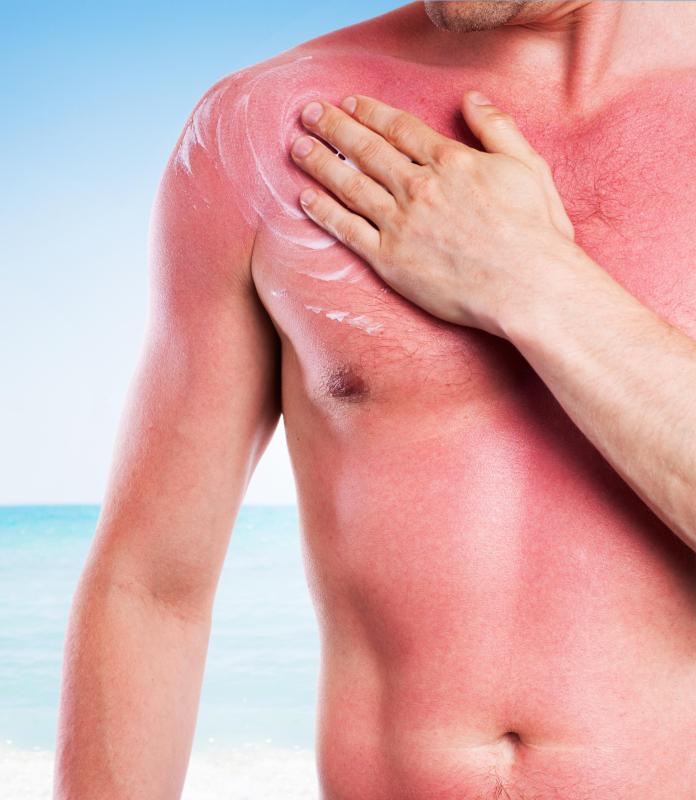
![People are most at risk of developing a sunburn between 10 am and 2 pm.]() By: Rostislav SedlacekPeople are most at risk of developing a sunburn between 10 am and 2 pm.
By: Rostislav SedlacekPeople are most at risk of developing a sunburn between 10 am and 2 pm.


Discussion Comments
My husband works outside all the time and he has to be really careful during the hottest days of summer. They try to start as early in the morning as they can so they can be done by around 3:00 p.m. Even though it is really hot outside, they are done before the warmest time of the day.
He also has to make sure there is plenty of water for everyone to drink. For new guys just starting out they don't always realize how important this is. He has had workers end up with heat exhaustion because they didn't drink enough water when they are out in the hot sun. This usually always happen in the early to late afternoon, which happens to be the hottest time of day.
I like to run outside and when it is hot outside, the earlier I can get this done in the day the better it is. If I wait until after work, that is the hottest time of the day and can actually be dangerous. I have seen people running outside during that time of day but don't know how they do it. I think they would lose a lot just from sweating so much.
I feel drained if I am trying to do any physical activity during the warmest time of the day if the sun is beating down on me. If the humidity is really high and the temperature is around 90 degrees I almost feel like I am suffocating when I am outside.
In the early morning it may be warm, but the sun isn't that hot yet and it is much easier to get my run in.
@cmsmith10 -- I have gotten sunburned when I have been snow skiing and it isn't very warm outside. I think being in the mountains you are closer to the UV rays of the sun and it doesn't take much to get a sunburn. When we are skiing in the winter I think the warmest time of the day is early afternoon when the sun is high in the sky. Once it starts going down, it cools off very quickly.
@kylee07drg – Yes, it does take longer to warm up. I've found that the water is chillier in the early afternoon than late in the day.
Even when the air temperature starts to cool off around 7:00 in the evening, the water feels warmer. I usually hit the pool between 6:00 and 8:00, and in the middle of summer, it feels almost like a hot tub at this time!
It's strange that I can actually feel the water getting hotter as the day cools down a bit. Still, it provides relief from the heat, because you have the cooler air around you mixing with the warm water.
I know that water takes longer to heat up than air. Can anyone tell me what the warmest time to jump in the pool would be?
@StarJo – You are right about that. I've also noticed that in spring, as the days start to get longer but we haven't set our clocks forward yet, the warmest time of day is about the same as in fall.
I absolutely love being able to replace my warmest coat with a lighter jacket. I go outside during the afternoon to really get the full effect of spring's warmth, even if it is just a slight one.
It depends on the season. If you go outdoors in fall or winter around 5:00 p.m., even the warmest winter jacket won't keep you from feeling the chill.
I have found that after the time change in fall, the warmest time of day shifts to between 2:00 and 3:00 p.m. Any later than this, and the sun will be so low that the chill will start to deepen.
I like finding a spot in my yard that is blocked from the north wind between 2:00 and 3:00 p.m. I will sit there and soak up the little bit of warmth that the sun offers in this season, and it feels so nice!
I always remember I always had one coach that complained about people getting too hot around 5:00 pm, which was less than an hour before practice ended, and he would say "Come on boys, it's not even noon!"
I kind of wish now that he had read this article and taken into account all the factors, like the Earth heating and the sun bearing down, because sometimes water would not be readily provided at this point in the day, because the coaches felt practice was about over and that it was later in the day, so it could not be near as hot as what people felt.
Whenever I was playing a baseball game, I always felt that on a clear day the sun was always bearing down around 5:00 pm and any player on the field, that was not strong headed about their belief, could attest that they felt a lot hotter at this point in the day, as opposed to at noon.
Some people on the team would try and say that the hottest time of day was around 2:00 pm and although it is hotter than noon, it definitely did not feel the same as it did a few hours later.
My thoughts concerning it revolve around the fact that the sun has been heating the Earth since the morning and even though nightfall would only come a few hours later, the sun is still very bright in the sky and the ground is as hot as it is going to be.
I tried explaining to someone once that, in the middle of the summer, the sun rose at around 4:30 am at the earliest, where I live, and set around 9:00 pm. Going by the mid point of the duration of daylight it would mean that it would not be high noon, but rather around 1:30 or 2:00 in the afternoon.
@pleonasm - Yeah, but you also want to make sure you're getting your vitamin D for the day as well. Lots of people get depressed because they don't expose themselves to enough sun. It's a matter of balance.
It's actually a pretty good idea to go outside at the warmer part of the day (in the early evening, as it says in the article) because you won't be exposed to as much radiation (because the sun is having to push its rays through more atmosphere the lower it sinks on the horizon) and the wind tends to drop around that time as well. So, you can get your sun fix without putting your skin in too much danger.
@calabama71 - Yeah, unfortunately people make that kind of mistake all the time. The other thing to bear in mind is that even if you're not getting burned, you are probably doing damage to your skin by being out in the sun unprotected. It doesn't have to burn to get damaged.
All you have to do is look at pictures of older people who live in cold regions. They still have wrinkly skin and those wrinkles are usually caused by sun damage.
@cmsmith10: Absolutely. It is the UV rays of the sun that burn our skin. It really doesn’t have anything to do with the temperature. I have gotten sunburned pretty badly on a cloudy day.
Can you get sunburned even if it's not hot outside?
Post your comments