
At WiseGEEK, we're committed to delivering accurate, trustworthy information. Our expert-authored content is rigorously fact-checked and sourced from credible authorities. Discover how we uphold the highest standards in providing you with reliable knowledge.
What is the Urinary Bladder?
The urinary bladder is an organ in the urinary system. The organ, or a form of it, is present in most animals. It is used to hold a waste product called urea until it can be removed from the body through urination.
The urinary bladder is a sac that is used to store urea and water until it can be eliminated from the body. In most mammals, this organ can expand to many times its original size. In marsupials, birds and many reptiles and amphibians, the urinary bladder exists as a pocket in the cloaca, which is part of a system that eliminates both solid and liquid waste. Fish also possess a urinary bladder, though it is less developed than the bladder found in other animals.
The bladder is located in the lower part of the abdomen, just above the pelvic bone in mammals. In human women, the organ is situated between the vagina and uterus. In men, it is in front of the prostate gland.

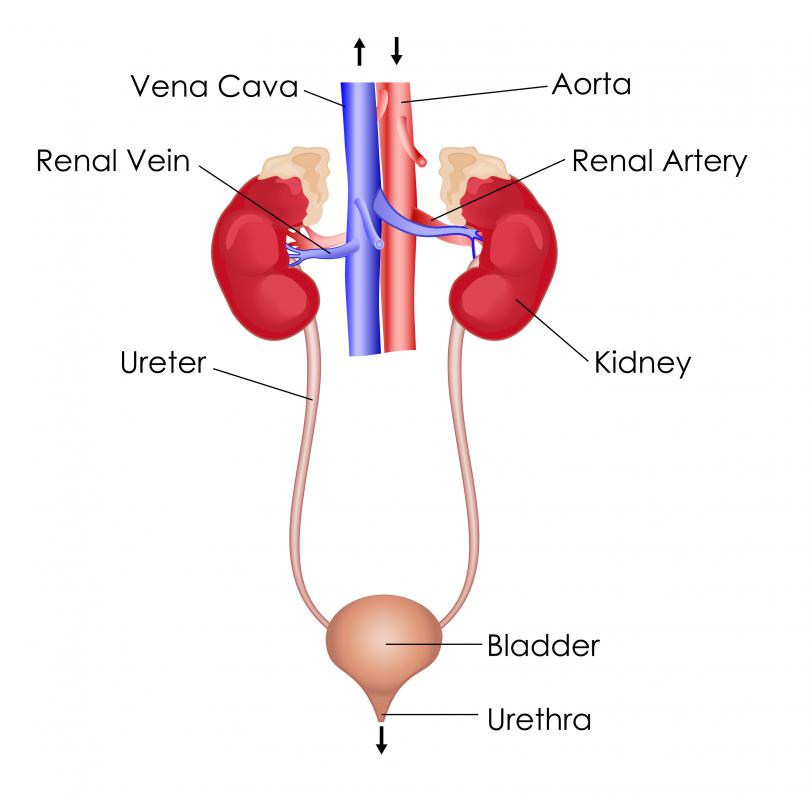
In humans, the urinary system is composed of the kidneys, ureters, bladder, sphincter muscles and urethra. When protein is broken down by the digestive system, a waste product called urea is created. This waste exists in the blood until it is transported to the kidneys, which filter the urea from the blood. The waste product is combined with water and then passed down to the urinary bladder through the ureters. Usually, the kidneys eliminate urea and water, called urine, every 10 to 15 seconds.

Once in the bladder, urea waste and water — or urine — is stored until it is convenient to eliminate it from the body. A healthy human bladder can hold up to 16 ounces (about 0.5 liters) of urine for two to five hours. After this, the urine must be eliminated from the body through the urethra. The muscles of the bladder contract while the sphincter muscles relax, allowing the urine to flow out of the bladder, through the urethra and out of the body. Most mammals are able to control these muscles, selecting both when to urinate and how much fluid to eliminate.

Problems with the urinary bladder are relatively common. If the bladder does not empty completely, the waste inside can cause an infection in the lining of the organ. Left untreated, this infection can climb to the kidneys, which can lead to a more serious infection. Antibiotics are readily available in most parts of the world to treat bladder infections quickly. The urinary bladder is also prone to developing calcium deposits called stones.
AS FEATURED ON:
AS FEATURED ON:









-
![A cutaway of a female body, showing the bladder in dark pink.]() By: kocakayaaliA cutaway of a female body, showing the bladder in dark pink.
By: kocakayaaliA cutaway of a female body, showing the bladder in dark pink. -
![The bladder is part of the larger urinary system, which filters out waste from the body.]() By: snapgalleriaThe bladder is part of the larger urinary system, which filters out waste from the body.
By: snapgalleriaThe bladder is part of the larger urinary system, which filters out waste from the body. -
![In men, the urinary bladder is in front of the prostate.]() By: tomschoumakersIn men, the urinary bladder is in front of the prostate.
By: tomschoumakersIn men, the urinary bladder is in front of the prostate. -
![Individuals recovering from a bladder infection should drink plenty of water.]() By: koszivuIndividuals recovering from a bladder infection should drink plenty of water.
By: koszivuIndividuals recovering from a bladder infection should drink plenty of water. -
![Individuals who experience frequent bladder infections may have an increased risk for developing bladder cancer.]() By: joshyaIndividuals who experience frequent bladder infections may have an increased risk for developing bladder cancer.
By: joshyaIndividuals who experience frequent bladder infections may have an increased risk for developing bladder cancer.



Discussion Comments
My cousin had urinary bladder stones once, and this caused him a lot of pain. He couldn't seem to empty his bladder all the way, and he even saw blood in his urine.
When he saw the blood, he found the motivation to see his doctor. It turned out that the stones were not big enough for him to pass simply by drinking more water, so the doctor had to do surgery.
He broke up the stones with a laser. Then, he flushed out the small bits of stone.
My cousin decided to start drinking more water and cut down on soda. He never wanted to go through that again.
I'm always afraid to hold my urine for too long, because I've heard this can lead to urinary bladder problems. Even if I have to go out in the woods somewhere, I make it a point to go when I need to go.
This can be problematic at times, because I really need to urinate about once an hour. My friends have all commented that I have to go to the bathroom a lot, but I suppose this is because I drink a lot of water. This seems like a healthy thing to me, because I'm flushing out my toxins.
The most inconvenient part of having to urinate so often is having to get up at night. At least I don't have to go every hour then, but I generally wake up once or twice during the night with the strong urge to urinate. The bathroom is all the way on the other end of the house, so this is really a pain.
@OeKc05 – The cranberry cure only works if you catch the infection early. If you wait several days, it is usually so pervasive that you have to get antibiotics. At least, that has been my experience.
I have waited far too long to get treatment for an infection before, and it traveled to my kidneys. That's when I felt really sick. I woke up and ran to the bathroom, and I had to vomit.
I had been feeling soreness in my lower back and sides for a couple of days. That should have been a sign that my kidneys were affected, but I was too stubborn about going to the doctor to do anything about it.
I had to take strong antibiotics for two weeks to get over it. The symptoms disappeared before I was done with the antibiotics, but I took them all anyway. I didn't want the bacteria to become resistant to them.
I get urinary bladder infections rather often. I have learned to recognize the symptoms, and they are rather unpleasant.
First, I notice that I have to urinate way too frequently. I feel the need to go every 30 minutes or so. Also, the urine feels warmer than it should.
Also, I get bladder cramps. They aren't terribly painful, but they are bothersome.
Sometimes, I have to get antibiotics to get better. However, I have found that it is possible to get rid of a urinary bladder infection by drinking two glasses of cranberry juice a day and taking cranberry supplements, and it also helps to drink plenty of water. The cranberry juice keeps the bacteria from clinging to the urethra, and all that liquid helps flush the bacteria out.
Post your comments