
At TheHealthBoard, we're committed to delivering accurate, trustworthy information. Our expert-authored content is rigorously fact-checked and sourced from credible authorities. Discover how we uphold the highest standards in providing you with reliable knowledge.
What is the Trendelenburg Position?
 Mary McMahon
Mary McMahon
Mary McMahon
The Trendelenburg position, named for Doctor Friedrich Trendelenburg, is a patient position that is used for certain kinds of medical procedures. When a patient is placed in this position, he or she is lying face up, and the table on which the patient lies is angled so that the feet are above the head. In the reverse position, the patient's orientation is switched so that the head lies above the feet.
This patient position was originally developed for use in surgery and it is still sometimes used in this way. For gynecological and abdominal surgeries, tilting the head down can pull the intestines out of the pelvis, creating a clearer surgical field that is easier to see and work in. This position is also sometimes used when a medical professional is attempting to turn a baby before birth, as reversing the usual pull of gravity creates more room to rotate the baby so that he or she will not be in a breech position.

Historically, the Trendelenburg position was recommended for people recovering from shock, people who need increased cerebral perfusion, people in anaphylaxis, and divers in recovery from deep dives. The medical literature now suggests that this is actually not wise, however, because patients in this position are at increased risk of airway problems and may aspirate vomit and other fluids. For this reason, many practitioners no longer routinely use it on patients in these situations.

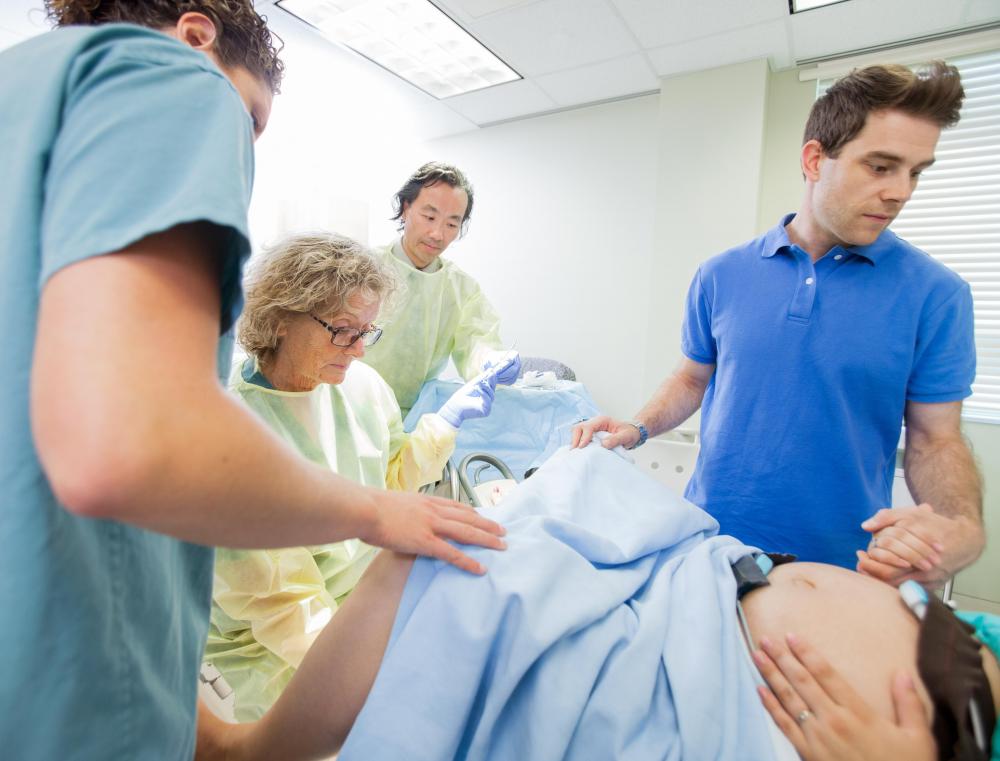
Another case in which this patient position may be used is during labor. If there are concerns about the umbilical cord being pressured and cutting off the supply of oxygen to the baby, lying in this position can relieve the pressure and may also provide working room for the delivery attendant to move the cord to reduce the risks of delivery. Some women may also find that lying in this position helps with the cramps associated with menstruation.

More infamously, this position is used in the torture tactic known as “waterboarding.” Because the person's airway can already be subject to obstruction in this position, the sense of simulated drowning is heightened when he or she is subjected to waterboarding. It can also be easier to control subjects when they are strapped to a table in an upside down position.
Mary McMahon
Ever since she began contributing to the site several years ago, Mary has embraced the exciting challenge of being a TheHealthBoard researcher and writer. Mary has a liberal arts degree from Goddard College and spends her free time reading, cooking, and exploring the great outdoors.
Learn more...
Mary McMahon
Ever since she began contributing to the site several years ago, Mary has embraced the exciting challenge of being a TheHealthBoard researcher and writer. Mary has a liberal arts degree from Goddard College and spends her free time reading, cooking, and exploring the great outdoors.
Learn more...AS FEATURED ON:
AS FEATURED ON:


-
![The Trendelenburg position may help alleviate menstrual cramps.]() By: matka_WariatkaThe Trendelenburg position may help alleviate menstrual cramps.
By: matka_WariatkaThe Trendelenburg position may help alleviate menstrual cramps. -
![The Trendelenburg position may be used during labor.]() By: Tyler OlsonThe Trendelenburg position may be used during labor.
By: Tyler OlsonThe Trendelenburg position may be used during labor. -
![Some women may find that lying in the Trendelenburg position helps with cramps associated with menstruation.]() By: reinegSome women may find that lying in the Trendelenburg position helps with cramps associated with menstruation.
By: reinegSome women may find that lying in the Trendelenburg position helps with cramps associated with menstruation.


Discussion Comments
What is the minimum acceptable degree of Trendelenberg during labor and delivery?
@MissDaphne - No, they're quite different. Natural birth midwives will sometimes use the Trendelenburg bed position for things like a swollen cervix--it gets the pressure off. But you'll never catch them using the lithotomy position!
In the lithotomy position, the patient lies flat on his or her back with legs in stirrups. As a childbirth position, it is super convenient for the doctor but not at all appropriate for the mom, who then is working against gravity and in a very painful position. (For me, the worst part of my labor was when I had to lie flat on my back waiting for my epidural to kick in.)
Is the Trendelenburg position similar to the lithotomy position? I've heard of both of them in conjunction with childbirth with negative connotations. Although it sounds like there are legitimate medical reasons for the Trendelenburg--but it sounds awful!
Post your comments