
At TheHealthBoard, we're committed to delivering accurate, trustworthy information. Our expert-authored content is rigorously fact-checked and sourced from credible authorities. Discover how we uphold the highest standards in providing you with reliable knowledge.
What is the Trachea?
The trachea, or windpipe, is the tube that connects the nose and mouth to the lungs. It is an important part of the respiratory system because, when a person breathes in, air flows into the lungs through the windpipe. Any damage to it is potentially life-threatening because of its role in respiration.
Structure

The windpipe is comprised of cartilage and ligaments and is located at the front of the neck. It begins at the lower part of the larynx, or voice box, and continues to the lungs, where it branches into the right and left bronchi. The trachea typically measures 3.9 to 4.7 inches (10 to 12 cm) in length and 0.6 to 0.7 inches (16 to 18 mm) in diameter. It is composed of 16 to 20 C-shaped rings of cartilage connected by ligaments, with a cilia-lined mucus membrane. This structure helps push objects out of the airway if something becomes lodged.
Choking and Coughing

The trachea is connected to the same tubing system that allows a person to swallow, so the respiratory system has a mechanism to prevent respiratory failures. When an object blocks the windpipe, choking occurs. The coughing reflex allows the ciliated cells to push the object out of the respiratory system.
Damage and Repair
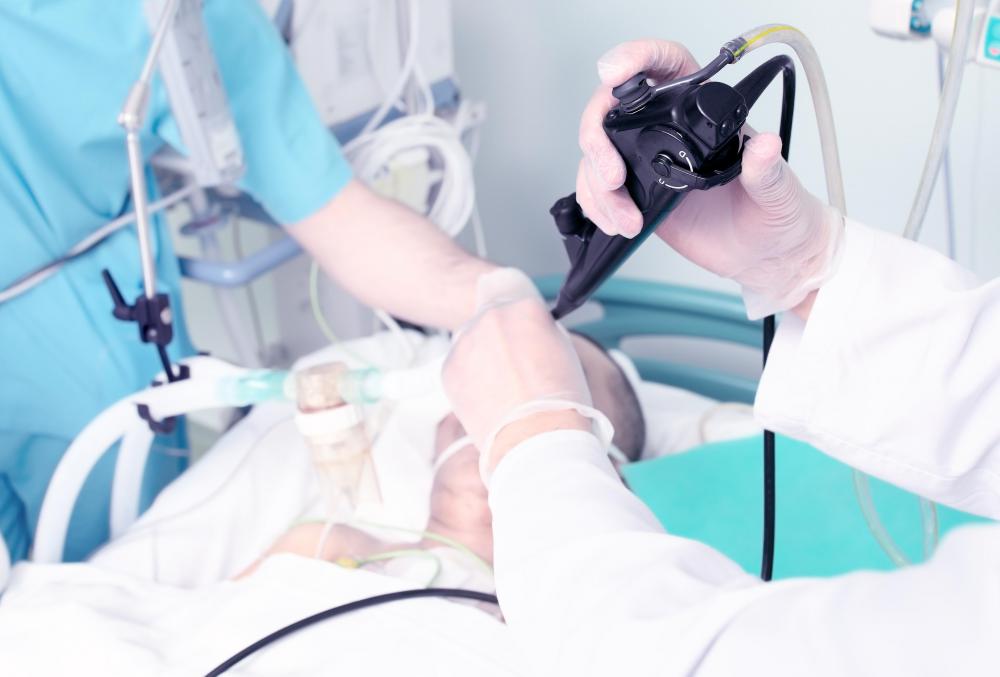
Any damage to the windpipe could seriously impair respiration. If it is damaged, a procedure known as intubation might be necessary. In this procedure, a medical professional places a tube in the nose or mouth and down to the trachea to get air to the lungs. The presence of fractures or inflammation in the trachea might require that a medical professional perform a surgical procedure called a tracheotomy to clear the airway. This procedure, which is performed while the patient is under general anesthesia, involves the surgeon making an incision in the throat area to create a hole in the windpipe, through which a tube is inserted to provide ventilation.
Medical Conditions

Inflammation of the windpipe can lead to other conditions, such as tracheitis, which is the inflammation of the tracheal lining. Tracheobronchitis occurs when the mucous membrane of the windpipe and bronchi become swollen, and tracheomalacia occurs when the connective nerve tissue in the area degenerates. Infections might result in what is referred to as tracheomegaly. A collapsed trachea, which is caused by defects in the cartilage that makes it unable to support the windpipe, can result in a dry, hacking cough. To detect and treat abnormalities associated with the trachea, computed tomography (CT) scans are often used.
AS FEATURED ON:
AS FEATURED ON:


-
![The human respiratory system with the trachea shown in red and white stripes.]() By: Alexandr MitiucThe human respiratory system with the trachea shown in red and white stripes.
By: Alexandr MitiucThe human respiratory system with the trachea shown in red and white stripes. -
![The coughing reflex helps to push an object out of the respiratory system.]() By: Ljupco SmokovskiThe coughing reflex helps to push an object out of the respiratory system.
By: Ljupco SmokovskiThe coughing reflex helps to push an object out of the respiratory system. -
![The trachea is commonly called the windpipe.]() By: Alila Medical MediaThe trachea is commonly called the windpipe.
By: Alila Medical MediaThe trachea is commonly called the windpipe. -
![Inflammation of the windpipe can lead to tracheitis.]() By: Artem FurmanInflammation of the windpipe can lead to tracheitis.
By: Artem FurmanInflammation of the windpipe can lead to tracheitis. -
![Intubation may be necessary for patients suffering from windpipe damage.]() By: sudok1Intubation may be necessary for patients suffering from windpipe damage.
By: sudok1Intubation may be necessary for patients suffering from windpipe damage. -
![A blocked trachea can lead to choking.]() By: nebariA blocked trachea can lead to choking.
By: nebariA blocked trachea can lead to choking.





Discussion Comments
First there's the trachea, then there's the bronchus that splits into the lungs and then breaks off into bronchioles, then the 3-4 million alveoli.
What is the tube that flows from the nose to the windpipe?
Can a tracheotomy be reversed?
i was diagnosed with thyroid cancer, so three weeks ago i had it removed with a mass attached to it that was positive for papillary cancer and now the doctor says i have cancer in my trachea. i don't know what to expect. does anyone know anything to help me?
I've been diagnosed with Tracheomalacia, and my question is can the trachea become weakened at night when one lies down to sleep?
I experience a very loud gurgling sound in my throat when inhaling and a feeling of a drip in the back of my throat. the little bit of muccus that may be present is clear or white. I can only sleep in a upright position. Any thoughts shared would be most appreciated.
I'm doing a project on the trachea. help?
So for the person that's doing the project. you could want the trachea for choking you. because that's what makes you choke. (answer to # 7)
I am doing a project on the trachea. Really it's a wanted poster. it says criminal charge but what could you want a trachea for?
if a person has a hole in their trachea can there be life long problems or even possible death if it is not treated?
what is it that the trachea does not do when swallowing
It's the cilia that's affected by smoking. The smoke makes them stop moving, and if they aren't moving then they aren't working to remove the things that should not be in the trachea.
It's the cilia that's affected by smoking. The smoke makes them stop moving, and if they aren't moving then they aren't working to remove the things that shouldn't be in the trachea.
Post your comments