
At TheHealthBoard, we're committed to delivering accurate, trustworthy information. Our expert-authored content is rigorously fact-checked and sourced from credible authorities. Discover how we uphold the highest standards in providing you with reliable knowledge.
What Is the Role of Peristalsis in the Digestive System?
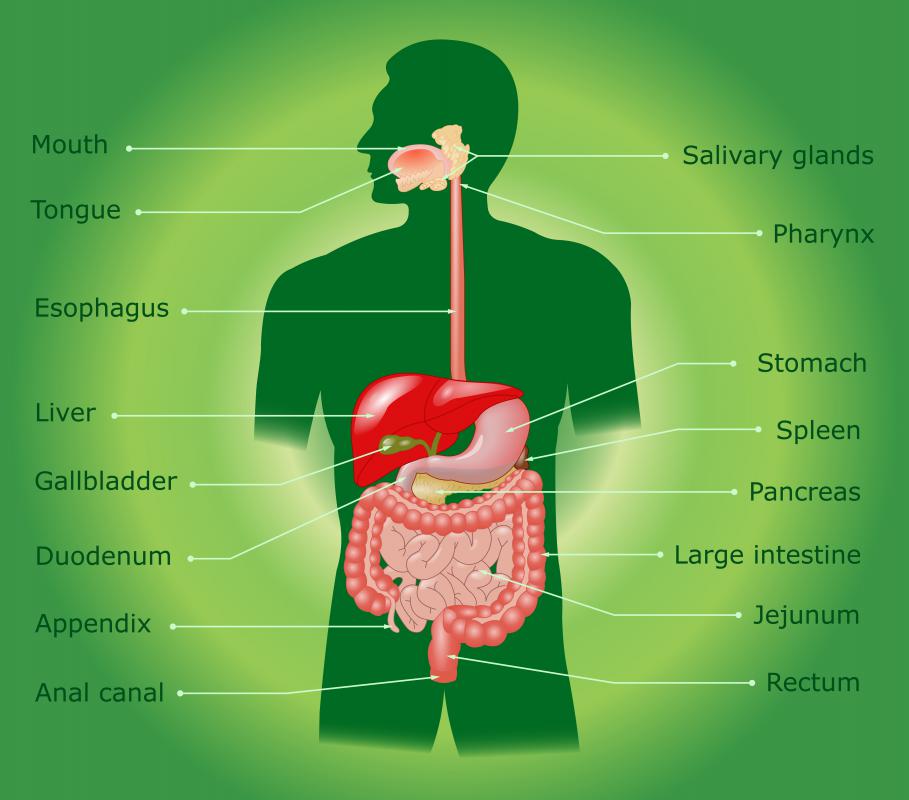
The role of peristalsis in the digestive system is that it is the way food is propelled down the esophagus and into the stomach; then peristalsis moves the digested food through the small and large intestine and then through the rectum and anus. It is a series of smooth muscle contractions and relaxations moving food in a wave-like manner through the different processes in the gastrointestinal tract.
The movement of peristalsis in the digestive system relies on two major reflexes that contract above the food that was swallowed, or bolus, and relax below it. This takes place within the enteric nervous system, which is the local nervous system comprising the digestive system. There are two networks of neurons embedded in the wall of the digestive tract and these begin at the esophagus and end at the anus. There are three types of neurons within the enteric nervous system which secrete neurotransmitters and between them, the sensory, motor and inter-neurons are responsible for peristalsis in the digestive system.

When a bolus of food is swallowed, peristalsis carries it to the stomach where it is turned into a liquid called chyme. Food is chewed into a bolus, or ball, and swallowed. It is moved through the esophagus by a primary peristaltic wave which forces the food through the esophagus and into the stomach; a process which takes about nine seconds. Should the food be poorly lubricated and the movement through the esophagus slow, then a secondary peristaltic wave continues to work around the bolus until it enters the stomach. Once the bolus has been turned into milky chyme in the stomach and carried into the small intestine, the process of peristalsis slows down as the purpose changes from movement to mixing, digestion and absorption.

Nutrition absorption takes place in the small intestine where peristalsis moves the chyme around, giving it the opportunity to be absorbed through the walls of the intestine and into the bloodstream. The next stage of the digestive process takes place in the large intestine where water is reclaimed from the undigested food and absorbed into the bloodstream. The remains are then excreted through the anus.
It has been estimated that a typical meal will take about five hours to pass completely through the stomach and up to 40 hours to travel through the colon with complete elimination from the body sometimes taking several days, depending on the food. Peristalsis in the digestive system works at different speeds as the process at different stages has different goals. Primarily, the goal in the esophagus is to stop swallowed food re-entering the mouth so the process is quicker. Finally, the goal in the large intestine is to absorb as much water as possible from the undigested mass so the process becomes much slower.
AS FEATURED ON:
AS FEATURED ON:


-
![Peristalsis occurs in the digestive tract, beginning with the esophagus.]() By: dr_oxPeristalsis occurs in the digestive tract, beginning with the esophagus.
By: dr_oxPeristalsis occurs in the digestive tract, beginning with the esophagus. -
![The peristalsis moves the digested food through the small and large intestines.]() By: nerthuzThe peristalsis moves the digested food through the small and large intestines.
By: nerthuzThe peristalsis moves the digested food through the small and large intestines.

Discussion Comments
I've heard that some medications are designed to stimulate or decrease peristalsis, depending on the patient's digestive situation. If things move too fast through the system, the result might be diarrhea. If it's too slow, a person might get constipated.
I remember seeing a science show for kids where the host demonstrated peristalsis. He hung upside down from a bar and started eating some crackers. He said that peristalsis made it possible for people to swallow their food no matter what position they were in. The pull of the esophagus during peristalsis was strong enough to overcome gravity, so people could eat while hanging upside down if they wanted to.
Post your comments