
At TheHealthBoard, we're committed to delivering accurate, trustworthy information. Our expert-authored content is rigorously fact-checked and sourced from credible authorities. Discover how we uphold the highest standards in providing you with reliable knowledge.
What Is the Renal System?
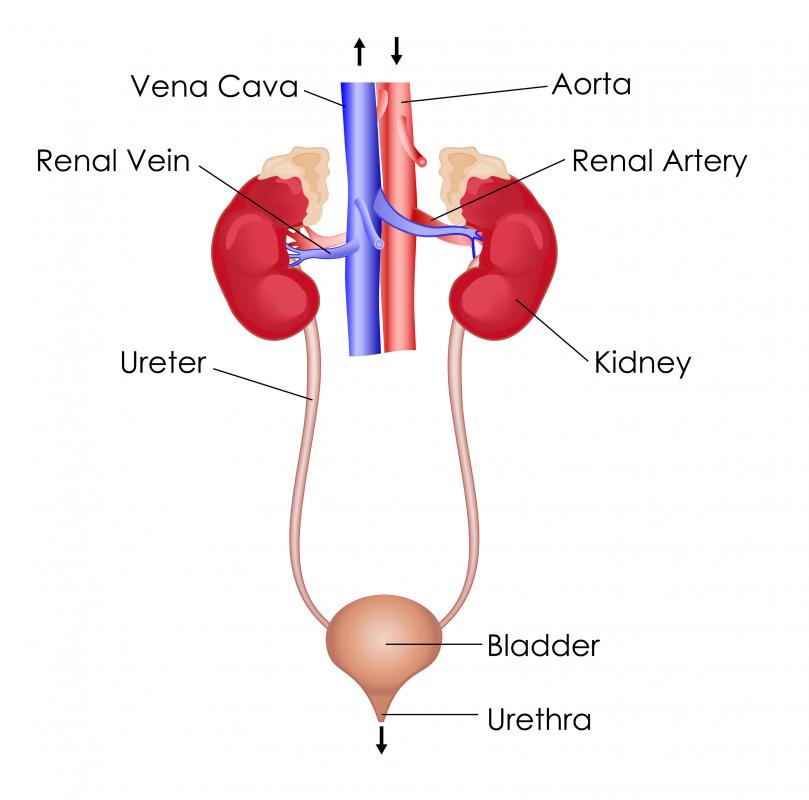
The renal system is a group of organs that work together to produce, store, and release urine. Urine is the liquid waste material excreted from the body. The organs that work together in this system include the kidneys, bladder, ureters, and urethra. It is also known as the urinary or the excretory system.
The kidneys are a vital part of the renal system. They are located in the back portion of the abdominal cavity, with one on either side. Perhaps the most well-known function of the kidneys is to transport urine into the tubes known as ureters before it exits the body. These organs also have several other important functions, however, such as helping to regulate blood pressure. They also work to regulate the pH balance in the human body as well as the balance of electrolytes such as sodium and potassium.

The next part of the system is the bladder, sometimes referred to as the urinary bladder. The bladder is shaped much like a muscular, hollow balloon and sits in the pelvic area of the body. Its primary function is to collect and store the urine that has left the kidneys. Once the bladder starts to becomes full, the urine begins to leave the bladder and pass into the urethra.

The ureters are small tubes made of muscle. These structures are attached at one end to the kidneys, and to the bladder at the other. They use a small amount of pressure to gently force or push urine from the kidneys to the bladder and then from the bladder to the urethra on its way out of the body. The ureters also prevent urine from backing up and going back into the kidneys once it has passed into the bladder, a disorder which would be known as reflux.

The urethra is the final portion of the renal system. This structure is a hollow tube connected to the bladder and passes through the genitals, exiting the body. The urethra passes through the penis in males and is responsible for transporting both urine and semen. This tube is significantly shorter in females and stops just above the opening to the vagina. An external muscle known as the urethral sphincter helps to control the action of voluntary urination.
AS FEATURED ON:
AS FEATURED ON:


-
![A diagram of a kidney, one of the main parts of the renal system.]()
A diagram of a kidney, one of the main parts of the renal system. -
![The excretory system, which includes the renal system, is a collection of organs that work in unison to remove waste and other harmful products from the body.]() By: snapgalleriaThe excretory system, which includes the renal system, is a collection of organs that work in unison to remove waste and other harmful products from the body.
By: snapgalleriaThe excretory system, which includes the renal system, is a collection of organs that work in unison to remove waste and other harmful products from the body. -
![The urethra, which in males is located inside the penis, is the final portion of the renal system.]() By: isysteThe urethra, which in males is located inside the penis, is the final portion of the renal system.
By: isysteThe urethra, which in males is located inside the penis, is the final portion of the renal system. -
![Part of the renal system, the kidneys play a crucial role in the urinary system and in maintaining electrolyte balance and blood pressure.]() By: Sebastian KaulitzkiPart of the renal system, the kidneys play a crucial role in the urinary system and in maintaining electrolyte balance and blood pressure.
By: Sebastian KaulitzkiPart of the renal system, the kidneys play a crucial role in the urinary system and in maintaining electrolyte balance and blood pressure. -
![The urethra is shorter in females than males, as it stops just above the opening to the vagina.]() By: isysteThe urethra is shorter in females than males, as it stops just above the opening to the vagina.
By: isysteThe urethra is shorter in females than males, as it stops just above the opening to the vagina.



Discussion Comments
The best way to keep these and all of your organs healthy is a healthy diet and lots of RO water. A healthy diet for me is the organic paleo diet. Eat more vegetables (a lot more) than fruits and very little meat is needed for me. Sometimes in order to meet my 'quota,' I'll juice my vegetables in a commercial quality blender.
Furthermore, I'm seeing a nutritional practitioner to help 'cleanse' my body of all of the junk my body doesn't need. He can literally use physics to test just about every vital organ and can also see what I'm allergic to. He looks for both negative and positive immune responses for the bad stuff like blood-borne pathogens and heavy metals but also checks to see if I 'get stronger' from specific minerals and supplements. I don't know how it works but I know it works for me and I've tried over and over to prove my doctor is an idiot, but he amazes me ever time.
Also, sugar is an immune suppressor so don't eat it. Carbs are sugar, remember that. Fat doesn't make you fat; it's essential to life. Some fats are much better than others, like in avocados. Conventional fruits and vegetables contain trace elements of pesticide/herbicides so unless you want to use a dropper to eat the stuff, stay away!
The FDA is not looking out for anyone's well-being. I point to the evidence of cancer, diabetes, autism, and various neurological diseases that aren't being prevented. Do your own homework (I'll let you cheat off me just this once). Pro tip: organic raw food contains more nutrients than cooked food. These statements have not been approved by the FDA, but they should be.
Politics is the pursuit of power. Government is force. Government seeks to pursue its own interests (corruption). The people want law and order and a just government. The people get corruption when the people stop looking at said government. The media is mostly responsible for looking for government corruption. The government seizes opportunities to corrupt the media to pursue it's own interests. The people absorb what the media tells them with naiveté. The people will then give more power to the government to control their lives in trade for less responsibility.
Take responsibility for your own food supply. Know more about your food than the FDA. Take back your own power to change your life and promote good health. Teach others to do the same. Responsibility is synonymous with freedom.
@browncoat - Actually, not as much as you'd think. The anatomy of the kidney is such that it will actually enlarge slightly if it needs to compensate. And most healthy adults can get along without any problems on one kidney, although, of course, there is always the possibility of trouble down the line.
The thing is, usually if one kidney fails, then both are going to fail anyway (unless one is somehow damaged by physical trauma) so it doesn't really matter whether you have one or two, either they will be healthy together, or they will fail together.
There was a really fascinating thing on the news a while ago about how in Europe, they held a reality show where three people on the waiting list for kidney transplants competed to get a kidney off of a terminally ill woman.
Many people were shocked and angry that they would air such a controversial and unethical show, but at the end of it, they revealed that it was only a stunt (although the people on the list were real, they were in on the stunt), aimed at getting more people to donate a kidney. It worked too, as thousands of people signed up to donate a kidney after the show aired.
It does seem like an extraordinary thing to do though. I mean, doesn't it put a lot more pressure on the remaining kidney to donate one?
@angelBraids - I studied biology so renal system physiology is forever burned into my brain! There are various things you can do to try to keep this part of your body healthy.
The most basic would be to avoid a high salt diet, as that may put strain on the kidneys. Drinking plenty of plain old water also helps to flush out your system. Plus, women and girls can reduce the risk of urinary tract infections by wiping from the front to back after using the toilet.
Women who have had children can benefit from doing pelvic floor (Kagel) exercises. Strengthening the muscles in the female reproductive system area may help to avoid or control bladder problems.
What I find really interesting is that these exercises are also really useful for men!
It does take a little time to get the hang of doing them, but the benefits are great. I think they're especially useful for controlling that urine that can leak out when you cough, laugh or sneeze.
I didn't realize that the renal system functions went beyond the kidneys! What is the best way to make sure you keep all of these organs healthy?
I am guessing that trouble with one could lead to problems with another, though I could be wrong. I think I slept through the class where we studied this stuff.
Post your comments