
At WiseGEEK, we're committed to delivering accurate, trustworthy information. Our expert-authored content is rigorously fact-checked and sourced from credible authorities. Discover how we uphold the highest standards in providing you with reliable knowledge.
What Is the Relationship between Cirrhosis and Ascites?
The relationship between cirrhosis and ascites is primarily causal; cirrhosis, which is a liver problem, is the primary cause of ascites, a condition that causes the abdominal cavity to fill with fluid and become painfully distended. There are a number of reasons why people might develop ascites, but experts typically say that roughly 65% of cases are related directly to advancing cirrhosis. In fact, it’s often the case that cirrhosis isn’t even detected or diagnosed until a patient presents with a painful swollen stomach. Both conditions can be very serious, and there tend to be more complications when the two occur together. In general it’s usually a lot easier to cure ascites than cirrhosis, but a lot depends on how advanced the problems are and how responsive patients are to treatment.
Understanding Cirrhosis Generally

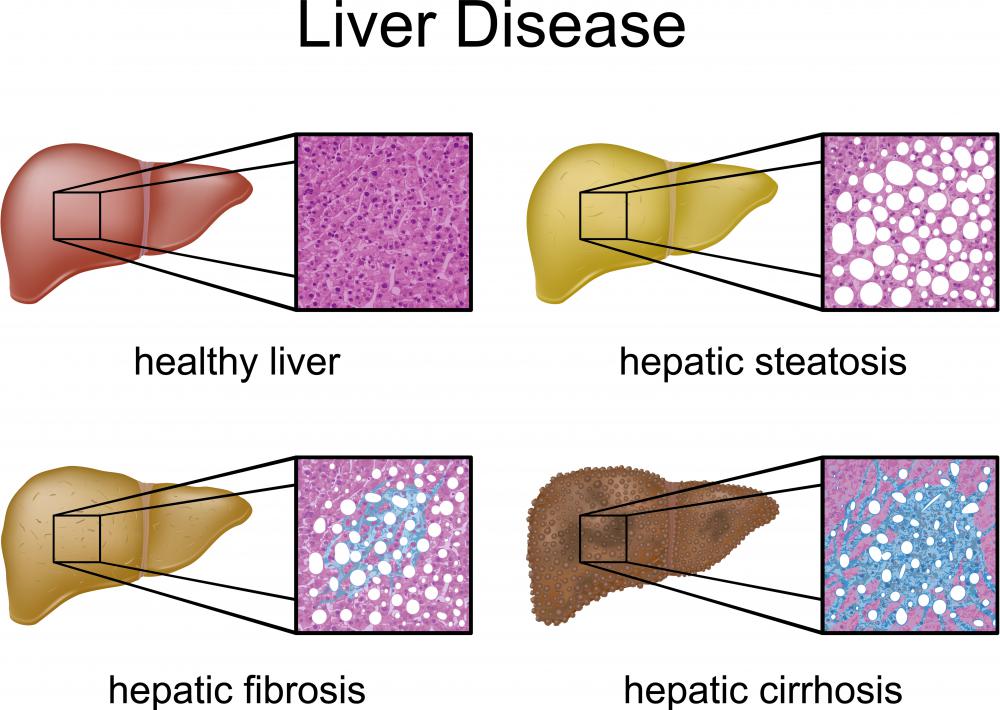
Cirrhosis is a condition in which the tissues of the liver, one of the body’s most important organs, becomes so scarred that it cannot perform its filtration role properly or at all. In healthy people, the liver processes blood, creates bile for digestion, and filters toxins out of the body. Alcohol and most medications are usually considered “toxins,” and in moderate or occasional amounts these don’t pose problems. Repeated exposure, as often experienced by alcoholics and drug addicts, can lead to scars on the surface of the liver as the organ struggles to keep up. Over time, these scars become more engrained and more numerous until the majority of the organ is scar tissue rather than functioning, healthy tissue.
Once cirrhosis sets in, the liver usually begins to fail. It’s this failure that commonly leads to the fluid build-up known as ascites.
Ascites Basics

Any fluid in the abdominal cavity is typically known as “ascites,” and the name is more indicative of a state of being than any defined condition or disease. Accumulation of abdominal fluid almost always has a cause, which is to say, it is abnormal and won’t happen all on its own. It may be caused by several diseases, including heart failure, viral infection, and various cancers, but cirrhosis is the most common.

In these cases, fluid usually accumulates as liver function deteriorates and pressure in the veins that pass through that organ increases. The result is that fluid seeps or leaks from the surface of the liver into the abdominal cavity, where it collects. Edema, the accumulation of fluid in the feet or legs, may also accompany cirrhosis and ascites.
Small amounts fluid aren’t usually noticed by the patient. Larger volumes frequently cause the patient to feel bloated or full in the abdomen, though, which is usually paired with pain and sleeplessness, among other symptoms. The presence of ascites is usually confirmed through diagnostic imaging tests such as ultrasound or computed tomography (CT) scan.
Complications When the Two Occur Together
While both conditions can be quite serious, experiencing the two together usually compounds a patient’s problems. Increasing intra-abdominal pressure from ascitic accumulation may result in abdominal pain or discomfort, decrease in appetite, and infection, all of which can put pressure on the already inflamed liver and can, in turn, cause the organ to deteriorate faster. Large-volume ascites accumulation may also result in a hepatic hydrothorax in which ascites enters the chest and accumulates between the chest and the lung in the pleural space. The resulting condition, known as a pleural effusion, may result in the patient experiencing difficulty breathing or shortness of breath.
Care and Treatment Options
Short-term treatment of hepatic ascites in the case of large-volume ascites may involve paracentesis. Paracentesis is a procedure that involves inserting a needle into the abdomen to draw off the accumulated abdominal fluid. While this may provide immediate relief from some of the discomfort and complications associated with the abdominal fluid accumulation, it won’t usually prevent it from recurring, particularly not if the cause, like cirrhosis, is still in full force. Long-term treatment of cirrhosis and ascites may include a special diet, the use of diuretic medications to help reduce ascites and edema and, in the most extreme cases, liver transplant.
AS FEATURED ON:
AS FEATURED ON:









-
![A build up of fluid in the abdomen, called ascites, is often caused by cirrhosis of the liver.]() By: peterjunaidyA build up of fluid in the abdomen, called ascites, is often caused by cirrhosis of the liver.
By: peterjunaidyA build up of fluid in the abdomen, called ascites, is often caused by cirrhosis of the liver. -
![Excess fluid builds-up in the abdomen when a person has ascites.]() By: ruigsantosExcess fluid builds-up in the abdomen when a person has ascites.
By: ruigsantosExcess fluid builds-up in the abdomen when a person has ascites. -
![Ascites are accumulations of fluid within the abdominal cavity, often leading to significant swelling, discomfort and digestive disturbances.]() By: probioticAscites are accumulations of fluid within the abdominal cavity, often leading to significant swelling, discomfort and digestive disturbances.
By: probioticAscites are accumulations of fluid within the abdominal cavity, often leading to significant swelling, discomfort and digestive disturbances.


Discussion Comments
No one with cirrhosis and ascites should continue their habits thinking that liver transplant is a viable option for treatment. Liver transplant is very difficult. It's difficult to find a donor with a liver that will match. The chances of the body rejecting the new liver is also high. This is definitely not a 100% possible and successful option.
Our liver is an amazing organ. It has the ability to renew itself better than any other organ in the body. Despite our liver working so hard to renew itself and stay healthy, some people are keen on destroying it through the use of alcohol. The good news is that if liver damage is only in the beginning stages, quitting alcohol immediately and getting treatment may mean that the cirrhosis and ascites will reverse itself. It will take many years for the liver to recover completely and some damage may be permanent, such as fatty liver. But at least, the result will not be death.
@burcinc-- No, ascites and "beer belly" are not the same. It's a common misconception. "Beer belly" actually just refers to central obesity which is when fat accumulates around the belly. Ascites on the other hand, is the retention of fluid, not fat.
Someone who has central obesity and who also drinks alcohol regularly may suspect ascites. It's best to see a doctor because one may not be able to differentiate them. Doctors have recently said that drinking alcohol doesn't necessarily cause central obesity. So the relationship between central obesity and cirrhosis is weak or maybe even nonexistent unlike the relationship between cirrhosis and ascites.
So the fluid retention caused by ascites (which in turn is caused by cirrhosis) is what most people refer to as a beer belly right?
I knew that a beer belly was a sign of too much alcohol use and some liver damage. But I had no idea that it's so serious and dangerous.
Post your comments