
At WiseGEEK, we're committed to delivering accurate, trustworthy information. Our expert-authored content is rigorously fact-checked and sourced from credible authorities. Discover how we uphold the highest standards in providing you with reliable knowledge.
What is the Pulmonary Vein?
 Dee Saale
Dee Saale
Dee Saale
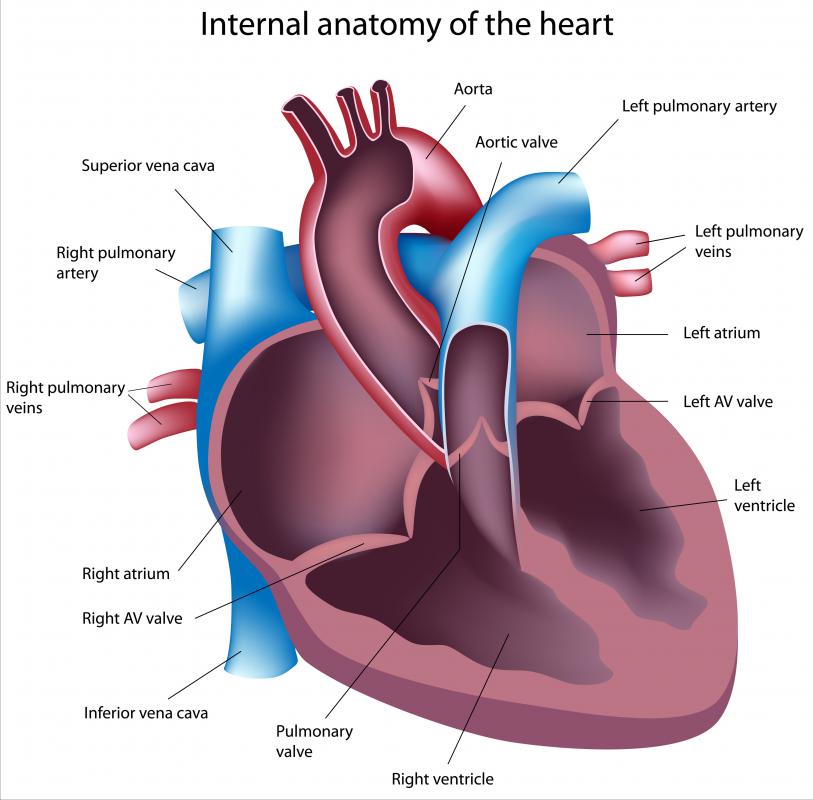
The human heart typically beats about one time every second – and oftentimes, even more frequently. In most adults, it weighs approximately 1 pound (.45 kg), but it pumps over 5 quarts (4.7 l) of blood through the body every minute. Every portion of the human heart serves an important function, from any of the ventricles to the pulmonary veins. These veins are unique in that they are the only type of vein that carry blood that is rich in oxygen from the lungs to the heart.
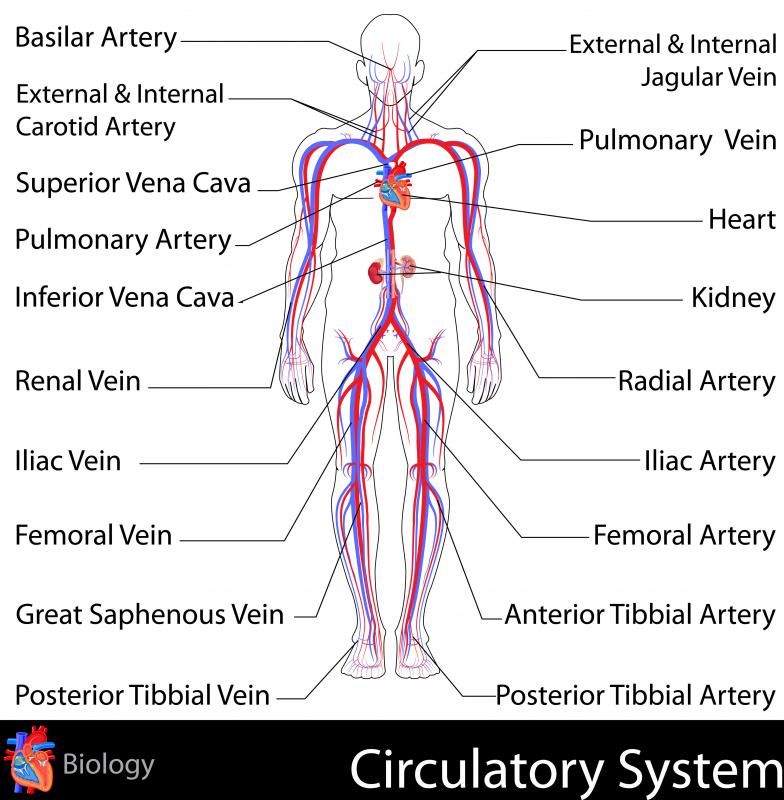
In order to fully understand the function of the four pulmonary veins, it is important to consider the components of the heart and the way the blood flows through the pulmonary circulation system. The heart can be categorized as a muscular pump that has four chambers connected by valves. Blood flows into the right atrium into the right ventricle of the heart. The right ventricle then pumps oxygen-depleted blood through the pulmonary valve to the lungs. After the blood flows through the lungs, it returns to the left side of the heart, oxygenated, through the pulmonary veins — there are two for each lung.

Various disorders can occur that can affect these veins. For example, pulmonary vein stenosis occurs when there is a blockage in one of these veins. The blockage is caused by uninhibited connective tissue cells growth that creates an abnormal thickening and narrowing of the vein walls. The stenosis will progress until there is a total blockage of the affected vein. This condition may be related to congenital heart disease or can occur in individuals with normal hearts.

Atrial fibrillation is another disorder of the heart that causes an irregular heartbeat in the top atrium. Research studies have found that most atrial fibrillation signals are received from the pulmonary veins. Luckily, pulmonary vein isolation or pablation is a procedure that can be conducted to treat atrial fibrillation. Through the procedure, a catheter is inserted into the atrium’s blood vessels. Energy is delivered through the catheter to the area where the atrium and the pulmonary vein connect that blocks the irregular rhythm and prevents atrial fibrillation.

Many heart problems can be detected by an experienced medical doctor before they become fatal. In some cases, if a potential problem is found, a doctor may suggest undergoing further medical testing before surgery is conducted. In those cases, a pulmonary vein CT scan may occur. Through such a medical procedure, the vein, or any portion of the heart can be inspected and a problem can be found – if one exists.
Dee Saale
Dee is a freelance writer based in Colorado. She has a B.A. in English Literature, as well as a law degree. Dee is especially interested in topics relating to medicine, legal issues, and home improvement, which are her specialty when contributing to WiseGEEK.
Learn more...
Dee Saale
Dee is a freelance writer based in Colorado. She has a B.A. in English Literature, as well as a law degree. Dee is especially interested in topics relating to medicine, legal issues, and home improvement, which are her specialty when contributing to WiseGEEK.
Learn more...AS FEATURED ON:
AS FEATURED ON:









-
![Pulmonary veins carry oxygenated blood from the lungs to the heart.]() By: Alila Medical MediaPulmonary veins carry oxygenated blood from the lungs to the heart.
By: Alila Medical MediaPulmonary veins carry oxygenated blood from the lungs to the heart. -
![A pulmonary vein CT scan may be performed to diagnose heart problems.]() By: Tyler OlsonA pulmonary vein CT scan may be performed to diagnose heart problems.
By: Tyler OlsonA pulmonary vein CT scan may be performed to diagnose heart problems. -
![Under normal conditions, the human heart beats roughly once per second.]() By: CLIPAREA.comUnder normal conditions, the human heart beats roughly once per second.
By: CLIPAREA.comUnder normal conditions, the human heart beats roughly once per second. -
![Pulmonary vein stenosis occurs when there is a blockage in one of the pulmonary veins.]() By: snapgalleriaPulmonary vein stenosis occurs when there is a blockage in one of the pulmonary veins.
By: snapgalleriaPulmonary vein stenosis occurs when there is a blockage in one of the pulmonary veins. -
![Atrial fibrillation is a heart condition which causes an irregular heartbeat in the top atrium.]() By: sudok1Atrial fibrillation is a heart condition which causes an irregular heartbeat in the top atrium.
By: sudok1Atrial fibrillation is a heart condition which causes an irregular heartbeat in the top atrium.



Discuss this Article
Post your comments