
At TheHealthBoard, we're committed to delivering accurate, trustworthy information. Our expert-authored content is rigorously fact-checked and sourced from credible authorities. Discover how we uphold the highest standards in providing you with reliable knowledge.
What is the Psoas Muscle?
 Mary McMahon
Mary McMahon
Mary McMahon
The psoas muscle is a major muscle in the human body, responsible for stabilizing the base of the spine, allowing the spine to flex, and rotating the hips for a free range of movement. When kept limber, the muscle functions smoothly with others to support an upright posture and a flexible lower spine and hips. When the psoas is strained or contracted, it can lead to limitations in free range of motion and an increase of lower back pain. For this reason, people should regularly engage in stretches to keep the muscle strong and limber.
The start of the psoas muscle is found in the lumbar, or lower spine, where the paired muscles anchor on either side of the spine. The muscles wrap around, into the pelvic area, and attach at the knobby part of the hip with several strong tendons. They are considered to be crucial among the hip flexor muscles, which allow people to bend their bodies into their hips and to pull their hips into their bodies.

Individuals who experience lower back or hip pain may have contracted psoas muscles that are not providing the support that they need. They should gently stretch to elongate their muscles and make them more flexible, as well as seeking medical attention if the pain continues, grows worse, or changes. Engaging in a regular physical fitness routine that includes stretching, such as Pilates or yoga, will help to keep the muscles aligned, strong, and flexible, along with other vital muscles of the body.

The most basic psoas stretch, and one of the most gentle, involves lying on the back on the floor. The person should make sure that his pelvic position is neutral, his scapulae are flush with the floor, and that his spine and head are in perfect alignment, forming a straight, smooth line. He should gently bring one knee up to his chest while extending the other leg along the floor, breathing deeply and evenly. The position should be held for several breaths before switching sides, and repeated several times.

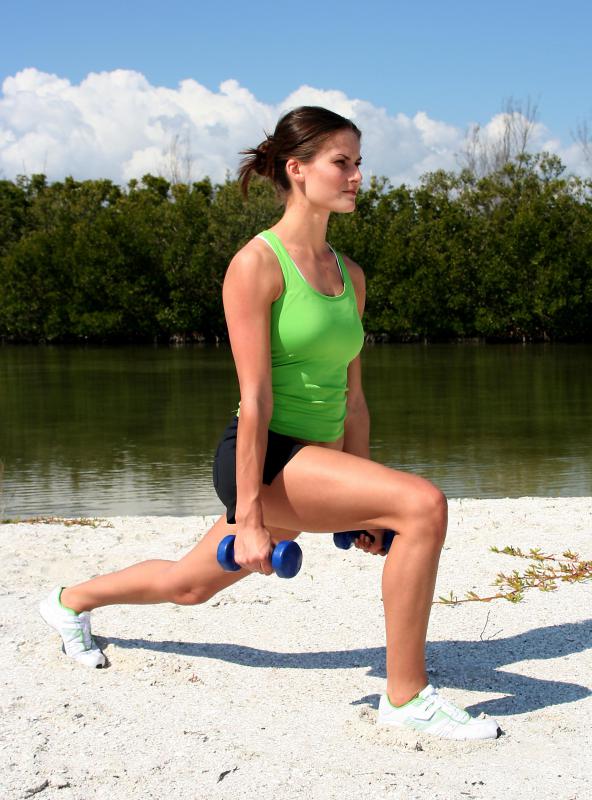
For a deeper psoas stretch, the person can adopt a lunging position with one knee forward, forming a 90° angle, if possible, between the hip and the calf. He should extend the other leg behind him, kneeling slightly, and lower himself slowly into the stretch, which can be felt in the front of the hip. The person should keep his spine perfectly straight while performing this stretch, and not allow the knee of his forward leg to overhang the toes.
Mary McMahon
Ever since she began contributing to the site several years ago, Mary has embraced the exciting challenge of being a TheHealthBoard researcher and writer. Mary has a liberal arts degree from Goddard College and spends her free time reading, cooking, and exploring the great outdoors.
Learn more...
Mary McMahon
Ever since she began contributing to the site several years ago, Mary has embraced the exciting challenge of being a TheHealthBoard researcher and writer. Mary has a liberal arts degree from Goddard College and spends her free time reading, cooking, and exploring the great outdoors.
Learn more...AS FEATURED ON:
AS FEATURED ON:


-
![Doing a lunge can help stretch the psoas muscle in the lower back.]() By: Dana HeinemannDoing a lunge can help stretch the psoas muscle in the lower back.
By: Dana HeinemannDoing a lunge can help stretch the psoas muscle in the lower back. -
![People with lower back pain might have contracted psoas muscles.]() By: mangostockPeople with lower back pain might have contracted psoas muscles.
By: mangostockPeople with lower back pain might have contracted psoas muscles. -
![Some yoga poses stretch and relax the psoas muscle.]() By: julief514Some yoga poses stretch and relax the psoas muscle.
By: julief514Some yoga poses stretch and relax the psoas muscle. -
![The start of the psoas muscle is found in the lower spine.]() By: freshideaThe start of the psoas muscle is found in the lower spine.
By: freshideaThe start of the psoas muscle is found in the lower spine. -
![The psoas muscle is responsible for stabilizing the base of the spine.]() By: JackFThe psoas muscle is responsible for stabilizing the base of the spine.
By: JackFThe psoas muscle is responsible for stabilizing the base of the spine.




Discussion Comments
This my not be the correct place to ask this question, but I couldn't find an answer anywhere else.
I recently had a therapeutic massage from an LMT, an older woman between 65-70. During the process of discussing where my pains were located (lumbar, cervical), I mentioned that I had a sharp "ice pick" type pain going through my left pectoral muscle and I assured her that it wasn't heart related.
She promptly put her hand under the sheet and laid it palm down on my pubic bone with her fingers touching my penis and testicles and said that the trigger point for the pain in the pectoral was here. She didn't do anything sexual but I was wondering if she was correct because what she was doing did nothing for the pain in my pectoral muscle. My wife just laughed at me and tried to tell me that it never happened. I think I know when a strange woman has her hand on my naked crotch.
to 36251: I am on this site because I had a very similar situation today where my acupuncturist told me that my endocrine system was imbalanced and that I need my female hormones back in range.
He did several manipulations down the center of my stomach and sternum, as well as my breasts. he then pulled my underwear completely down past my hips and and pressed on the areas on my groin and then inside my labia. I also realized that he did not have gloves on nor did he wash his hands.
I felt very awkward and did not know what to do. I was wondering if this is legitimately an area that is treated with these manipulations or if it is something I should report. I would think that he should have at least told me what he was going to do.
I had hip joint pain about two years ago and after sitting for periods of time at my desk could hardly stand up straight to walk anywhere unless is took 5 minutes to stretch. I went to the doctor for diagnosis.
After x-rays showed no arthritis (which I really doubted anyhow) I was instructed to do some stretches which did absolutely no good.
After almost nine months of being in pain I mentioned the problem to my chiropractor who immediately recognized this as a psoas muscle issue. He had recently had some training in this area.
After a single adjustment I started to improve and by three months later could barely tell I had ever had a problem. Way to go Doc! Don't let anybody tell you they can't help.
Anon36251: as paralegal for an attorney who represents a woman who came forward with very similar allegations against a NC chiropractor, could you possibly identify where you are located?
Although our client did go to the police, it was a he said/she said situation so that the chiropractor was not charged with criminal action but her complaint to the Chiropractic Board resulted in a Review Board hearing that found probable cause for a full Board hearing.
This chiropractor has practiced in three different states and we would be very interested in determining if it is possibly the same individual and, if not, how your claim has proceeded if you have followed the advice of other posters.
My brother contracted colon cancer four years ago. It was stage IIIC then. It has not gone anywhere else but to his psoas muscle. He's had lots of chemo and radiation. The chemo is wearing him down and his tumor is basically stable and mostly calcified.
He is pretty miserable with pain and chemo response to his body. Has anyone had successful surgery to remove the tumor? His MD's are hesitant but don't know what else to do! Thanks SS
I wrote sometime back above and due to car accident have severe Psoas muscle, ligament issues, etc. I mentioned that I was seeing a acupuncturist, and did so for a little more than a year. I also began to have Deep tissue massage which helped tremendously.
I just lost my job and insurance and so I can't go but they both did wonders. I am looking forward to getting a new job where I will be able to get to go again and insurance cover some of the cost.
About one week ago my husband bought me a cute little thing called a Sacrowedgy that cost about $30. They have both male and female versions and I should receive in about one week. I think it will help a lot my husband will also massage with that in place.
I will let people know after I try it.
If you might have cancer or a compromised immune system for any reason, please research about taking LDN. It is a comfortable safe therapy that often helps. There are videos about LDN results, too.
Of course eat healthfully and consider nutritional supplements if you aren't already taking them, and maybe supplemental iodine for your thyroid. And you may want to consider high-dose Vitamin C, too, even intravenously.
@ anon: You can easily massage your psoas muscle yourself. Your belly button should not be a point of reference.
If your right psoas is in trouble, lie on your side and dig deep, about two inches away from the belly button, until you feel a muscle that feels like a long sausage. Follow the muscle up to its rib attachment and down to the pelvic area. palpating this muscle may reproduce your groin pain, but it's O.K. It means you have found the culprit.
@ anon13693: Lower abdominal pain will usually come from the rectus abdominal muscle. Check the whole abdominal region for painful muscle knots, paying particular attention below the belly button.
For abdominal pain, massage is the answer. Start gently at first and work out the knots before you decide to stretch this muscle.
mikezag: the psoas referred pain to a number of places -- in the groin, down the leg, sometimes as far as the knee, and in the spine itself.
For chest pain, you need to search for knots in your pectoral muscles. Massage them out frequently during the day. For shoulder pain, it is good to start working knots out of the trapezius and rhomboids.
Referring to the post about the massage therapist going below the hip and past the underwear.
The psoas attaches to the last rib, to all lumbar vertebrae and then to the lesser thronchanter of the femur. In the pelvic area ie the femoral triangle, there is a muscle called the iliacus...which works with the psoas and supports its healthy functioning...if your therapist is massaging this muscle then it is not inappropriate...gloves are not necessary....although they should be careful with pressure in this area.... if your problem is the psoas then feel lucky you have found a therapist that will massage here....in england where i am i have been through tons of therapists that will do this...and i find it really helpful
To anon36251: I have worked as a massage therapist and worked closely with an osteopath.
This is completely inappropriate. Please ensure that the chiropractor is reported the the police for sexual assault. They should never have their hand inside your underwear, least of all without an explanation of their treatment, or more to the point, your consent.
To anon63251,
I have had on going lower back pain for four years with some psoas pain as well. I have seen quite a few physios, 2 massage therapists and 1 chiro and I have never had that happen to me. they all usually push around my hip area and even then there has been at least a sheet between their hands and my skin.
As the others have said think seriously about reporting this person as you may not be the only person this has happened too. Good luck and take care.
To anon36251,
I also agree that you have been treated in a very irresponsible, if not criminal, manner. Especially telling is the lack of gloves - OMG. I wanted to respond sooner, but I haven't been to a chiropractor or had experience with my own psosas muscle, so I didn't know what to say. But thanks to the last poster, and their own experience with a massage therapist and chiropractor, I know this is not right. Please consider reporting this "doctor", as you may not be the only one. And take care of yourself!!
To anon36251:
I have had issues with my Psoas muscle for several years. I see both a chriopractor and a massage therapist. And I have never had either of them "massage" that intimately. In fact, both often use my belly button as a point of reference and never have gone lower than my pelvic area.
I am concerned that you might have been placed in a very inappropriate situation. Please think very carefully about returning as well as reporting the incident. One would think that if this was at all on the up and up, a professional would have explained the procedure, called in a female attendant, and most certainly used gloves.
Wishing you all the best.
My chiropractor has explained that my lower back and hip pain is caused in part by tightness in my "psoas" muscle, which he explains extends across the top of my uterus.
In treating this tightness during one visit, he put his hand inside my panties at the place where my upper inner thigh merges into my outer labia. He put one finger inside the labia. He repeated the same position when he massaged the inner thigh of the other leg.
I'm embarrassed to ask anyone whether this is proper treatment. I trust him, but I hadn't prepared myself for such an intimate contact. Also, I did not see him wash his hands. He did not wear gloves. I was supposed to go back in two weeks for another adjustment, but I have not made an appointment.
The latest CT scan impression of a female patient closely related to me is as follows. The doctor's opinion is that it is now a lost case. Can anybody tell me if there still some treatment options available and what that could be? The patient has undergone 6 chemotherapy session with Taxol .
CT Report:
" Large SOL involving the right posas muscle with engulfment of right ureter carring right sided hydroneprosis in a case of metastatic adeno Ca "
Also a CT guided biopsy was conducted from retroperitolneal mass on 3,oct'08; the findings: Microscopy : Metastatic adenocarcinoma .The tumor cells express "Cytokeratin & CK-7 and are immuno-negative for CK-20"
I have found that is is best to be your own advocate and do your own research... First if you get a "diagnosis", you should be asking the Drs. at that time what it all means and then go home and start researching...
I have major groin issues with Psoas and everything else related due to a headon collision (not my fault)-the femur in my leg dislocated and the head of the femur which usually breaks punched through my whole pelvic girdle(the ensuing physical therapy initially was terrible I was told they didn't know how to help me), and so I ended up with severe muscle atrophy, I finally got a couple of good PT's who helped me somewhat and then I began to have Acupuncture which has helped me more than anything else. As of this date I have had about 7 Acupuncture treatments and am feeling better (I have other injuries as well-crushed foot, and wrist), I am planning on having approx. 8 more treatments within the next 4 months and see how it goes... No Acupuncturist is supposed to tell you how many treatments is recommended they are supposed to just say how ever many you need until you feel better basically...
Yet another question here about masses in the psoas muscle. My husband has kidney cancer, and his most recent scan showed a 1.6 cm growth in his psoas muscle that wasn't there three months ago. Since this is generally a slow growing cancer, isn't it possible that it's something else? I had heard of blood clots occurring after workouts, and my husband is a gym rat, so I'm really hoping that's the case. Answers, anyone?
I am having knee troubles which I am pretty sure are originating in my hip due to tightness, but unfortunately can't get in to see the surgeon for three weeks. So, I'm hoping someone can help me figure out what it is/how to feel better in the meantime.
When I lay on my back and try to hug my knees to my chest my left leg doesn't go to my chest like the right leg. When I pull it in, I feel a sharp pain in what I would describe as "along the bikini line" - not sure if that's considered the groin or not. Someone told me that this is my psoas, but if this is a muscle issue then I would think I would feel more of a stretching or would feel something when I put icy hot on it but I do not, which makes me wonder if this is maybe a tendon or ligament? Just not sure if I should continue stretching it until I go to the doc or hold off.
Out 14 year old son has a lobular mass in right psoas muscle with left hip pain. We're meeting with doctors this week, but are anxious to know what this is. Has anyone know what a lobular mass could mean?
I just had a CT because of severe lower abdominal pain and it showed a hematoma on the muscle. I may have injured the muscle doing my rower with one leg (don't ask me why I only used one!) I was recommended physical therapy.
I have had psosas muscle spasms for the past 5 years but never any back pain. My pain is in my chest and entire upper body to my neck and shoulders. What do you recommend to relieve this type of pain and how to improve to reduce the pain....
I've had a cancer operation that removed a 6" square sarcoma and most of my psoas muscle. This happened two years ago and I just found out about the missing muscle. I'm a low handicap golfer and I'm wondering what exercises I could do to rebuild or strengthen that attachment of muscle.
Just found out today that my husband has the same kind of mass. What happened with you???
I just had a CAT scan that shows "stable appearance of a soft tissue mass posterior to the right psoas muscle". What does this mean and is there anything I can do about it myself?
Post your comments