
At TheHealthBoard, we're committed to delivering accurate, trustworthy information. Our expert-authored content is rigorously fact-checked and sourced from credible authorities. Discover how we uphold the highest standards in providing you with reliable knowledge.
What is the Pericardium?
 Michael Pollick
Michael Pollick
Michael Pollick
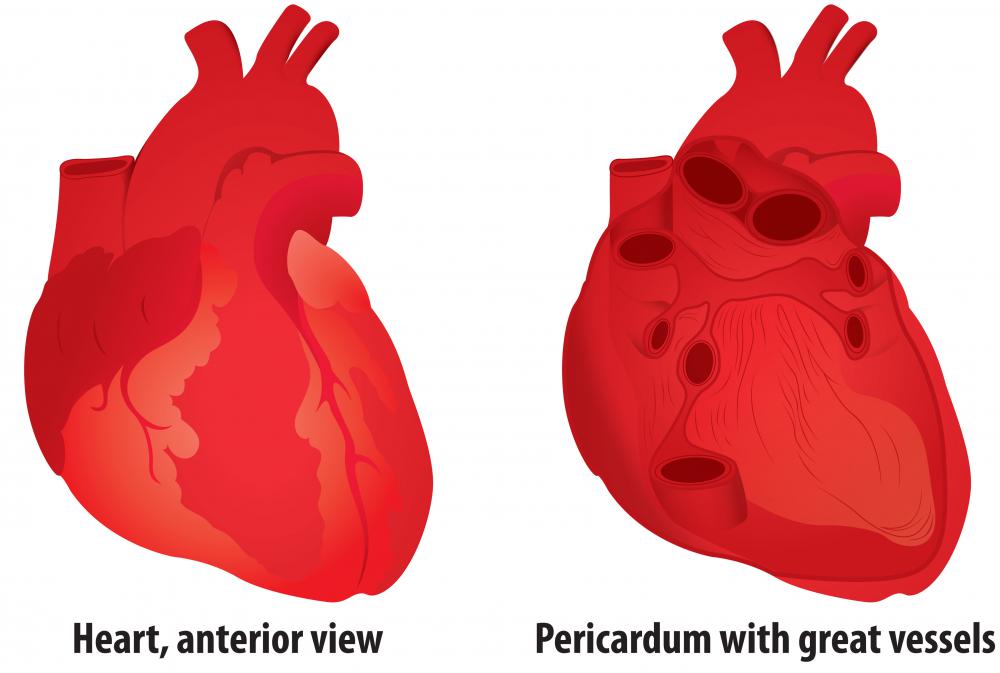
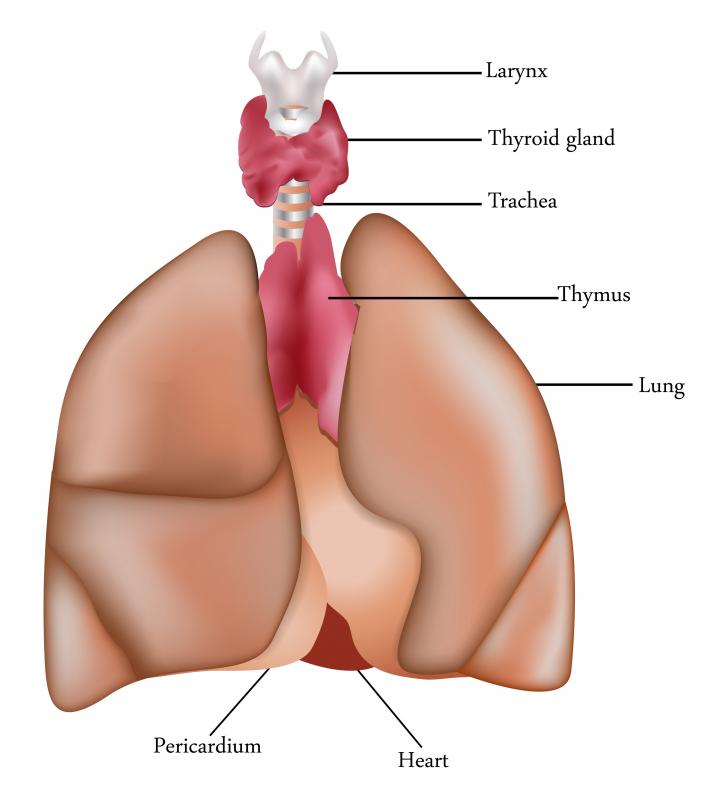
The pericardium is a protective sac around the heart and the roots of the major veins and arteries leading to it. It consists of two primary layers, one of which is broken down into two sub-layers. Its main purpose is to hold and lubricate the heart, and make sure that it doesn't expand too much. Though problems with the pericardium are fairly rare, they can occur if it swells up or collects too much fluid. Most of the time, such problems are treatable, though a particularly large build up of fluid, called a cardiac tamponade, can be a life-threatening emergency.
Structure

This sac is made up of two main parts: the fibrous layer, which is outermost from the heart, and the serous layer, which is inside of it. The fibrous layer is adjacent to the pleura, or the membrane covering the lungs, and is attached to the breastbone and the diaphragm. The serous layer is divided into two sub-layers: the parietal layer, which is immediately inside the fibrous layer, and the visceral layer, which is directly next to the heart. There is about 1.2 ounces (35 ml) of fluid in the space between the visceral and parietal layers, which is called the pericardial cavity.
Functions

The pericardium serves three main functions. It protects the heart and holds it in place, ensuring that it isn't affected by changes in blood pressure and that it can keep functioning even if a person receives a severe blow to the chest. It also keeps the heart lubricated, so it can pump efficiently and smoothly, without it or the different layers of the pericardial sac catching on one another. Additionally, it limits the amount of space that the heart has to expand in, which keeps the heart from getting too big when it fills with blood.
Pericardial Disorders

One of the most common problems associated with the pericardium is a condition called pericarditis, in which it becomes inflamed and swollen, causing pain and shortness of breath. This can be caused by a viral infection, an inflammatory condition like lupus, a tumor, or trauma directly to the heart, as in the case of cardiac surgery or an injury. Some people also develop it in response to certain medications, including phenytoin and procainamide, and some have it for no discernible reason at all. Many cases of pericarditis resolve themselves, and this condition is usually not a cause for concern as long as the swelling doesn't become too serious. The common treatment for most cases of mild pericarditis is Non-Steroidal Anti-Inflammatory Drugs (NSAIDs).

Another common pericardial disorder is pericardial effusion, in which extra fluid builds up in the pericardium, putting pressure on the heart. It can stem from extended periods of pericarditis, trauma, an infection, lupus, or cancer, and generally clears up when the underlying condition is treated. If too much fluid builds up, then a condition called cardiac tamponade can occur, in which the increase in pressure seriously affects the heart's functioning. This is a medical emergency, and can be deadly if not treated promptly. The treatment for cardiac tamponade it usually either pericardiocentesis, in which fluid is removed from the pericardium with a needle and syringe, or a pericardial window, in which a surgeon cuts a hole in the pericardium and places a chest tube in it to drain the fluid.
Michael Pollick
A regular TheHealthBoard contributor, Michael enjoys doing research in order to satisfy his wide-ranging curiosity about a variety of arcane topics. Before becoming a professional writer, Michael worked as an English tutor, poet, voice-over artist, and DJ.
Learn more...
Michael Pollick
A regular TheHealthBoard contributor, Michael enjoys doing research in order to satisfy his wide-ranging curiosity about a variety of arcane topics. Before becoming a professional writer, Michael worked as an English tutor, poet, voice-over artist, and DJ.
Learn more...AS FEATURED ON:
AS FEATURED ON:


-
![The protective sac around the heart and the roots of the major veins and arteries leading to it is called the pericardium.]() By: AlienCatThe protective sac around the heart and the roots of the major veins and arteries leading to it is called the pericardium.
By: AlienCatThe protective sac around the heart and the roots of the major veins and arteries leading to it is called the pericardium. -
![Pericarditis can cause pain and shortness of breath.]() By: nuiikoPericarditis can cause pain and shortness of breath.
By: nuiikoPericarditis can cause pain and shortness of breath. -
![Individuals who have experienced a recent heart attack or sustained trauma to the chest and heart may develop pericarditis.]() By: hrianaIndividuals who have experienced a recent heart attack or sustained trauma to the chest and heart may develop pericarditis.
By: hrianaIndividuals who have experienced a recent heart attack or sustained trauma to the chest and heart may develop pericarditis. -
![Excess fluid between the heart and the pericardium is referred to as pericardial effusion.]() By: arcticsilenceExcess fluid between the heart and the pericardium is referred to as pericardial effusion.
By: arcticsilenceExcess fluid between the heart and the pericardium is referred to as pericardial effusion. -
![If pericardial fluid exerts pressure on the heart, it can restrict its movement.]() By: reinegIf pericardial fluid exerts pressure on the heart, it can restrict its movement.
By: reinegIf pericardial fluid exerts pressure on the heart, it can restrict its movement. -
![The pericardium ensures that the heart isn't affected by changes in blood pressure.]() By: Photographee.euThe pericardium ensures that the heart isn't affected by changes in blood pressure.
By: Photographee.euThe pericardium ensures that the heart isn't affected by changes in blood pressure. -
![Cancers affecting the lungs can metastasize to the peritoneum.]() By: NaeblysCancers affecting the lungs can metastasize to the peritoneum.
By: NaeblysCancers affecting the lungs can metastasize to the peritoneum. -
![Situations where the pericardium fills up with too much fluid can be life-threatening emergencies.]() By: CandyBox ImagesSituations where the pericardium fills up with too much fluid can be life-threatening emergencies.
By: CandyBox ImagesSituations where the pericardium fills up with too much fluid can be life-threatening emergencies.





Discuss this Article
Post your comments