
At TheHealthBoard, we're committed to delivering accurate, trustworthy information. Our expert-authored content is rigorously fact-checked and sourced from credible authorities. Discover how we uphold the highest standards in providing you with reliable knowledge.
What is the Parietal Lobe?
 Tricia Christensen
Tricia Christensen
Tricia Christensen
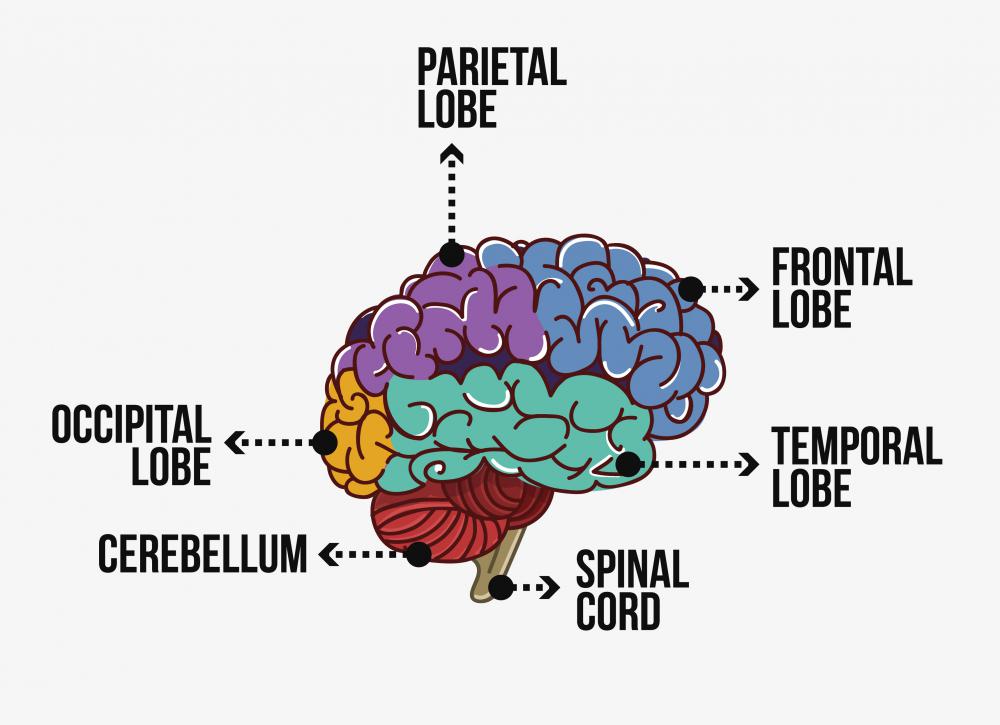
Part of the brain called the forebrain contains a number of different elements. One of these is the cerebrum, which is divided into sections referred to as lobes. The parietal lobe is one of these sections that sits in between the front and back lobes, known as the frontal and occipital lobes. The name of this section of the brain may not mean much until it is understood that it sits under the parietal bone.
Like most brain structures, the parietal lobe has many functions, which may be different depending on which side of the lobe is considered, since it stretches to both sides of the brain. The right side helps to do things like interpret spatial information, and it may have an effect on regulating personality. The left side is involved in a person’s ability to perceive numbers, understand what objects are, and perform writing tasks. This side is also involved in language production and perception.

Researchers know that the functions vary by side because damage to either or both sides of the lobe has been shown to inhibit certain abilities. Additionally, a number of tests on people with undamaged brains have helped determined what sections are involved in certain tasks. For example, a study performed at the end of the 20th century showed the very special part the left parietal lobe and the frontal lobe have to play in mathematics operations, even simple math like arithmetic. When test participants were asked to answer simple arithmetic problems, a great deal of activity was shown in the parietal and frontal lobe sections of the brain.

It’s understood that damage to the lobe through injury, malformation, cell death, or the presence of tumors can result in significant changes in human behavior and personality. People with such damage can suffer from conditions like aphasia, which means they have trouble remembering certain words or producing some types of language. Similarly, it’s been shown that the ability to remember numbers decreases if damage or illness is present.

There are several conditions specifically associated with problems with the parietal lobe. One of these is Gerstmann syndrome, which may be present in childhood or adulthood (especially after a stroke), and has symptoms that include trouble writing (dysgraphia), challenges when speaking, issues in understanding the communication of others, and difficulty with math (dyscalculia). How to address the disorder isn’t always known, but early diagnosis may help, especially in young children, since occupational therapy can be used to help overcome any deficits.
Tricia Christensen
Tricia has a Literature degree from Sonoma State University and has been a frequent TheHealthBoard contributor for many years. She is especially passionate about reading and writing, although her other interests include medicine, art, film, history, politics, ethics, and religion. Tricia lives in Northern California and is currently working on her first novel.
Learn more...
Tricia Christensen
Tricia has a Literature degree from Sonoma State University and has been a frequent TheHealthBoard contributor for many years. She is especially passionate about reading and writing, although her other interests include medicine, art, film, history, politics, ethics, and religion. Tricia lives in Northern California and is currently working on her first novel.
Learn more...AS FEATURED ON:
AS FEATURED ON:


-
![The parietal lobe is situated between the frontal and occipital lobes.]() By: Matthew ColeThe parietal lobe is situated between the frontal and occipital lobes.
By: Matthew ColeThe parietal lobe is situated between the frontal and occipital lobes. -
![The two hemispheres of the brain generally carry out different functions, including those handled by the parietal lobes.]() By: Athanasia NomikouThe two hemispheres of the brain generally carry out different functions, including those handled by the parietal lobes.
By: Athanasia NomikouThe two hemispheres of the brain generally carry out different functions, including those handled by the parietal lobes. -
![The functions of the parietal lobe include helping people recognize faces and read words.]() By: baluchisThe functions of the parietal lobe include helping people recognize faces and read words.
By: baluchisThe functions of the parietal lobe include helping people recognize faces and read words. -
![Damage to the parietal lob may cause personality changes to occur.]() By: CreativaDamage to the parietal lob may cause personality changes to occur.
By: CreativaDamage to the parietal lob may cause personality changes to occur. -
![Parietal lobe damage will never affect two people in the exact same way.]() By: Verity JohnsonParietal lobe damage will never affect two people in the exact same way.
By: Verity JohnsonParietal lobe damage will never affect two people in the exact same way.




Discussion Comments
@lighth0se33 – I'm glad that a few people were brave enough to volunteer. Think about how much more doctors know about the functions of the parietal lobe because of these people!
If they just had to poke around in there during an emergency surgery, there might not be time to experiment with tests. Since the testing has already been done, surgeons know enough about the brain to react quickly and do what needs to be done right away.
My aunt had a stroke, and the function of her parietal lobe declined. She developed Gerstmann syndrome.
She couldn't speak except to say, “Yeah.” She couldn't use her hands for months.
She eventually learned to say a few other words again, but most of these she could only say after someone else had just uttered them. It was improvement, but it was slight.
I can't believe that people with no parietal lobe damage actually volunteered for a study like this! They probably had to have at least part of their heads shaved so the surgeons could get to their brains. There's no way I would let anyone cut on my brain if it didn't need some sort of repair!
Post your comments