
At TheHealthBoard, we're committed to delivering accurate, trustworthy information. Our expert-authored content is rigorously fact-checked and sourced from credible authorities. Discover how we uphold the highest standards in providing you with reliable knowledge.
What is the Greater Tuberosity?
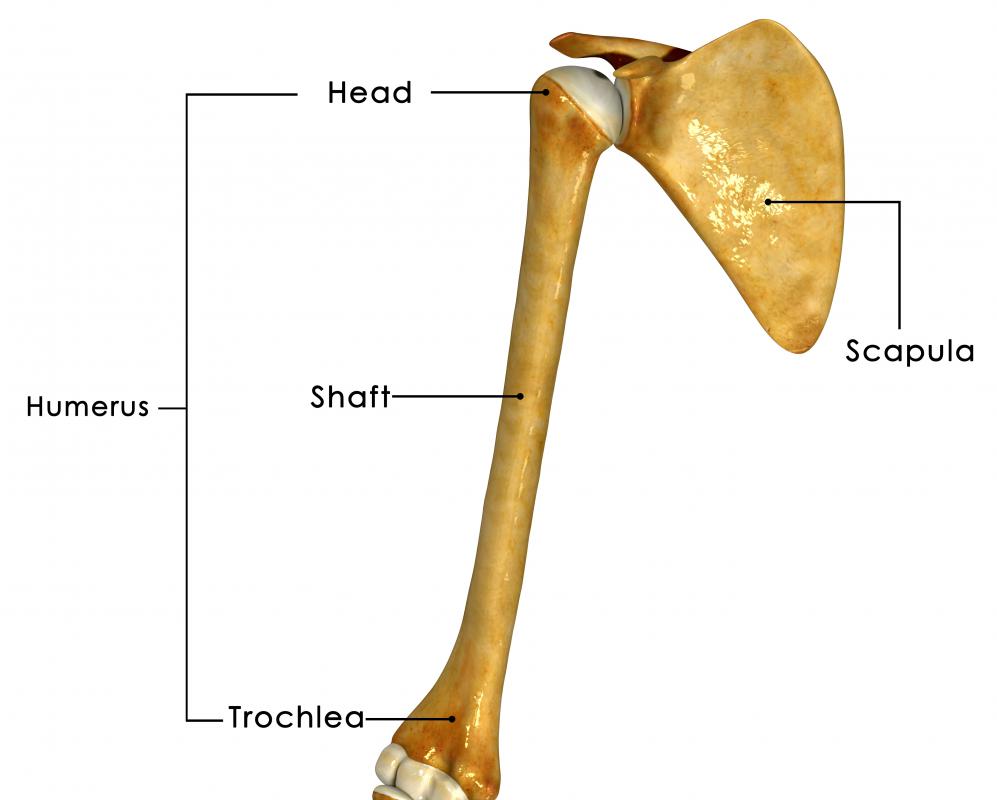
The greater tuberosity, located on the humerus next to the head of the humerus and the lesser tuberosity, is a large, bulbous protrusion from this long arm bone that serves as an attachment point for several muscles. Four of these muscles control movement of the shoulder. As a group, they are referred to as the rotator cuff, which functions to provide the wide variety of movements that the shoulder can perform and to hold the greater tuberosity in place in the complex shoulder joint. When the shoulder becomes dislocated, it often is because the head of the humerus, located next to the greater tuberosity, has slid out of its normal position.
Falling directly on the shoulder can cause a bone fracture to the greater tuberosity, which is located on the "point" of the shoulder. This type of arm injury also occurs about 15 percent of the time when the shoulder is dislocated, or pulled out of position, and is more likely when the dislocation occurs toward the front rather than toward the back. Shoulder dislocation is seen as a result of violent stress to the shoulder joint and sometimes can happen during severe seizures or as a result of sports accidents. The way the bone breaks during this type of injury is why fractures to the greater tuberosity are referred to as shear injuries.

Fractures to this area can require surgical treatment, including placing screws in the bone to hold the fragments in place during healing. Treatment must also allow for movement of the shoulder during healing in order to prevent the joint from freezing and thus losing much of its natural mobility. For this reason, it is vital not only to have proper treatment during healing, physical therapy after the break has healed also is very important.

In many cases, however, fractures of the greater tuberosity heal without surgical intervention because the natural location of the bone in the shoulder joint produces enough pressure to hold any bone fragments in place during the healing period. Doctors in the field of orthopedics often recommend holding the shoulder joint immobile with a sling for several weeks, then a period of physical therapy to restore motion to the joint. If, after this period of healing, there still is weakness or pain in the shoulder, surgery might then be recommended to help the fragments of the greater tuberosity heal properly. Repair to the muscles of the rotator cuff sometimes is necessary as well.
AS FEATURED ON:
AS FEATURED ON:


-
![Fractures of the greater tuberosity are often treated with the aid of a sling.]() By: waxartFractures of the greater tuberosity are often treated with the aid of a sling.
By: waxartFractures of the greater tuberosity are often treated with the aid of a sling. -
![If shoulder persists after a fracture of the greater tuberosity, surgery may be recommended to help the injury heal properly.]() By: Photographee.euIf shoulder persists after a fracture of the greater tuberosity, surgery may be recommended to help the injury heal properly.
By: Photographee.euIf shoulder persists after a fracture of the greater tuberosity, surgery may be recommended to help the injury heal properly. -
![Falling on the shoulder can cause a bone fracture to the greater tuberosity.]() By: Alexander GospodinovFalling on the shoulder can cause a bone fracture to the greater tuberosity.
By: Alexander GospodinovFalling on the shoulder can cause a bone fracture to the greater tuberosity. -
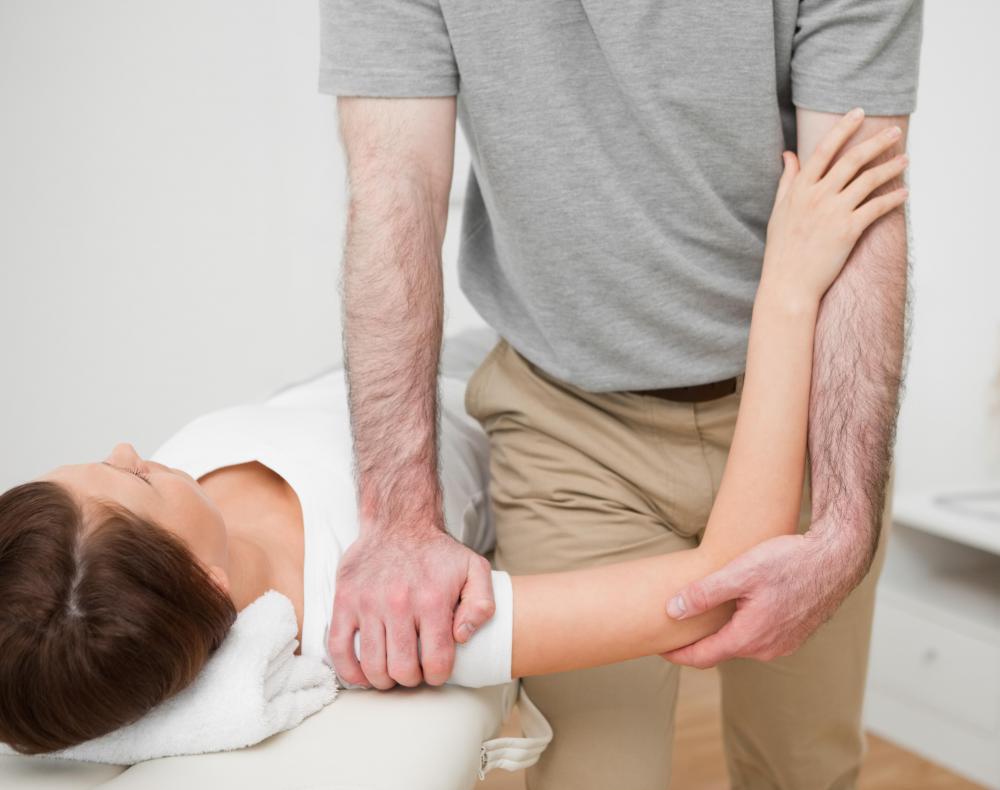
![Physical therapy is a necessity following a fracture to the greater tuberosity.]() By: WavebreakMediaMicroPhysical therapy is a necessity following a fracture to the greater tuberosity.
By: WavebreakMediaMicroPhysical therapy is a necessity following a fracture to the greater tuberosity. -
![When the shoulder becomes dislocated, it is often because the humerus has slid out of its normal position.]() By: 7activestudioWhen the shoulder becomes dislocated, it is often because the humerus has slid out of its normal position.
By: 7activestudioWhen the shoulder becomes dislocated, it is often because the humerus has slid out of its normal position. -
![Shoulder dislocation may occur as a result of violent stress to the shoulder joint.]() By: cristovao31Shoulder dislocation may occur as a result of violent stress to the shoulder joint.
By: cristovao31Shoulder dislocation may occur as a result of violent stress to the shoulder joint.




Discussion Comments
On New Year's Day, my wife fractured her greater tuberosity. After two and a half weeks, the associated pain is getting worse daily. At the moment we both are pessimistic about the outcome and hope we actually have no cause to be so. At our advanced age, we know that is against us but -- fingers crossed (if possible!)
Please suggest to me what I should do? My MRI report says
an MRI study of right shoulder reveals marrow edema in the greater tuberosity of humerus suggesting Hillsach's lesion. There are suggestion of minimal tears in supraspinatus tendon with bicipital tendinitis. Please correlate clinically.
I had a greater tuberosity fracture 2 1/2 months ago and there is hope for returned range of motion after lots of physical therapy and exercise.
I had a skiing accident, falling face first at about 25 mph. The impact onto my outstretched arms caused a greater tuberosity fracture of my left humerus. I have very toned shoulder muscles due to my work. The doc did X-rays to diagnose and had me in a sling for six weeks, after which he said it's healed so now go start getting movement back. But now at 16 weeks and pushing it hard (maybe too hard) it is as bad off in the sideways lifting as day three after the accident. I have no movement other than maybe 6" from my side. I want an MRI but the doc says it's not necessary.
I am out of work as I am a professional athlete and life stinks pretty much about now. I'm on the sidelines for now and permanently, I fear, the way things are going.
I had a skiing accident falling face first at about 25 mph. The impact onto the outstretched arms caused a greater tuberosity fracture of left humerus. The doc did xrays to diagnose and had me in a sling for 6 weeks after which he said it's healed so now go start getting movement back. But now at 16 weeks it is as bad off in the sideways lifting as day 3 after the accident. No movement. I want an MRI bu he says it's not necessary. I am out of work as I am a professional athlete and life sucks pretty much about now. On the sidelines.
I fell down from halfway up a flight of stairs, apparently on my left shoulder, and could not move it. I had no idea that I could have broken any bones as I have never had any fractures before. I also broke a couple of ribs from the fall.
My primary care physician didn't think there were any broken bones, either. He wanted me to have an MRI, but because I have metal clips in my neck on the left side from a prior surgery to remove my parotid gland and submandibular gland, he had to order a CT scan. The CT scan showed the fractures.
My question is: how can the orthopedist or other doctor know if there are any other problems going on in that area i.e. muscles and /or tendons, without an MRI?
Thank You for explaining this type of injury in terms we regular people can understand.
I fell while standing on a rolling chair (smart, I know) and landed on my outstretched arm- three months ago. My greater tuberosity fracture has not healed at all and there is 'extensive bone marrow edema' around the site, according to this latest MRI. I am amazed that it can still be bleeding as much as when it first happened.
I am scheduled for internal fixation (screw- or plate if the bone is mush) one week from today. It feels like so much more is damaged in there as well. The surgeon said it would be laparoscopic, unless he finds large tears in the rotator cuff. This whole experience just really stinks!
I suffered a greater tuberosity fracture a week ago from a mountain biking accident. This is the first website I've found that describes the injury in easy-to-understand terms (thanks!).
My doctor said that he doesn't think I'll need surgery because the bone fragment is still in place. He's got me in a sling for three weeks, then he's going to take a closer look at the soft tissue (I believe with an MRI) to see if I need any repairs there.
@SimeyO - I am so sorry that you are still experiencing pain from your injury. I have some understanding of how painful it can be.
Our son participated in wrestling in high school. During one of his matches in his senior year his shoulder was dislocated which resulted in what they called a greater tuberosity humerus fracture.
It was his right shoulder that was injured and with surgery and recovery time he missed quite a bit of school. Luckily he was still able to graduate!
When I had a shoulder injury after I was knocked down after playing soccer, my doctors ordered a arthrogram to diagnose that I had a tuberosity fracture. I didn't have to have surgery but it took a lot of physical therapy to get normal motion back and I still have a bit of pain to this day.
Post your comments