
At WiseGEEK, we're committed to delivering accurate, trustworthy information. Our expert-authored content is rigorously fact-checked and sourced from credible authorities. Discover how we uphold the highest standards in providing you with reliable knowledge.
What Is the Greater Occipital Nerve?
The greater occipital nerve runs between the first and second cervical vertebrae to the top of the scalp. One branch runs down both the right and left side of the neck, along with the lesser occipital nerves. This nerve extends almost to the forehead and permits sensations on the scalp.
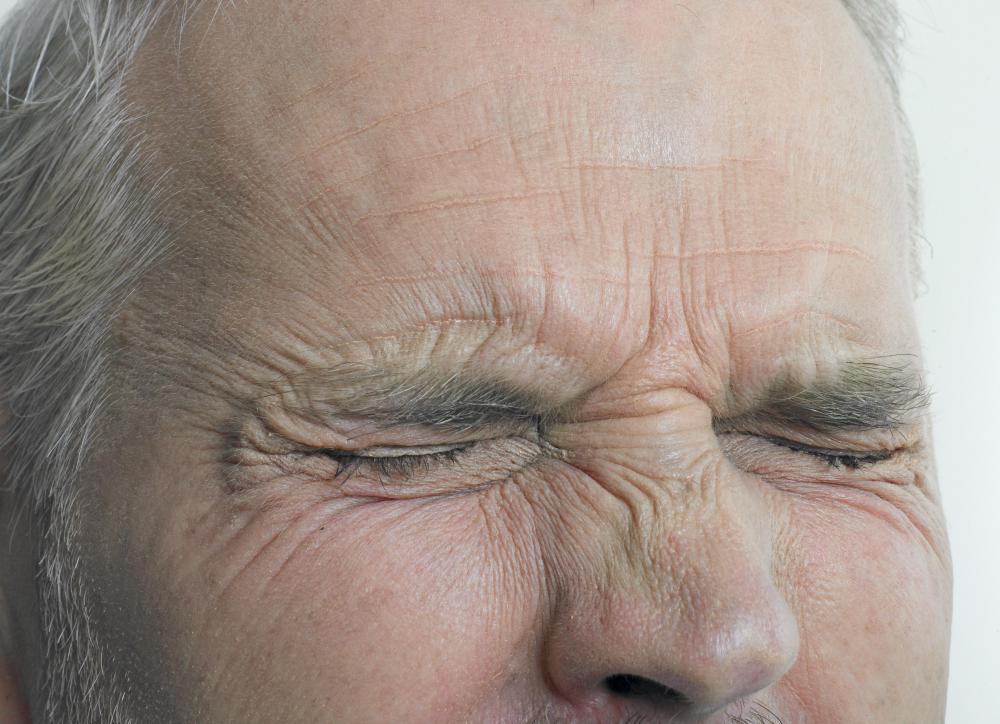
Disorders of the nerve might create stabbing, burning, or tingling pain that radiates to the eye. In some patients, the scalp becomes ultra sensitive to any kind of touch, making it difficult to wash the hair or rest on a pillow. This condition is called occipital neuralgia and occurs in three forms.

Long-term pain and discomfort in this nerve might resemble a tension headache with pain in the back of the neck and head. The area might be tender to the touch and the pain can affect one or both sides of the head. Muscles in the neck might be stiff, and pain typically spreads to the forehead and near the eye.
The second form of occipital neuralgia produces migraine headaches marked by intense pain lasting between two and 36 hours. It may stem from inflammation of the nerve that starts on one side of the head and spreads to the other side. Some people suffer nausea and vomiting with a migraine, along with sensitivity to light. Medical professionals might call this disorder a migraine involving the greater occipital nerve instead of occipital neuralgia.

Occipital neuralgia can occur from injury, a tumor, inflammation, or pressure on the nerve when it becomes compressed. Tension in the neck might precipitate a pinched nerve, leading to pain. These conditions might cause the scalp to become extremely tender and result in frequent headaches.
Treatment typically involves a greater occipital nerve block to deaden sensation to the scalp. An injection of anesthesia and steroids might numb pain and address swelling. The anesthesia generally wears off in a few hours, but steroids usually start relieving pain in a few days. Some patients need additional injections to control pain, but medical professionals generally limit nerve block treatments to no more than three within six months.

If nerve block injections fail to control discomfort, several other treatments might be tried. The nerve can be cut to permanently block sensation to the head. Injections of a toxin might kill nerve cells causing pain, or radio waves might deaden nerves. Another option involves the implantation of a nerve stimulator, similar to a pacemaker, that converts pain to a tingling sensation. These treatments might cause permanent numbness to the scalp region.
AS FEATURED ON:
AS FEATURED ON:









-
![Occipital neuralgia may result in frequent headaches.]() By: Ana Blazic PavlovicOccipital neuralgia may result in frequent headaches.
By: Ana Blazic PavlovicOccipital neuralgia may result in frequent headaches. -
![Greater occipital nerve discomfort may manifest as pain in the back of the head and neck.]() By: vladimirfloydGreater occipital nerve discomfort may manifest as pain in the back of the head and neck.
By: vladimirfloydGreater occipital nerve discomfort may manifest as pain in the back of the head and neck. -
![An inflamed occipital nerve may cause intense migraine headaches.]() By: MediablitzImagesAn inflamed occipital nerve may cause intense migraine headaches.
By: MediablitzImagesAn inflamed occipital nerve may cause intense migraine headaches. -
![A gel pack can be used to soothe neck pain caused by damage to the greater occipital nerve.]() By: JPC-PRODA gel pack can be used to soothe neck pain caused by damage to the greater occipital nerve.
By: JPC-PRODA gel pack can be used to soothe neck pain caused by damage to the greater occipital nerve. -
![Light sensitivity can be cause by headaches.]() By: djtaylorLight sensitivity can be cause by headaches.
By: djtaylorLight sensitivity can be cause by headaches. -
![Disorders of the nerve may cause stabbing pain that radiates to the eye.]() By: Laurent HamelsDisorders of the nerve may cause stabbing pain that radiates to the eye.
By: Laurent HamelsDisorders of the nerve may cause stabbing pain that radiates to the eye.




Discuss this Article
Post your comments