
At TheHealthBoard, we're committed to delivering accurate, trustworthy information. Our expert-authored content is rigorously fact-checked and sourced from credible authorities. Discover how we uphold the highest standards in providing you with reliable knowledge.
What Is the Function of the Nucleolus?
A nucleus of a cell holds the necessary genetic information for the organism. Part of this nucleus is the nucleolus, which specializes in certain ribonucleic acid (RNA) products of the genes. The primary function of the nucleolus is to make ribosomes, which act as workhorses to transcribe information from deoxyribonucleic acid (DNA).
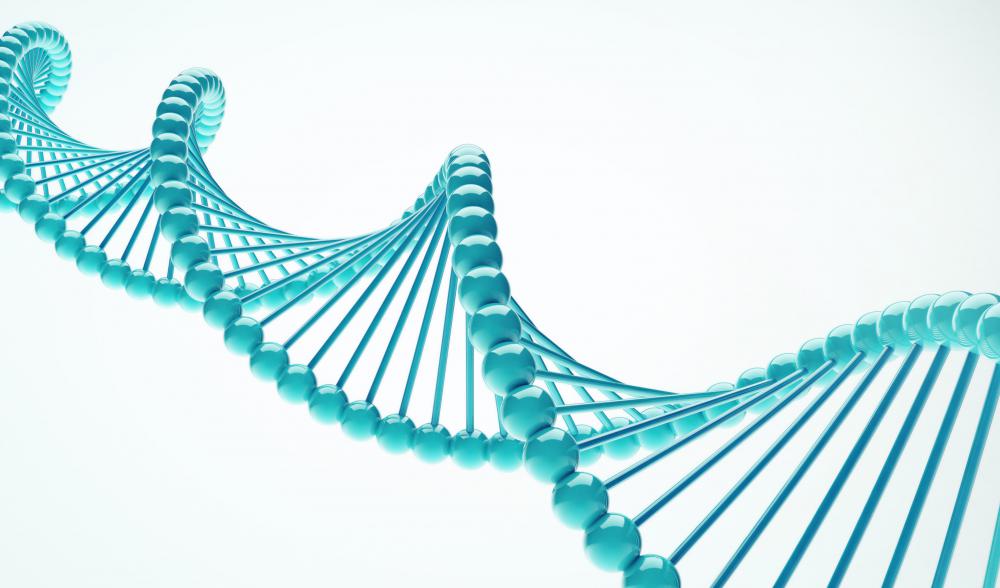
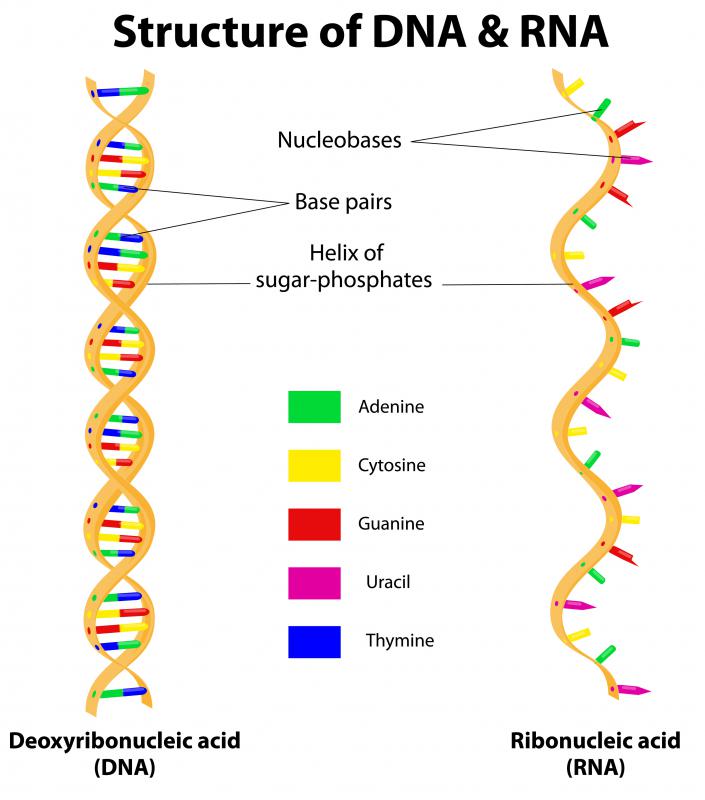
DNA is the blueprint for all of the functions of a cell. The cell reads the code of the DNA and turns it into RNA sequences. Then, the cell reads the RNA sequence as a blueprint for protein sequences.

Inside the cell in a area enclosed by a membrane is the DNA of the cell. This is the nucleus. Inside the nucleus is a dense area whose outer boundaries are not wrapped in a membrane. This is the nucleolus. This area shows up under a microscope as a dark spot inside the nucleus.
Nuclei of cells are the areas where the cell reads genetic information, creates the RNA intermediary, and then produces the appropriate proteins. To do this, the cell needs to also build ribosomes, which are structures made of RNA that acts as workers to bring the various raw materials together. The function of the nucleolus is to make these ribosomes. Structurally, the nucleolus is made of two different substances.

The fibrillar part of the nucleolus is made of protein and the ribosomal RNA (rRNA) structures. These directly act on DNA to transcribe the sequence information into RNA. The function of the nucleolus granular substance, on the other hand, is composed of immature sections of the rRNA, which are waiting to be exported into the cytoplasm. There, the immature subunits develop into the mature 40 S and 60 S ribosomal subunits.

As the function of the nucleolus is to make ribosomal subunits only, the size of the nucleolus can vary depending on the type of cell it is in. Cells that make more protein require more ribosomes to keep up with manufacturing, and so these cells have large nucleoli. Sometimes, up to a quarter of the volume of the nucleus is taken up with the nucleolus.
Each adult human cell can have only one nucleolus, although different species of eukaryotes have varying numbers. A eukaryote is an organism with a membrane-bound nucleus, such as animals, as opposed to organisms whose genetic information is free in the cell, such as bacteria. When a human cell divides, ten small nucleoli appear instead of one before merging into one large nucleolus. Nucleoli may have other functions apart from making ribosomes, and research is ongoing into an association between cell aging and the nucleolus.
AS FEATURED ON:
AS FEATURED ON:


-
![The nucleolus makes ribosomes, which are critical to DNA function.]() By: Mark RasmussenThe nucleolus makes ribosomes, which are critical to DNA function.
By: Mark RasmussenThe nucleolus makes ribosomes, which are critical to DNA function. -
![DNA is the blueprint for all the functions of a cell.]() By: xtockDNA is the blueprint for all the functions of a cell.
By: xtockDNA is the blueprint for all the functions of a cell. -
![The primary function of the nucleolus is to make ribosomes, which transcribe information from DNA.]() By: designuaThe primary function of the nucleolus is to make ribosomes, which transcribe information from DNA.
By: designuaThe primary function of the nucleolus is to make ribosomes, which transcribe information from DNA.

Discussion Comments
So as described in the article above, nucleolus should be important for biologists to study cell aging. Maybe this is a great point to reveal the secret of aging.
Post your comments