
At SmartCapitalMind, we're committed to delivering accurate, trustworthy information. Our expert-authored content is rigorously fact-checked and sourced from credible authorities. Discover how we uphold the highest standards in providing you with reliable knowledge.
What is the Federal Reserve?
 Mary McMahon
Mary McMahon
Mary McMahon
The Federal Reserve, or Fed is the central system of banking of the United States. It is owned both publicly and privately, and is comprised of a number of different branches, which work together to control the supply of money in the American economy and to set fiscal policy. The goal of this organization is to keep the American economy strong, healthy, and balanced using a blend of central policymaking and localized branches.
The Federal Reserve was created by the Federal Reserve Act of 1913, although several attempts at creating a central bank had been made before this act was passed. Since the Fed plays a major role in the American economy, most economic analysts keep a close eye on its activities, as the Fed's actions will influence the direction of the economy.

The centralized portion of the bank is the Board of Governors, which consists of a group of presidentially appointed policymakers who serve terms of 14 years each. Appointments are staggered to ensure that a single President does not end up with too much control over the Board of Governors, which acts independent of the federal government. The Board of Governors meets on a regular basis to discuss monetary policies and to implement new policies, if necessary. Members of the board come from all over the United States, ensuring that the board has a broad perspective on the American economy.

The seven members of the board also sit on the Federal Open Market Committee, the branch of the Federal Reserve which oversees open market operations. In addition to the board members, the Open Market Committee also includes five representatives from Fed banks; the President of the New York district always sits on the committee, and the other four seats are rotated on a regular basis. The Federal Open Market Committee meets eight times a year, and meetings are attended by representatives of all Federal Reserve banks.

There are 12 regional Federal Reserve banks, broken up by district and usually referred to by the city in which the regional bank is headquartered: Boston, New York, San Francisco, Philadelphia, Richmond, Kansas City, Dallas, Minneapolis, Atlanta, St. Louis, Chicago, and Cleveland. These branch banks retain reserves of currency, and each bank has its own President and board. In addition to the regional banks, there are also a number of member banks, which include all national banks and some regional banks which elect to join the Federal Reserve.
Mary McMahon
Ever since she began contributing to the site several years ago, Mary has embraced the exciting challenge of being a SmartCapitalMind researcher and writer. Mary has a liberal arts degree from Goddard College and spends her free time reading, cooking, and exploring the great outdoors.
Learn more...
Mary McMahon
Ever since she began contributing to the site several years ago, Mary has embraced the exciting challenge of being a SmartCapitalMind researcher and writer. Mary has a liberal arts degree from Goddard College and spends her free time reading, cooking, and exploring the great outdoors.
Learn more...AS FEATURED ON:
AS FEATURED ON:








-
![Richmond, Virginia, is the site of one of the country's regional Federal Reserve banks.]() By: josefhanusRichmond, Virginia, is the site of one of the country's regional Federal Reserve banks.
By: josefhanusRichmond, Virginia, is the site of one of the country's regional Federal Reserve banks. -
![St. Louis is home to a Regional Federal reserve bank.]() By: Marty HaasSt. Louis is home to a Regional Federal reserve bank.
By: Marty HaasSt. Louis is home to a Regional Federal reserve bank. -
![The Federal Reserve System is headquartered in the Mariner S. Eccles Building in Washington.]() By: qingwaThe Federal Reserve System is headquartered in the Mariner S. Eccles Building in Washington.
By: qingwaThe Federal Reserve System is headquartered in the Mariner S. Eccles Building in Washington. -
![Philadelphia is home to 1 of the 12 Federal Reserve banks.]() By: SeanPavonePhotoPhiladelphia is home to 1 of the 12 Federal Reserve banks.
By: SeanPavonePhotoPhiladelphia is home to 1 of the 12 Federal Reserve banks. -
![Dallas is home to one of the 12 regional Federal Reserve banks in the U.S.]() By: kanonskyDallas is home to one of the 12 regional Federal Reserve banks in the U.S.
By: kanonskyDallas is home to one of the 12 regional Federal Reserve banks in the U.S. -
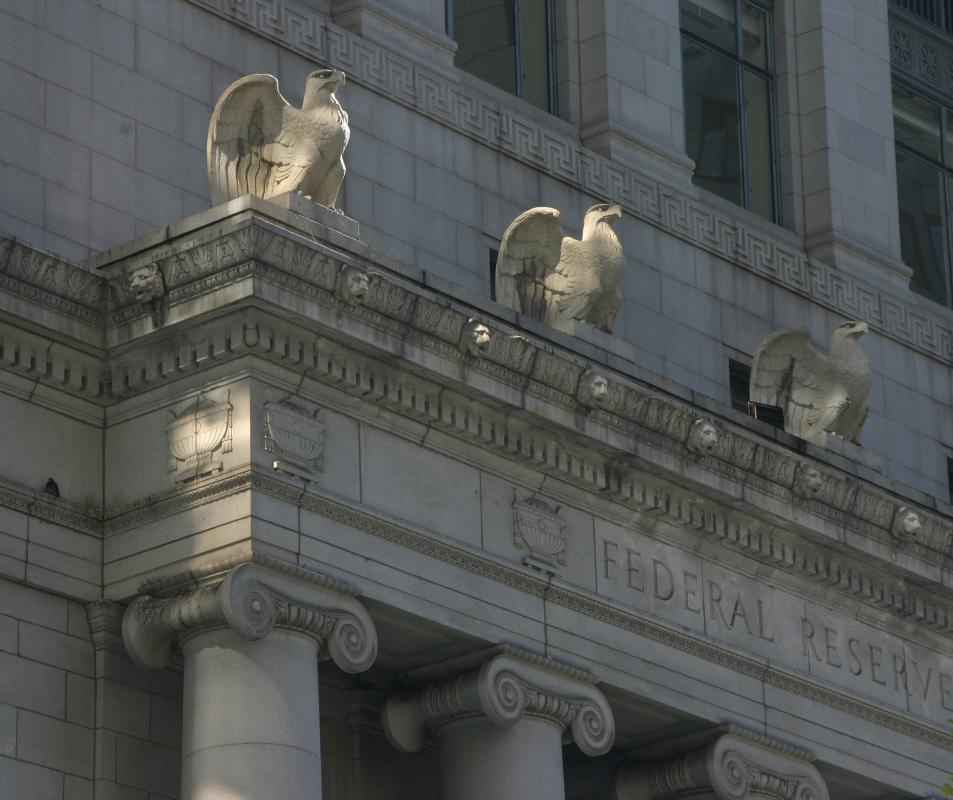
![The Federal Reserve's actions impact the direction of the overall economy.]() By: Aaron KohrThe Federal Reserve's actions impact the direction of the overall economy.
By: Aaron KohrThe Federal Reserve's actions impact the direction of the overall economy.


Discussion Comments
OK maybe a dumb question: Why should a nation's (in our case, USA) money supply be in the hands of privately owned banks? Shouldn't a nation's money be controlled and supplied by said nation's treasury?
anon335303, post 10 has really nailed it. This is what must be done and what I in my own small way am already doing living off grid in Portugal. I have 500 watts of solar panel on the roof, 15 hens, 8 goats and 12 sheep. When not planting things, I go fishing. My place cost about $20,000 to buy and provides ample energy, room and sustenance for two adults and three kids with plenty left over to barter. Free yourselves. We all have the power.
Pretty much, the Federal Reserve is owned by a group of powerful international families of bankers. You may know them better as the rich-ruling elite, or Illuminati. They created the Fed, made a recall of all gold, in order to put the world into debt. Because money is now legal tender, you don't actually have any money -- just useless paper. Why? Because everybody owes money to someone else, therefore everyone is in debt, and debt is owed to everybody.
This is what keeps the money flowing, because if everybody paid off all their debt, there would be no money in circulation. The money system would stop dead, causing the system to fail. Which is why we need to boycott the banks, become debt free and start communities that go outside the law and currency.
In a free world, you wouldn't need to be told that you're free.
For every dollar printed in the fed the us government has to pay interest to the fed. where does the interest come from?
how does the federal reserve monitor inflation and unemployment?
reference the number 5 comment above. The Federal Reserve System is the Central Bank of the U.S. It requires no backing to print money, remember.
Where does the unlimited supply of money come from?
The tax money goes to the U.S. treasury so where does the fed get the trillions to lend from?
Names of the members that sit on the Federal Reserve Governors Board. Why is kept a secret who they are? Doesn't America need to know who they are? We the people have been lied to forever, yet the government is supposed to be for the people etc.
zeitgeist: addendum....watch it on google video. it explains the true nature of the fed.
The American economy is definitely not strong, healthy, or balanced... Destroy the Fed!
The Federal Reserve is not owned by the Federal Government but rather is a private corporation owned by 10 banks...most of which are foreign banks! The banks themselves have majority owners which means that outside private interests own the US Federal Reserve. The name only sounds official and sounds like the government owns it. It was designed that way to fool the ordinary person. The original purpose was to keep the US Congress out of the influence loop and make the bank independent. What a farce that is. It can be argued that all our problems stem from wayward outside interests pushing the Fed to raise or lower interest rates to suit their interests and not the best interests of the US citizen. The Congress, in its wisdom back then, allowed the Fed to manufacture money, out of thin air, which when pushed into the money system or pulled out of the money system made interest rates rise or fall. However, in adding money to the system...thereby causing inflation but driving down interest rates, the Fed was allowed to charge interest which is why there is a national debt. Who do we owe this money to? Why the Federal Reserve who is really the representative of those 10 banks...mostly foreign banks. Rockefeller, for example, owns 22% of the largest of the 12 banks (the New York Federal Reserve) that make up the Federal Reserve and that the New York Federal Reserve owns the majority interest in the other not so powerful Fed Banks.
In the conspiracy world...one of the possible reasons for killing Kennedy was that he was going to demand that the Treasury Secretary issue Government backed money and move away from the foreign owned Federal Reserve Bank. Hence the "they and them" were not going to let a good thing go so they took him out as only insiders could have known the route and made the guards stand down. The insiders represent the guardians of the "they and them". Such power exits!
The expression "follow the money" is where this power lies.
Post your comments