
At WiseGEEK, we're committed to delivering accurate, trustworthy information. Our expert-authored content is rigorously fact-checked and sourced from credible authorities. Discover how we uphold the highest standards in providing you with reliable knowledge.
What is the External Jugular Vein?
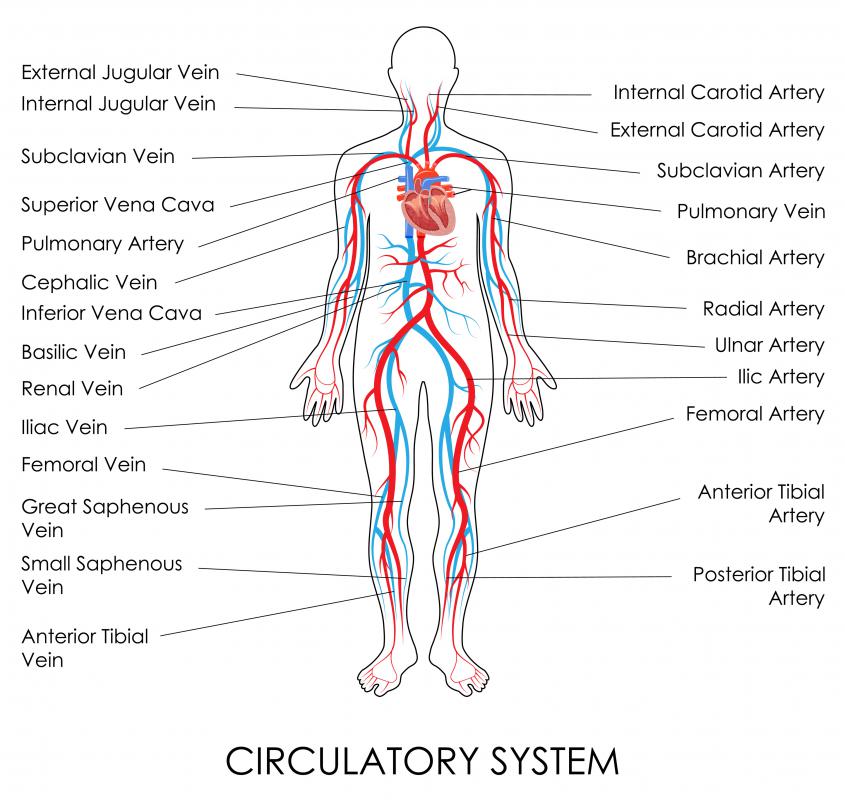
The external jugular vein is a major blood vessel of the head and neck. Originating just behind the jaw and beneath the front of the ear on the right side of the head, it runs down the right side of the neck toward the collarbone. This vein is responsible for collecting blood from the external areas of the head — from the vessels surrounding the skull and penetrating the face — and returning it to the heart. It is not to be confused with the two internal jugular veins, which transport blood from the brain back to the heart.
Much as tributaries converge to form larger rivers that run into still larger bodies of water, the external jugular vein is formed by the convergence of smaller capillaries and veins in the head. Two veins in particular form the point of origin for the external jugular at their junction: the retromandibular vein and the posterior auricular vein. As its name suggests, the retromandibular vein is found just behind the mandible, or jawbone, where its posterior branch becomes the external jugular. Likewise, the posterior auricular gets its name for its location, which is just behind the auricle, or ear. This vessel angles slightly forward beneath the earlobe to merge with the retromandibular vein and form the larger external jugular vein.

Running vertically down the posterior or rear aspect of the mandible, it diverges from the jawbone to descend the right side of the neck toward the clavicle, or collarbone. Along the upper two-thirds of its length it is situated superficially, or externally, to the sternocleidomastoid, a major muscle of the side of the neck. The lower third of the external jugular vein crosses the rear border of the muscle, where it merges with the subclavian vein, a large blood vessel that returns blood from the arms to the heart. This occurs just behind and beneath the horizontal clavicle bone at its midpoint.

In total, the external jugular vein spans approximately 6 inches (15.24 centimeters) in length, though this can vary depending on the size of the person. Eight other veins branch out from the external jugular. Five of these are major veins of the neck and face: the ascending pharyngeal vein of the throat, the superior thyroid vein of the neck, the lingual vein of the tongue, the facial vein of the cheek, and the occipital vein of the base of the skull.

The external jugular vein is covered only by the platysma, a broad, flat muscle that descends the front lateral aspect of the neck from the chin to the top of the chest, and above that only fat and skin. As it lies so close to the surface, it is vulnerable to damage from accidents and injuries. In addition, because it transports a fairly large volume of blood, severing of the external jugular can prove fatal.
AS FEATURED ON:
AS FEATURED ON:









-
![The external jugular vein is a major blood vessel of the head and neck.]() By: ricardoferrandoThe external jugular vein is a major blood vessel of the head and neck.
By: ricardoferrandoThe external jugular vein is a major blood vessel of the head and neck. -
![The external jugular vein runs down the right side of the neck toward the collarbone.]() By: stockshoppeThe external jugular vein runs down the right side of the neck toward the collarbone.
By: stockshoppeThe external jugular vein runs down the right side of the neck toward the collarbone. -
![A chemotherapy catheter is often placed near where the external jugular merges with the subclavian vein, then emerges just below the collarbone.]() By: Photographee.euA chemotherapy catheter is often placed near where the external jugular merges with the subclavian vein, then emerges just below the collarbone.
By: Photographee.euA chemotherapy catheter is often placed near where the external jugular merges with the subclavian vein, then emerges just below the collarbone. -
![Any blood vessel that returns blood to the heart is a vein.]() By: 7activestudioAny blood vessel that returns blood to the heart is a vein.
By: 7activestudioAny blood vessel that returns blood to the heart is a vein.



Discuss this Article
Post your comments