
At TheHealthBoard, we're committed to delivering accurate, trustworthy information. Our expert-authored content is rigorously fact-checked and sourced from credible authorities. Discover how we uphold the highest standards in providing you with reliable knowledge.
What is the Duodenum?
 Niki Foster
Niki Foster
Niki Foster
The duodenum is a short portion of the small intestine connecting it to the stomach. It is about 10 inches (25 cm) long, while the entire small intestine measures about 20 feet (6.5 meters). This structure begins with the duodenal bulb, bordered by the pyloric sphincter that marks the lower end of the stomach, and is connected by the ligament of Treitz to the diaphragm before leading into the next portion of the small intestine, the jejunum.
There are four distinct parts to the duodenum, the first three forming a "C" shape. It begins with the superior duodenum, which extends from the pyloric sphincter laterally to the right and posteriorly for about 2 inches (5 cm). The next section, the descending duodenum, is the middle of the "C". The inferior duodenum passes laterally to the left, and the last portion, the ascending duodenum, joins the jejunum at the duodenojejunal flexure.

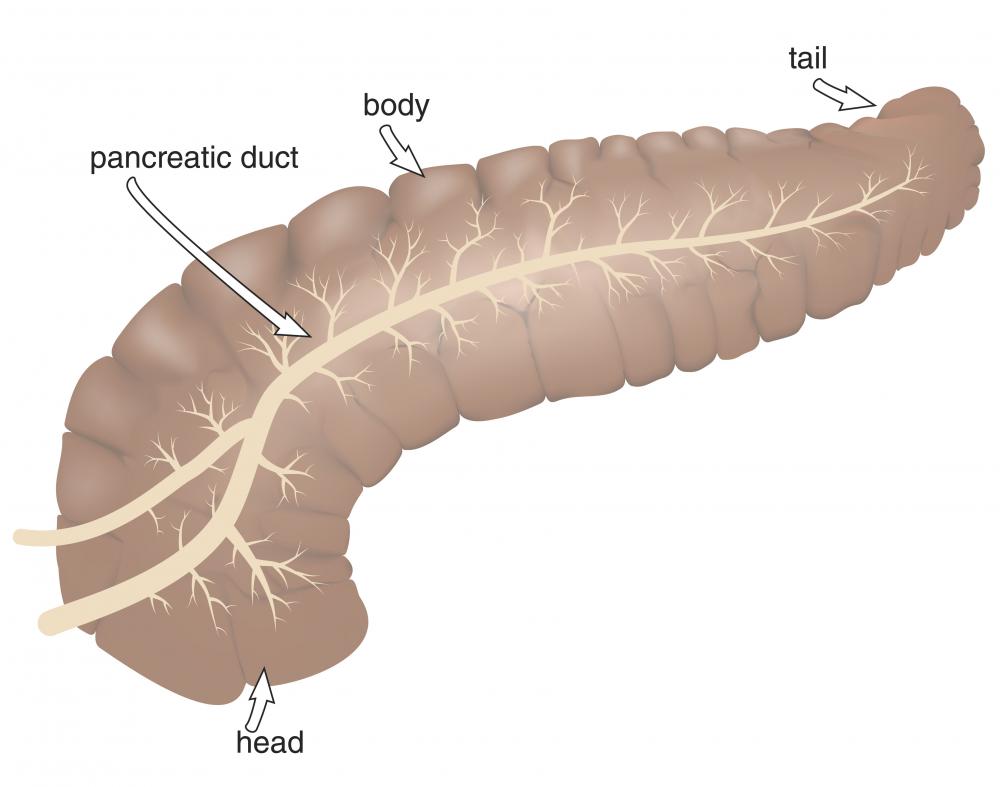
Though the portion is such a tiny fraction of the small intestine, it is the site of most of the breakdown of the food passing through it. It is lined with Brunner's glands, which secrete an alkaline mucus that supports the intestinal enzymes and aids in the absorption of nutrients. The pancreatic duct, which introduces bile and pancreatic juice into the small intestine, is directly connected to the descending duodenum. Pancreatic juice contains enzymes that help break down food, while bile aids in the digestion and absorption of fats. This part of the small intestine is responsible for secreting hormones that trigger the pancreatic duct to release pancreatic juice and bile.

The duodenum also serves to neutralize the acidity of the chyme that exits the stomach, an intermediate product in the digestive process. Both the Brunner's glands and the pancreatic duct secrete alkaline fluids to temper the acidity of the chyme. In addition, the mucus secreted by the Brunner's glands helps protect the duodenum from the acidity, making it much less sensitive than the rest of the small intestine to the material. This allows it to help protect the rest of the small intestine by neutralizing the chyme to some extent before it passes into the jejunum.
Niki Foster
In addition to her role as a TheHealthBoard editor, Niki enjoys educating herself about interesting and unusual topics in order to get ideas for her own articles. She is a graduate of UCLA, where she majored in Linguistics and Anthropology.
Learn more...
Niki Foster
In addition to her role as a TheHealthBoard editor, Niki enjoys educating herself about interesting and unusual topics in order to get ideas for her own articles. She is a graduate of UCLA, where she majored in Linguistics and Anthropology.
Learn more...AS FEATURED ON:
AS FEATURED ON:


-
![The small intestine is around 20 feet in length, while the duodenum makes up 10 inches of that total length.]() By: Balint RaduThe small intestine is around 20 feet in length, while the duodenum makes up 10 inches of that total length.
By: Balint RaduThe small intestine is around 20 feet in length, while the duodenum makes up 10 inches of that total length. -
![The duodenum is a short portion of the small intestine connecting it to the stomach.]() By: nerthuzThe duodenum is a short portion of the small intestine connecting it to the stomach.
By: nerthuzThe duodenum is a short portion of the small intestine connecting it to the stomach. -
![Villi, which are tiny projections that line the walls of the intestines, absorb nutrients during the digestive process.]() By: designuaVilli, which are tiny projections that line the walls of the intestines, absorb nutrients during the digestive process.
By: designuaVilli, which are tiny projections that line the walls of the intestines, absorb nutrients during the digestive process. -
![The duodenum is attached to the stomach by the pyloric sphincter.]() By: stockshoppeThe duodenum is attached to the stomach by the pyloric sphincter.
By: stockshoppeThe duodenum is attached to the stomach by the pyloric sphincter. -
![The pancreatic duct, which introduces bile and pancreatic juice into the small intestine, is directly connected to the descending duodenum.]() By: kaianniThe pancreatic duct, which introduces bile and pancreatic juice into the small intestine, is directly connected to the descending duodenum.
By: kaianniThe pancreatic duct, which introduces bile and pancreatic juice into the small intestine, is directly connected to the descending duodenum.


Discussion Comments
Is there such a thing as a Duodenum blood clot and how dangerous could it be? --Don
my daughter had an upper Gi endoscopy and in her letter it says no major significant abnormality seen. histology of duodenum and stomach with significant abnormalities. can anyone transfer this in laymen's terms please?
However, she is allergic to milk and soya and has other food allergies.
my mother has some stomach aches as well as no taste in her mouth. we did one medical investigation called endoscopic particulars like Procedure: OGD, Indication N/A, and medication: Xylocaine, 10 percent spray. After that report showed: Esophagus: normal, Stomach: normal, duodenum: Normal up to the second part. Biopsy: Not done. Comments: Normal upper G.I. tract at endoscopy.
my question is, as we know, the duodenum has four distinct parts, so why didn't it show the present status of the other two parts of the duodenum? Is there something wrong which made her lose her appetite? As a result, she has become weaker and weaker day by day. She is also a diabetic patient for 18 years. Fortunately, her diabetes is under control. in this situation, any useful suggestion would be highly appreciated and I would be grateful to you.
I would like to know what happened with #25 -- the person whose sister had a perforation of the duodenum. This happened to my daughter and she is now out of breath.
anon16655: I lost my wife with this cancer. I wish you all the luck. Choose a good hospital and be very careful about blood clots; tha't what did her in. I am still so sad.
The suffix -ase- when attached to the root of a word means enzyme.
what does -ase and the end of a word indicate?
my sister was found to have a perforation of the duodenum. she is in icu, having found a severe infection.
How could a person vomit fecal matter? This happened to my elderly mother before she died and I cannot understand what went wrong with her.
I have to do a stupid project about the digestive system.
Why would a feeding tube need to be placed in the duodenum as opposed to the stomach if the pt has esophageal cancer?
I lost my duodenum several years ago when I was just four years of age. I am twenty three now and I have not had a duodenum since then. What do you think about that?
I have recently been told by a physician that the duodenum, thyroid, and pituitary glands work together and specifically need eachother to work properly. This discussion was a result of severe cramping in the duodenal area, linked to the function of my pituitary. Does anyone have any information relevant to this connection?
If you have cancer in the duodenum, is an operation likely? If so, what is the prognosis? And what happens afterward?
Are there papers regarding removal of the duodenum and its effect?
Is too much mucus in the duodenum a bad thing?
If you have cancer in the duodenum, is an operation likely? If so, what is the prognosis? And what happens afterwards?
I recently heard about disconneting the duodenum to reverse diabetes. Where can I get more info on this. If it is true I would consider this. I have type 2 disbetes.
Thank You,
Andy
How and why does gastric bypass eliminate diabetes? I saw on 60-Minutes yesterday that people left the hospital in four days and were off their meds entirely and have had no trace of diabetes since.
In gastric bypass surgery bigger part of the stomach and duodenum are sealed off. Food enters the second part of intestines, jejunum, and as a result, fewer calories are absorbed.
It appears that duodenum plays a big part in type two diabetes. Some studies show that when duodenum is bypassed, diabetes disappears too.
(while bile aids in the digestion and absorption of fats)
this is too general. the bile emulsifies the fats only. because the starches are broken into polysaccrides in the mouth, and proteins are broken into polypeptides in the stomach by pepsin(not hydrochloric acid.)
-crystal.
This article really helped me complete a biology worksheet that i had to finish for class. It gives great details, and it's easy for me, a tenth grader, to follow.
Post your comments