
At TheHealthBoard, we're committed to delivering accurate, trustworthy information. Our expert-authored content is rigorously fact-checked and sourced from credible authorities. Discover how we uphold the highest standards in providing you with reliable knowledge.
What Is the Difference between Oxycodone and Fentanyl?
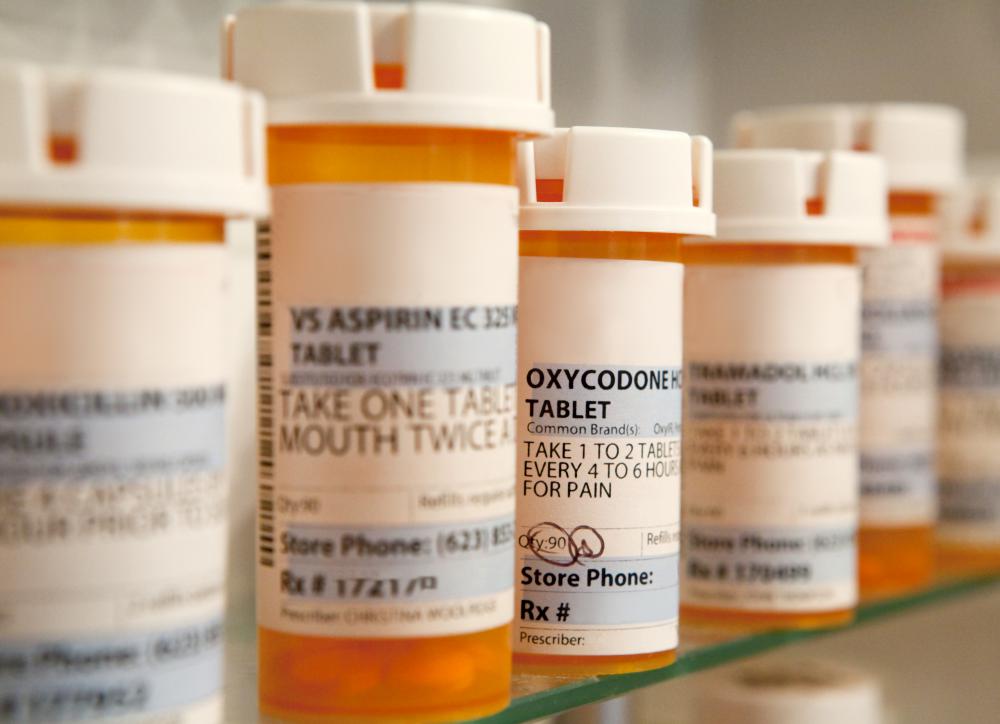
Two of the most potent pain relievers that are prescribed to patients with moderate to severe pain are oxycodone and fentanyl. Both of these medications are members of the class of drugs known as opioid analgesics, meaning that they are painkillers derived from compounds found in the poppy plant, and work by activating brain cells that play a role in blocking pain-related signals in the central nervous system. Despite their similarities in function, oxycodone and fentanyl actually have several differences that make them appropriate for different medical conditions.
Perhaps the most important difference between the two medications is their half-life, or the length of time it takes to break down and remove half the substance from the body. Oxycodone has a half-life of around three to four hours, which means it can only control pain for a few hours before redosing is required, unless it is given in a time-release format. Fentanyl has a rapid half life of just a few minutes when given intravenously (IV), which is why this drug is popular as a surgical anesthetic. Shortly after the IV is removed, this medication no longer affects a patient, and it becomes safe to give post-operative pain relief. The half-life of this drug is longer when it is used through the mouth or through the skin, making it suitable for chronic pain relief as well.

Onset times differ for oxycodone and fentanyl, in addition to their half-lives. Usually, oxycodone is only administered orally, and it takes around an hour to absorb through the stomach into the blood. This means that it is usually best administered for chronic pain that occurs on a predictable basis. Fentanyl, when administered in the form of a lollipop or a lozenge, has an onset time of just a few minutes. The quickness of its onset means that this drug can be used to control acute pain that arises unexpectedly, as a patient can receive pain relief almost as quickly as it occurs.

The risks and side effects of oxycodone and fentanyl are similar, as they belong to the same class of drugs. Fentanyl tends to cause less sedation and has a lower chance of histamine release, a reaction similar to allergies that can cause itching. Oxycodone, on the other hand, may be more sedating, but less likely to cause respiratory depression, a drop in the rate of breathing that can be hazardous if this drug is taken in high doses.
AS FEATURED ON:
AS FEATURED ON:


-
![Both oxycodone and fentanyl are classified as opioid analgesics.]() By: JJAVABoth oxycodone and fentanyl are classified as opioid analgesics.
By: JJAVABoth oxycodone and fentanyl are classified as opioid analgesics. -
![When given intravenously, the effects of Fentanyl wear off rapidly once the IV line is removed from the patient.]() By: auremarWhen given intravenously, the effects of Fentanyl wear off rapidly once the IV line is removed from the patient.
By: auremarWhen given intravenously, the effects of Fentanyl wear off rapidly once the IV line is removed from the patient. -
![People who abuse oxycodone often crush, "cook," and then inject the substance.]() By: gawriloffPeople who abuse oxycodone often crush, "cook," and then inject the substance.
By: gawriloffPeople who abuse oxycodone often crush, "cook," and then inject the substance. -
![Oxycodone is an opioid analgesic medication that is used to provide relief for moderate to severe pain.]() By: nyulOxycodone is an opioid analgesic medication that is used to provide relief for moderate to severe pain.
By: nyulOxycodone is an opioid analgesic medication that is used to provide relief for moderate to severe pain. -
![Fentanyl is usually used in the management of chronic pain for people with cancer.]() By: prudkovFentanyl is usually used in the management of chronic pain for people with cancer.
By: prudkovFentanyl is usually used in the management of chronic pain for people with cancer.




Discussion Comments
@literally45-- I don't think that either one is necessarily better than the other, they're just more effective in different kinds of situation for different kinds of pain.
I think you had a bad experience simply because you quit the oxycodone more abruptly. Opiates can cause tolerance and withdrawal effects, so the dose has to be reduced slowly.
I personally prefer oxycodone too, but only because I don't like the patches, not because it's a better medication.
I think oxycodone is a better pain reliever. I was on oxycodone and then my doctor switched me to fentanyl. I had a terrible experience switching over because the fentanyl did not work as well and I had so many withdrawal symptoms.
I'm on fentanyl pain relief patches and I think they work great. It took a few days for my pain to go away completely, but I have been pain-free since. I changed the patch every two days.
I was actually shocked that fentanyl only has a half-life of a few minutes when used intravenously, but apparently, the patches are different. The drug gets released into the bloodstream more slowly with the patch, so it gives long-term relief.
Post your comments