
At HomeQuestionsAnswered, we're committed to delivering accurate, trustworthy information. Our expert-authored content is rigorously fact-checked and sourced from credible authorities. Discover how we uphold the highest standards in providing you with reliable knowledge.
What is the Difference Between Mold and Mildew?
"Mold" and "mildew" are terms that are used generally to describe growths of fungi on various surfaces. "Mildew" also is a scientific term that describes a type of plant disease. In common usage, the difference between mold and mildew usually is in their appearance and the surfaces on which they are growing. Mold is often thicker and black, green, red or blue in color, and mildew usually is lighter, powdery and gray or white. Both mold and mildew often grow in moist and warm locations, but mildew is more often found in showers, on paper and on fabrics, and mold is often found on foods and in walls and other permanent structures.
Mildew

In plant science, the two main types of mildew are powdery and downy. Powdery mildew is commonly found on roses and other flowering plants, and usually looks like white or gray splotches. It is created by an ascomycota type of fungus. Downy mildew is from the oomycota type of fungus and is found in agricultural products such as grapes and potatoes. Its appearance varies from plant to plant, with some common indications being leaf spots and distortions, downy patches and crystalline spores that might look like sugar.

Around the house, mildew often forms in bathrooms, where moisture provides a suitable environment for fungi to grow. It also can form on objects, such as pieces of paper or clothes, that get damp and are left in one spot for several days or weeks. Mildew in these situations usually is a thin, powdery growth of fungus. When it is allowed to grow for a long period of time, it might turn into what most people would call mold.
Mold

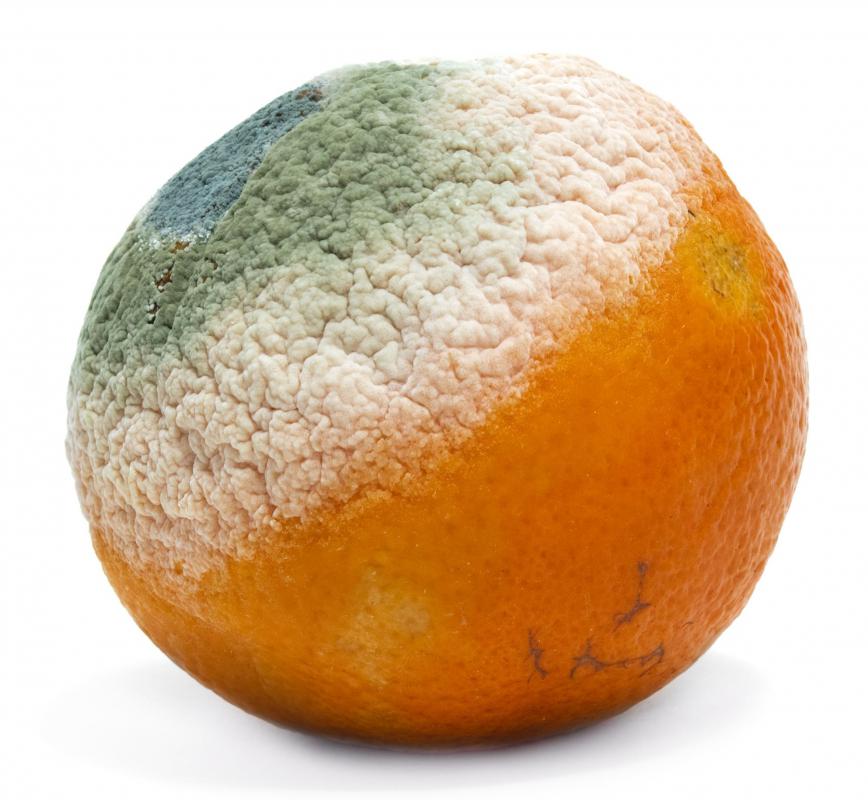
Mold often looks fuzzy or slimy, depending on the type. A heavy mold might begin to look like a plant growth covering the surface. Some surfaces that are covered by mold might begin to rot. Mold can also appear in various colors. On a wall or ceiling, some types of mold might appear to be irregularly shaped spots of black or gray.
Dangers
Some molds have toxins called mycotoxins that can cause an allergic reaction or other illness in some people. Symptoms of a mold allergy might include headaches, asthma and coughing. Irritation of the eyes and throat might also occur as a result of breathing mold toxins. Molds are not always harmful; the antibiotic penicillin was created from the mold of the same name.
Safety Precautions

Keeping areas dry is the most important preventative measure for eliminating mold and mildew. Moldy food should not be eaten. A mildew infestation on paper and some fabrics cannot be scrubbed off, but a mildew remover can usually get rid of mildew on harder surfaces such as those found in bathrooms. Some mold and mildew removal products should not be used by people who have asthma or in areas that are not well-ventilated. In situations where there is serious mold growth, a professional might be needed to clean the space and repair any damage.
AS FEATURED ON:
AS FEATURED ON:


-
![Grapes with mildew on them.]() By: FrenkGrapes with mildew on them.
By: FrenkGrapes with mildew on them. -
![An orange with mold on it.]() By: nitoAn orange with mold on it.
By: nitoAn orange with mold on it. -
![Loaf of moldy bread.]() By: anetlandaLoaf of moldy bread.
By: anetlandaLoaf of moldy bread. -
![Penicillin was discovered accidentally when mold formed in a petri dish.]() By: catollaPenicillin was discovered accidentally when mold formed in a petri dish.
By: catollaPenicillin was discovered accidentally when mold formed in a petri dish. -
![Mold is thicker than mildew and can appear in various colors, including red.]() By: nikkytokMold is thicker than mildew and can appear in various colors, including red.
By: nikkytokMold is thicker than mildew and can appear in various colors, including red.



Discussion Comments
To anon160823 Post 16: Amen. That is the answer. You nailed it!
Go to Home Depot and get something called Mold Control. It's by Concrobium. It not only removes the mold, but it kills it on contact. A 32 oz bottle cost me 9.00 and I did my whole 800 square foot apartment. I have mold behind a wall in a closet but I was able to quarantine the bedroom where the mold is after spraying. I also sprayed down the rest of the apartment. It smells like a brand new place.
Also go to Walmart or Home Depot and buy an air purifier. You don't need the most expensive ones, either. I am running three of the mini towers by Holmes. They cost me $33 bucks each at Walmart and my air in my apartment is so clean, I hate to leave it. I feel like I can't breathe whenever I have to go outside. On top of that, my neighbor is a chain smoker so you know what I am dealing with.
But I swear right now the air is so clean my lungs are singing. This is not a permanent fix as you still need to find and eliminate the source of the mold. But at least you can look out for your health while you are waiting.
Go to home depot and get something called Mold Control its by Concrobium. It not only removes the mold but it kills it on contact. A 32 oz bottle cost me 9.00 and I did my whole 800 square feet apartment. I have mold behind a wall in a closet but I was able to quarantine the bedroom where the mold is after spraying. I also sprayed down the rest of the apartment. It smells like a brand new place.
Also go to Walmart or home depot and buy an air purifier. You don't need the most expensive ones either. I am running 3 of the mini towers by holmes. They cost me $33 bucks each at Walmart and my air in my apartment is so clean, I hate to leave it. I feel like I can't breath whenever I have to go outside. lol. On top of that my neighbor is a chain smoker so you know what I am dealing with. But I swear right now the air is so clean my lungs are singing.lol This is not a permanent fix as you still need to find and eliminate the source of the mold. But at least you can look out for your health while you are waiting.
Downy mildew is not a type of fungus; it's a fungus like protist which is the water molds.
@anon160823: With all due respect, you couldn't be more wrong. We've only lived in my apartment for two months, and we both were feeling sick almost immediately. We have only just discovered the mold, and are taking steps to get it fixed. Problems caused by mold spores can affect you almost immediately. Mold is a poison, and poisons take effect as soon as they enter your system!!
I have noticed black, powdery groupings (they look like little nests the size of a golf ball and hey wipe up with paper towels). I have cleaned two off an exterior window recently. We have had a lot of rain. Could this be mold?
Mold is found in dark places and mostly in basements.
I moved into an apartment that had a foul, moldy smell upon first entering. I asked if there was a recent flood in this top floor apartment and I was told no, and the smell was from prior tenants who had cats!
The carpets were new, so that's impossible, plus I have cats and knew this was a lie. I pointed out a stain on the ceiling and noted the carpet smell directly below the ceiling stain. I was promised the ceiling would be painted and again was assured there were no problems I should be worried about.
I was in a hurry to move after leaving a bad relationship, so
I was vulnerable and chose to trust the answers I was given. I moved in. The ceiling was never painted. They came to paint and I talked the non professional maintenance men to open the ceiling and saw wet baseboards! I called the manager and said obviously there was a prior flood concealed from me! I wasn't home to watch the repairs and had another roof leak six months later and now my trust was broken.
I asked for a third party at my expense, to test for mold. I got the run around, and workers showed up to fix the ceiling and I refused. I was intimidated by the manager. I sent pics and documentation of all in my six months here. I was bullied to back off! I have become ill and it's a year and a half later!
I have pictures and documentation of all events in the one and a half years! I need to find a lawyer or one I can trust to not cover this up for money. I have heard horror stories about mold and floods from neighbors and one actually died.
Does anyone have any advice about one to call who cares about what is right and will not be suckered into a cover up or can be paid to lie by the management company?
I know there are a lot of code violations and paid off secrets in this building. I am ready to expose this at any cost, for myself and those who have been bullied and lied to as well. This must stop. It is a disgrace that property owners rent unhealthy apartments, knowing this, all in the name of profits over people! Too many are in bed with the inspectors and money shouldn't be traded to cover up the truth.
A few of these posts are just ridiculous. I don't know why I even took the time to read them. I guess nothing really surprises me online anymore, though.
For someone to say black mold is not toxic to humans or dangerous annoys me because they have to be smart enough to know this is not true. Get real. And for the guy who must obviously be a landlord, why isn't it your fault if someone becomes ill while paying you good money to live in a clean, healthy environment and that is not what they are getting? They might be paying thousands for medical bills to try and find out why they are so sick and here it is they are breathing in mold and don't even know it! It can make you very sick in so many ways, trust me. It can rob you of life and living and feeling well and it is nothing to mess with. For those who think it is no big deal, well, you certainly have not become ill from exposure. Stop posting things online that mislead innocent people who might just be looking for answers or a little help because they are finally realizing they are sick all of the time and there has to be an underlying issue. Help people, don't mislead them. It's just wrong.
The whole house smelled like mold when we finally decided removing the siding would get to the root of the problem, because our siding was loose due to windstorms, etc.
We found out that the outdoor exhaust hood to out Thermador hood had about five gallons of water in it. The mold inspector thought that it would now dry out and be OK, the mold should dry up and the smell should go away. We have had the contractors properly seal the outdoor vent now so no water can get in.
I just wonder if any remediation should be done still, but there are no visible signs of mold in the house at all.
Just sue everyone for everything. That's all anyone wants to do. There is mold everywhere: at your work, at the park, in the store. There is no place that doesn't have mold spores. They have been around since the beginning of time and will continue to be around.
It takes years to develop problems with mold. Allergies are not your landlord's problem, so if you have allergies to mold, move out. This is not your landlord's fault that you have been exposed to mold.
Who are you going to sue for the allergy that you have to pollen? It's everywhere too and causes basically the same symptoms if you have allergies. Sue! That's the answer to every American problem: get some money that you don't deserve. Soon no one will be willing to rent to anyone else because of people like these.
@curious101 - we were having the same problem with our whole house having a mildewy earthy smell that only kept getting stronger and stronger. We were able to narrow it down to one room in the house by keeping all of the doors closed.
Turns out is was coming from a guest room and it was inside the walls. We had absolutely no signs of water damage at all. We even had specialists come out to test humidity levels and check for moisture with infrared cameras.
Finally, we just tore out the carpet and the drywall and it ended up being behind the vapor barrier. Still no moisture issues that we can tell. Maybe from condensation? It was a white mold and we had the room fumigated and everything was bagged up and hauled off by professionals. Good luck!
OK, question: can mold and moldy particles growing in standing water make your household sick? I have a large (probably close to 50 gallon) water basin that holds water for the water softener that is full of water and moldy looking particles.
We do not use the softener itself because it is extremely loud when running and we are in a rental. This water is possibly cycling into our water system. In turn, we are using it to wash, cook, clean, etc. Is this type of mold bad for you?
I am a mold survivor. After my parents moved into a brick and siding house built in 1920 when I was 3, the basement began leaking during heavy rains and within 10 years there was small amounts of slimy black mold visible on drywall that slowly started climbing up the walls after each flood.
By the time I started college, with classes held in buildings over 100 years old that smelled like dirty socks, I was getting much sicker, and eventually I had to drop out of school (and I was on full scholarship) and move out of my parents house due to Chronic Fatigue Syndrome and a host of strange health problems. Now I'm in graduate school, living well but aware of the dangers.
There are resources online that have information that you may find helpful or even life-saving. I live a fairly normal life these days, although I can't enter about half of all buildings without getting sick. But I'm healthy again. People doubt my story, and many of these are the same people that claim that bleach will stop a mold problem (it won't, but it might make you sick) or that the worst that could happen is some respiratory allergy (the worst that could happen includes scarring of the brain and death).
Fungi have evolved so much since the widespread introduction of commercial, agricultural, and residential fungicides in the 1970s that they have a structure that isn't properly processed by up to 24 percent of the population's immune system properly, something called failure of antigen processing.
Human evolution hasn't kept pace, and with all of the particle-board and drywall providing food for mold and the climate-controlled, sealed environments that frequently have water damage providing a lush environment, mold is a huge problem that may not even be known to homeowners, as it hides out in HVAC ducts, crawlspaces, and under carpets. Do your homework, be skeptical, and don't underestimate the potential of a building to make a person sick.
Water is the cause for your mold problem. Either you have high humidity or you have a moisture intrusion issue, or both.
Mold and mildew are the same thing with different names. One is given to the common household variety, mildew. But the simple fact is this, if you have mold then you need to eliminate the source of moisture, Bottom line: Don't let someone tell you that black mold is deadly. While all visible molds growing in your home are an issue, don't harp on the color. Clean the mold.
You can do this yourself, but I don't recommend using bleach. Find a cleaning product (mild) and use that. All you need in order to re mediate (clean) mold is elbow grease and towels. Also understand that there are two different mold infestation scenarios, one being surface mold growth and the other being mold growth that infests beyond the surface.
Examples would include mold growth in the interior of wall and ceiling cavities. This happens as a result of moisture intrusion issues such as window leaks, foundation leaks, roof leaks, or plumbing leaks. When such leaks occur, you will find in most cases that the saturation of building materials such as sheet rock and insulation will result in mold growth in the interior cavities. In these cases, it is necessary for you to open up your walls or ceilings to expose and then treat/clean those areas.
You can find other products out there to clean your mold with, but I recommend using something that is more mild than bleach. It is not necessary to use such a harsh chemical. Mold can be neutralized with many different everyday cleaners, and enzymatic cleaners do the best job since they are natural and have residual protective properties.
I don't think water can make whole house smell, but if there is an air vent on a plumbing pipe, the gases can be escaping (sewer gas). It could be hidden like up in the attic (supposed to vent out through roof).
Depends on the age of house if things got updated properly or done by a handy man. many times landlords save money by not using licensed people to do tasks, causing issues in future.
When it comes to mold, plumbing, and gas lines, I say always use a well known licensed person who knows they need to pull a permit, which causes more expenditures for the owner of rental units.
Re: Mold, thanks for the advise on how bleach does not work on wood and masonry, I was jut about to use a bunch on all the walls and wood. Now I am going to use vinegar instead, and or lemon juice. FYI, I read both kill the mold. But the spores land wherever, and it will grow then wherever. The hiding mold is the problem. In the attic, in wood, in siding, etc. I think they might have a black light test for it?
I know they have mold test kits at Home Depot for about $9-12 dollars then you send in results and pay about 40.00 I think. Get a report sent back to you in the mail. Almost everyone will show mold growth on the petri dish, go by the amounts/levels and type said on report to determine how bad it is.
If you know for a fact you have it, I would put the test in the least moldy spot in home to see what has moved in the air to that spot. Just what I would do.
I would also say mold is bad for some, depends on the immune system. If you breathe spores into your lungs, they tend to be mycotoxins in your lungs and can get in body depending. And immune system and god are the determining factors, I guess, as to the outcome for you.
Don't rely on non-professional opinions (including landlords) Do read your rights as tenant with city laws, and go to court and show the test result evidence. They will hold his rent from him/her until they fix it. (but not sure if it insures a proper fix) Or, move out asap, and wash all your stuff in borax.
how do you best rid mildew from clothing?
We live in a rented house and have very bad damp in our loft! After bringing down the Christams tree we found that all our clothes, babbies things like car seats bedding is covered in mold! We had black fluffy black mold around windows and really bad in one cupboard! Our landlord doesn't seem to be doing anything about i! I have suffered 3 misscariages and after all my tests coming back that there is nothing wrong i can't help think that it has something to do with it!!! we are planing to start trying again but part of me thinks i need to get to the bottom of this mold 1st!!Please i need some advice on how to treat it and clean our things!
I'm not sure about mildew but I know for a fact, from personal experience, that bleach absolutely positively does not get rid of a mold problem.
According to OSHA, the chemical make-up of bleach is such that the effective properties of it do NOT penetrate porous surfaces (such as wood, insulation, concrete, particle-board, practically any organic building material). The only thing that can be done is removal of the infected materials.
If you are a renter suffering from health issues due to mold infestation (like me), contact your landlord. If they suggest using bleach or do nothing, begin to research your state's laws on rent escrow. (Which is basically holding your rent hostage in an account until they address the issue)
Above all else, DO YOUR RESEARCH. Mold on your walls, windowsills, floors, carpets, any porous item.... bleach will not work.
We live on the second floor of a three-story apartment building.
Over the past few years, the third floor has been flooded due to a hot water leak or torrential rains. Recently, we began to see water stains on our ceiling and large green splotches inside our closet extending from the ceiling to the floor.
I wrote a letter to the landlord mentioning mold and he came out within four days. He said what we had was mildew and was careful to say that we definitely did not have mold since that was a serious offense in California.
I took pictures of the growths in the closet, which left my closet and everything inside smelling sickly, and compared it to pictures on the Internet.
Supposedly he has someone to tear out the closet today but I'm afraid of further damaging our health from spore escape as we have many of the symptoms from the mold list. Is there anything else we can do?
i think that your blog is awesome.
I noticed that there is either mold or mildew growing my air vents throughout my apartment. I notified the apartments today and explained to them that I have two small children that are chronically sick and have health issues. She informed me that because its summer in TX that people's air conditioners were first in line but hopefully they should be able to get to it soon. Is this harmful to any of our healths? How do I find out what is causing it? If they just replace the vents won't it just grow right back?
hghrllr67,
You need to insert the following magic phrase in your next conversation with your landlord: "implied warranty of habitability".
Also, I have the feeling that the mildew is the least of your problems, and that a dryer vent that doesn't leave the building might be a fire hazard.
My fiance and I have been renting an apartment for about well almost a year now. We noticed before we moved in that there was stains underneath the flooring in the bathroom. Spots with a dark blue coloring to them. We notified the landlord and nothing. We also noticed that the dryer vent that was supposed to lead outside did not. instead it went directly under the apartment. As the months go by we noticed that the spots were spreading through out the bathroom floor and that on the back of the toilets tank is black also the floor is separating from the wall. We notified the landlord he sent the maintance guy and he said it was caused from the dryer vent said he would be back to spray the bathroom floor and never did. What should I do????????
We have mold on the outside of our house and there is mold in the attic. can this be dangerous for our health and what can we do to get rid of it?
Is it possible to have airborne mold or mildew and not have any surface mold or mildew? I think our house smells but we don't see any mold or mildew anywhere. We have an air exchanger, could that bring mold spores in from the outdoors? We also have a wood stove and the smoke from the chimney comes in through the air exchanger. Can that make the house smell? Also, we have water problems, hard, high in iron and sulphur smell, can that make clothing smell after the wash? Can the water problems make the whole house smell?
Post your comments