
At DelightedCooking, we're committed to delivering accurate, trustworthy information. Our expert-authored content is rigorously fact-checked and sourced from credible authorities. Discover how we uphold the highest standards in providing you with reliable knowledge.
What is the Difference Between Mandarins and Tangerines?
 Mary McMahon
Mary McMahon
Mary McMahon
While all tangerines are mandarins, not all mandarins are tangerines. Tangerines, in short, are a specific type of citrus fruit within the mandarin grouping, and individuals may hear the mandarin grouping referred to as the “tangerine grouping” in some areas of the world. In addition to tangerines, the group also includes Clementines, satsumas, Dancy oranges, and honey oranges, among others. Tangerines are especially commonly grown and eaten in the United States, where they are sometimes called mandarins, and the two are viewed interchangeably in some parts of the country.
Mandarins come from the Citrus reticulata tree, a small citrus tree native to Southeast Asia. The tree itself is fairly hardy, but the fruits are very delicate, growing only in tropical to subtropical areas. The mandarin was introduced to the West through the city of Tangiers in Morocco, which gave rise to the name “tangerine.” This created some confusion between mandarins and tangerines in the West, since people didn't realize that the tangerine was simply a specific mandarin cultivar.

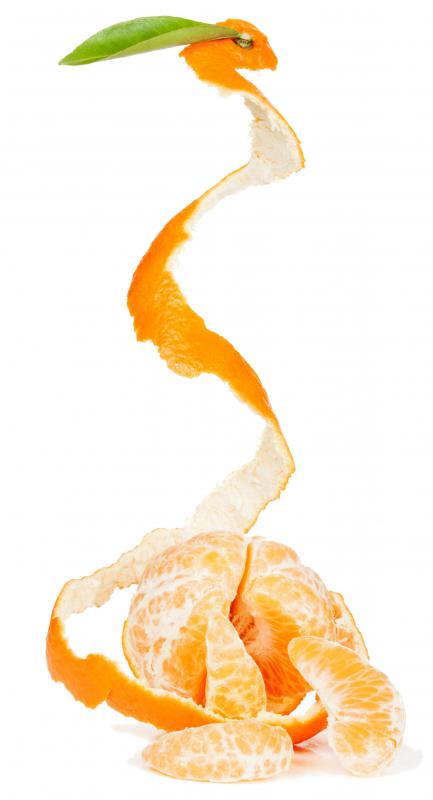
Fruits in the mandarin grouping have a very distinctive thick rind that makes them easy to peel, especially if a person starts around the flower or stem end of the fruit. It is often possible to start peeling and them slip the peel away like a glove, in contrast with other citrus fruits, in which the peel sometimes fights to stay attached, making peeling much more difficult.

Tangerines are usually distinguished by their reddish color, in contrast with the more orange tones found in other members of the mandarin grouping, and this is sometimes cited as the defining difference between mandarins and tangerines by people who are not aware of the fact that tangerines are mandarins. People most commonly see tangerines sold fresh, usually in the winter months when these fruits are in season. Canned tangerines are often actually canned satsumas which have been mislabeled, as satsumas are renowned for their durability in the canning process.

There are a number of ways to use tangerines and other fruits from the mandarin family. Many people enjoy eating them straight, since they peel easily and the segments usually pull apart with minimal effort. These fruits can also be added to fruit salads, used in jams and jellies, pureed in citrus sauces, and added to breads and sweet treats. In some cultures, exchanging mandarins for the holidays is a common tradition, with fruits which have retained their leaves being especially lucky.
Mary McMahon
Ever since she began contributing to the site several years ago, Mary has embraced the exciting challenge of being a DelightedCooking researcher and writer. Mary has a liberal arts degree from Goddard College and spends her free time reading, cooking, and exploring the great outdoors.
Learn more...
Mary McMahon
Ever since she began contributing to the site several years ago, Mary has embraced the exciting challenge of being a DelightedCooking researcher and writer. Mary has a liberal arts degree from Goddard College and spends her free time reading, cooking, and exploring the great outdoors.
Learn more...AS FEATURED ON:
AS FEATURED ON:


-
![Mandarins have a thicker,easy peel skin.]() By: deniraMandarins have a thicker,easy peel skin.
By: deniraMandarins have a thicker,easy peel skin. -
![Tangerines have a darker reddish color than mandarins.]() By: hanabiyoriTangerines have a darker reddish color than mandarins.
By: hanabiyoriTangerines have a darker reddish color than mandarins. -
![Both mandarins and tangerines can be enjoyed as part of a fruit salad.]() By: bercBoth mandarins and tangerines can be enjoyed as part of a fruit salad.
By: bercBoth mandarins and tangerines can be enjoyed as part of a fruit salad.


Discussion Comments
Okay, so they're all different kinds of the same species that originated in different regions of the world.
How are hybrids of these different types categorized? For example, I ate something called a "tangor" once. It's the hybrid fruit of an orange and mandarin. Do we include this in the mandarin family or the orange family? Can all mandarins and tangerines be categorized as oranges in general?
I think part of the reason for all the confusion about these fruits is that grocery stores also tend to mislabel them. I've seen clementines labeled as satsumas even though there are clear distinctions.
I lived in Turkey as a child and clementines were my favorite fruit. Clementines are the only kind of mandarin found in Turkey, they are called "mandalina" similar to the name mandarin. I was so confused when I came to the U.S. because I bought mandarins, not knowing which specific type it was, only to be disappointed with the sourness of the fruit. I've finally figured out that the kind I'm looking for is clementine oranges- they are smaller, sweeter and tend to have a thinner rind than the other kinds. But they are still easy to peel and so fragrant. I love the scent of clementines. Yum!
now i finally know. thanks.
Post your comments