
At EasyTechJunkie, we're committed to delivering accurate, trustworthy information. Our expert-authored content is rigorously fact-checked and sourced from credible authorities. Discover how we uphold the highest standards in providing you with reliable knowledge.
What is the Difference Between GSM and CDMA?
Global System for Mobile Communications (GSM) and Code Division Multiple Access (CDMA) are two competing standards in cellular service. They both have derivatives for use with 3G phones known as Universal Mobile Telecommunications System (UMTS) and CDMA2000, respectively. The major difference between the two technologies is how they turn voice data into radio waves and how the carrier connects to the phone. Other differences include the coverage area, the data transfer speeds, and the type of hardware used.
Coverage

Some areas and countries only have one technology available, so users should be sure to review coverage maps before buying a phone. Generally speaking, CDMA is most commonly found in North America and some parts of Asia, while GSM is found in most other places. Some carriers do offer international or "world" phones that can work with both, but if the phone is going to be used predominantly in one area, it may make sense just to get one that's tied to one type.
Data Transfer Speed

Both technologies can be used with 3G standard phones, but 3G GSM speeds can be faster than 3G CDMA speeds, which can make a big difference for those who use their phones for social networking, email and streaming video. The fastest 3G standard used with CDMA2000 is EV-DO Rev B., which has downstream data rates of about 15.67 Megabits per second (Mbit/s). The fastest standard available with UMTS is HSPA+, with downstream speeds of up to 28 Mbit/s.
Hardware

GSM phones and CDMA phones also use different types of smart cards known as Universal Integrated Circuit Cards (UICC). These are small removable cards that can be used to store information like a contact list and activate, interchange, and upgrade phones without carrier intervention as long as the phone is unlocked. This means that the carrier makes it possible for phone to work even if the end user removes and changes the card. Though both types can be sold locked, this is more common with CDMA phones.

UICCs can be programmed to work with either GSM or CDMA and their derivatives, or with both. Those that only work with GSM phones are called Subscriber Identity Module (SIM) cards and those that only work with CDMA phones are called CDMA2000 Subscriber Identity Module (CSIM) cards. There are also a few types of UICCs that are programmed to work with GSM, UMTS, CDMA, and CDMA2000, including CSIM/USIM cards and Removable User Identity Module (R-UIM) cards.
Roaming
Generally speaking, both networks have fairly concentrated coverage in major cities and along major highways. GSM carriers, however, have roaming contracts with other GSM carriers, allowing wider coverage of more rural areas, generally speaking, often without roaming charges to the customer. CDMA networks may not cover rural areas as well, and though they may contract with GSM cells for roaming in more rural areas, the charge to the customer can be significantly higher.
International Roaming
Some GSM and CDMA carriers offer international roaming, which means users can still use their phones when traveling abroad. To work internationally, the phone has to be a quad-band phone, which means that it works with frequencies of 850, 900, 1800, and 1900 MHz. Additionally, the phone does have to be unlocked and the user does have to be trying to use a network that exists in the country, which is sometimes more difficult to do with CDMA since fewer countries have CDMA networks. If the phone is unlocked and there is a network present, though, then users can buy a UICC with minutes and a local number in the country in which they're traveling to avoid paying international rates.
4G
Things get a little bit more complicated when it comes to phones with 4G. Most US cellular carriers use CDMA. 4G phones generally use LTE (Long Term Evolution), a high speed wireless broadband technology. In most of the world, GSM is preferred and 4G phones with LTE outside of the US use this service. In the US, however, US cellular carriers offering 4G phones have made the switch to LTE on the CDMA service. It is possible to determine which service a smartphone uses with the model number of the phone. Phone manufacturers or the cellular carrier can clarify this information. As of 2014, users in the US are most likely using CDMA. With the exception of countries like Russia and Japan, which continue to use CDMA like the US, most other countries in the world use GSM for 4G.
AS FEATURED ON:
AS FEATURED ON:









-
![A SIM card, like that used in a GSM phone.]() By: SwapanA SIM card, like that used in a GSM phone.
By: SwapanA SIM card, like that used in a GSM phone. -
![SIM card being placed into a GSM mobile phone.]() By: Brian JacksonSIM card being placed into a GSM mobile phone.
By: Brian JacksonSIM card being placed into a GSM mobile phone. -
![A variety of cellphones.]() By: Aleksey BakaleevA variety of cellphones.
By: Aleksey BakaleevA variety of cellphones. -
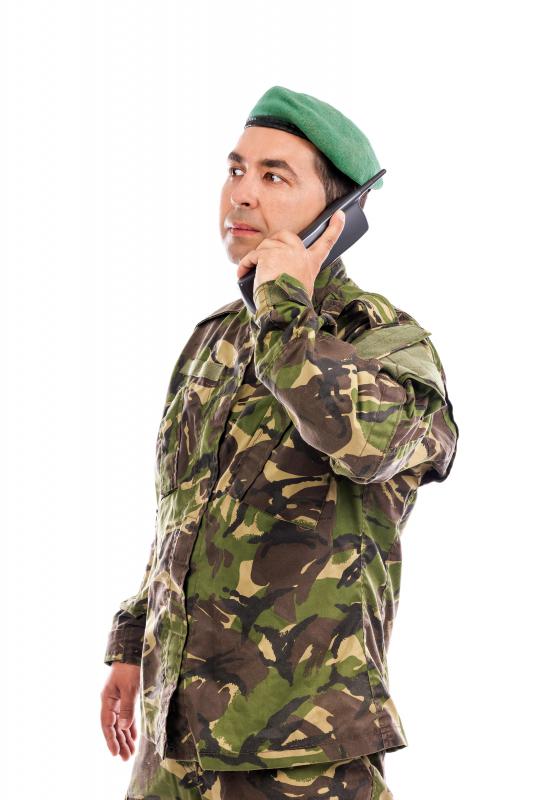
![CDMA has been used by the military due to its secure nature.]() By: jinga80CDMA has been used by the military due to its secure nature.
By: jinga80CDMA has been used by the military due to its secure nature.


Discussion Comments
Both Tracfone and Motorola told me that the Moto G 3rd gen would work with on the Verizon network with pay as you go from Tracfone. It requires a Tracfone SIM card which I got. It also came with the GSM card. So I contact Tracfone to set it up and they say it isn't supported. Someone I know has the exact same phone and it is working on Verizon w/ tracfone. \Maybe the operating system software is different? Mine came with Lollipop (5.1.1) and was upgraded to Marshmallow (6.0).
Anyone know what it wouldn't be supported? Specs said GSM/CDMA/HSPA/LTE, had several 2G, 3G, and 4G bands.
How does one get that software?
@anon231922 -- As far as I know, CDMA phones also use SIM cards now. I think in the past they did not. In fact, that's how people could tell apart CDMA from GSM. GSM had a slot for a SIM card and CDMA did not. But some cellular carriers now also have CDMA phones with SIM cards. So unfortunately, we can't tell them apart this way any longer.
If anything has changed and I'm wrong, please let me know. I like to keep up to date with these things even though it's not easy. Things are changing so quickly.
Cell phones still have a very long way to go to satisfy customers. They are all so different. You must read for several weeks to find the one you think is right for you. It's much, much easier to buy cars.
@anon350633: I'm a cell tower foreman. Although I work in Florida now, I was all over the NE a few months ago.
I've worked for all major carriers, and have seen a lot! Brace yourself my friend. Most people who work in my industry, are in fact "Two fries short of a happy meal." It is appalling what is done to get these sites up and running as fast as humanly possible, in some cases if the insertion loss max is 1.5, and the actual loss is 1.5-1.8..."well, they can't see it from their house".
Among a lot of other issues, in response to your CDMA issue, be thankful you have any service at all. I've been on a tower, with an AT&T 3G phone, setting up the new 4G equipment (note: no service was turned off, or nested at this time) and only had two bars. I was right behind the antenna! If only companies would hire competent people who take pride in their work, but alas, this costs more money due to more hours spent working on the sites.
Both Verizon and AT&T have towers within 20 miles of my rural area in SW Arkansas. But, my CDMA phone cannot even get one bar of antenna signal. My GSM phone has two bars. Since both towers are equidistant from me, with the same topography/terrain characteristics between said towers and my property, the cell signal should be but isn't comparable. Not at all! So, those users who claim that CDMA technology is better at serving rural areas don't know what they are talking about.
Every carrier claims that their coverage is best. But, actual user experiences are what matters, not bald-faced lies by media marketing morons who erroneously believe that their prospective customers are idiots.
I have bought a gsm i9300 phone with gsm. Will this work in Australia on the 3g network and will the data work? Is it possible to convert it to accept data?
The information regarding the CDMA coverage in rural areas is incorrect. I have done work with public cellular providers buying coverage for large utilities. CDMA (Verizon) is by far the best choice for rural areas. GSM coverage is spotty in these areas.
I'm moving overseas soon and I have an iPhone 4 with Verizon (CDMA). I don't see a SIM card slot on the side like my friends have on their AT&T iPhones (GSM) but I read online that the tiny hole on the top of the phone next to the headphone jack is where to unlock the phone? Is that true? If so, where would I put the SIM card? Thanks for any suggestions and help!
@anon130: No,it's not possible.
GSM phones don't need a new sim every time you change countries. They use the nearest cell phone tower, shoot a signal into space and the signal is reflected back by acts of transmission. Then the other phone rings. No extra charges.
Come on. CDMA does not use SIM cards. GSM however, does.
GSM only has a crappy signal in the USA. It has perfect coverage everywhere else. This is because the USA's GSM network isn't that big and developed, like the other countries' networks.
Go to Australia or Africa and try your CDMA phone! Right, no signal. Whereas GSM has signal worldwide, whether that be crap signal (in America) or great signal (everywhere else).
GSM = older/more supported/more mature/more users/SIM cards for easy phone transferring
CDMA = newer/developing/secure/no SIM cards
This is like the battle of Metric VS Imperial. Metric is used worldwide however the USA fails to embrace it, sticking with that Imperial standard.
GSM = win.
How do I transfer my contacts from one sim card to my new phone. It would only transfer the photos that I had taken with my old phone.
My wife and I are retired. We travel fairly frequently. We had Sprint for years and were happy with the service. However, I got tired of paying $120/mo. for our months at home when we never used the cell phones. Also, our cdma phones would not work in Europe or Australia.
We dropped Sprint, and bought two unlocked Nokia GSM smartphones. We also bought prepaid TruPhone GSM sim cards with a UK phone number and a U.S. phone number. TruPhone rides on either AT&T or T-Mobile in the U.S. and on other providers in Europe and Australia at reasonable rates. In the U.S., we pay $0.17 per minute voice and $0.12 to send a text message. No monthly fee.
We have been very happy with TruPhone service and would recommend the service for anyone tired of paying monthly fees for unused service.
I'd rather use a GSM carrier (TIM and AT&T), because of its capacity to change or picking out carriers without the need to make the phone useless, as it would happen with the CDMA phones. So that's the biggest advantage GSM has over CDMA, in my opinion. Despite the internet and 3G speeds, which are better, in the CDMA technology, I don't like the idea of having to be tied to only one carrier. So the SIM card means a lot to me.
why we can not change the time on a cdma mobile?
I am thinking of buying a SAMSUNG GALAXY tablet which uses 3G connectivity/Verizon Wireless EV-DO, Rev A network. I am living in Iraq and our internet service is using wireless broadband connection EVDO (ZTE Chinese company). My question is: can I use the Samsung tablet with this connection? will it be OK? or i will waste my money? can anyone help me please?
i have a micromax evdo which supports only cdma sim cards. i want to use a gsm sim card. can i use it in this?
Here in Australia we use 3g 850 mhz, 900 mhz and 2.1 ghz and 4g lte has been up and running in four cities using 1.8 ghz with telstra, but they are testing the network and the network might be available to the public between august and november 2011 and vodafone will be doing the same in november on the 1.8 ghz. All networks will get the 700 mhz band switched on when analog tv gets switched off in 2013. gsm 2g frequencies in australia are 900 mhz and 1.8 ghz and the 1.8 ghz will be switching off 2g on this band because of 4g lte.
is it possible to combine both technologies in a single device? if yes then how it can be possible?
Where I live, GSM is awful. The signal and sound quality are both bad. I don't like the old technology that CDMA represents, but it kicks GSM's butt here in northern NJ USA.
My point is: on GSM system with a GSM phone, you just have to pay for local calls. You never pay for long distance or roaming. Examples are in many countries, when you are in one city, you just have to buy a local SIM card and insert in your GSM phone, and your phone starts working now. All your calls to local are local and some of them free of charge for incoming calls. When I travel to other cities, I put in another SIM card, no activation fees, no extras, refill the card if you need to keep the number. Great idea?
If I purchase a cellular phone here in Italy, will I be able to activate it back in Canada. There are so many phones here in Italy not even on the market back in Canada.
here is the deal: anyone with too much time on their hands can make any phone work on all networks. these are the things to consider 1. Is it worth it to modify? 2. Is it cost effective? 3. Is it worth the headache? my hd2 is modded for both att and t-mobile soon to be the same. when i went to england i use vodophone there with very little work.
yes it is possible to convert a CDMA phone into GSM.
And whoever asked can you covert GSM to CDMA, yes you can. Only problem is Verizon only accepts certain phones, so then you will need to send your phone to their factory to change the hardware and get a new software update. Plus, it's going to cost you.
And once you convert to CDMA, you can't change from Verizon to Sprint, unless you know the right people. Even to get it converted, I would try to find someone you know in the company since the guys who do the selling aren't even going to know that.
CDMA is garbage to me. Verizon is powerful only because of commercial success. The CMA technology is faulty by nature, as the network grows, the signal quality and call quality go down.
With GSM, it's true that security will be a problem, since all someone has to do is find what frequency you are running, but with UTMS most of those problems are "improved".
Personally, what I'm happy to see is the growing market of free service like OpenBTS, when people can manufacture there own SIMs and personally select what band to run on will be the day for me. For now I'm sticking to ATT, never had dropped calls, or bad sound quality like I did on Verizon. The real answer for anyone deciding what to get is to personally check out how each service runs in your area. No one can say "This is what you should run" Its crap. You should get the one with 1. best sound quality 2. best reception 3. fastest internet 4. no dropped calls, and this can only be decided on what company has invested their money to build towers in your area for optimum coverage.
For me in Detroit, MI, it happens to be ATT. And also take into account if you do a lot of traveling, then GSM would be the way to go.
I've traveled all over Europe and Canada and never had a coverage problem with my GSM Samsung Captivate Galaxy S(SGH-I897). Plus these days Wifi is everywhere, so I'm almost never connected to my 3G. So for me, investing in 4G LTE is not worth it at all, considering most people have wireless routers at home.
nope you can't convert cdma into gsm because the hardware is different from each other.
i think yes, but how? I'm also waiting for the answer. if anyone has one, then please write your comment.
All this very interesting, but doesn't help much with deciding what cell company to go with. I read several posts about how wonderful verizon is. It all depends on how close you are to one of their towers, apparently.
We were with verizon and had terrible service, so they let us out of our contract and we went to Alltel. Now, verizon bought Alltel (in our area, anyway) and for a while, service didn't change noticeably. But then, apparently, something happened to the Alltel towers in our area and verizon can't be bothered to fix them, so they are letting us out of our contract (again!)
Problem is, I have no clue which, if any, carrier will be any better. I don't really know if this GSM/CDMA debate has any bearing on my problem or not. I like the phone I have (LG nv3) but from reading above, I guess I can't use it on another network?
RE: anon423 going to Korea. Been there done that. Most contracts can be broken with a waiver of the fee if you are going overseas. I just did it with AT&T and also did it years back with T-Mobile when I went to Korea.
Also, you will find a SIM card in Korea no problem, specially if you go to the U.S.post in your area. They will take care of you.
No question: an unlocked multiband WiFi enabled GSM phone is without question the way to go. I use it from Canada to Chile, from Los Angeles to Bermuda, from London to Dubai and all over the South Pacific: read Tonga, Tahiti, Cook Islands, Samoa, New Zealand, Salomon Islands, Truk, Palau. In fact, bloody everywhere! Either buy local chips and use the local networks (temporary local number), as I did in Nuku'alofa (Tonga), Dubai (UAE) and so on, or use their provider that connects to yours (automatic) and pay the international rate on your home number (stupid).
Once you have Skype downloaded to your phone (and Google Talk) and/or an Internet telephone provider (there are a ton), then as you travel the world and pass through free WiFi networks (Starbucks Canada, Dubai Airport) or ones you pay a fee for, you can use these apps to call anyone in the world for between 2 cents a minute and $2 a minute, depending on whether you're calling a land line or a mobile and in which country they reside. I made a 2 hour call to Tahiti from Dubai (can't get much more expensive than that) using my Nokia E66 Wifi phone sitting at home using Net Telephone Internet service provider for about $30. This would have been a King's ransom on a pay network. Would have been even cheaper on Skype.
Kamugisha, go to i-Tel Uganda. They use CDMA.
i have a version and am in Africa particularity Uganda. can i use it while I am here?
where can I find documentation about CDMA?
I live on the east coast of the US and have family on the west coast. We all have verizon. I get coverage everywhere with it and have had it over five years, and in that time, coverage has gotten a lot better. So, in my opinion, any phone with verizon especially an LG will work nationwide without a problem.
I have had T-Mobile and Cingular, now At&t, and both had horrible coverage. Verizon works in the country and the city my only complaint is the price, hence Straight Talk. It's a tracfone on the verizon network through Walmart; great coverage and 100 percent unlimited for $45 a month!
Again, I have had phones with all four service providers I mentioned above and a few more. Also, I've had primarily contract phones through these networks but also some prepaids and let me tell you, that has no bearing on coverage. VZW prepaid and Verizon plans get the exact same coverage. To recap, I've tried GSM(T-Mobile, Cingular, Straight Talk, TracFone and SafeLink (the later three are sister corps), and CDMA (Cricket, Verizon, and Alltel --now owned by Verizon) and traveled all over the country with them.
The CDMA phones get better nationwide coverage overall, but the GSM phones are much cheaper (except TracFone). I would estimate at least 90 percent of the people I know have Verizon, and I know a lot of people.
167: last time i checked they have verizon in puerto rico, which is CDMA. The individual you sold it to may just be on a different network, in that case they are SOL for not doing there research. It's not your problem.
If I get a Telus Blackberry Torch, will I be able to use it if I change to a USA provider?
It is true that the encryption of the GSM protocol has been hacked. However, GSM itself is a protocol dating from 1987. Even though most people still call it GSM, the protocol currently in use on most phones is UMTS.
UMTS started replacing GSM seven years ago. This, however, has gone largely unnoticed. UMTS sim cards contain all the software needed to operate on a GSM only phone. Conversely, GSM sim cards still work in UMTS phones, because these contain all the hard and software to operate on GSM sim cards and networks.
Most people only know UMTS because it provides higher mobile Internet speeds. However, UMTS also contained a big security update. (Things have changed since 1987). This means UMTS will probably be safe to use for years to come.
Australian and New Zealand carriers (Telstra and Telecom NZ) have both migrated their customers from CDMA to 3G GSM. Both are using the 850MHZ frequency for greater reach. They are siting the costs to maintain the CDMA networks was too great and in their press release, Telecom NZ even said CDMA was "end of life"!
What hardware components need to be changed to convert a cdma phone to gsm? Will changing the transceiver be enough if the processor is able to handle both cdma and gsm technologies or is it just impossible?
Another note is security. GSM encryption has been cracked and the cost of making a "listening" device is coming down quickly. This will have to be addressed by networks that use GSM. They have ignored the threat as being "impractical" for a long time, but it isn't and this will come back to bite bite them unless they take some steps soon.
I am from India. Here I use both CDMA and GSM phones. CMDA phones in India can be used like in GSM with just interchanging the RUIM cards with open network CDMA handsets. I use a open network Samsung CDMA Handset. The fact that CDMA in USA is linked to the Phone is typically a country specific affair. CDMA technology should not be put to the backburner only for this.
#184 says buy an unlocked GSM phone and put the SIM card of the service provider and the phone will work anywhere in the world. That is not true. I sent an unlocked GSM phone to my friend in India and it didn't work there. There is something else we need to know like 'band'. 2 band or 3 band something like that. I lost money.
Very western World Article. I live in Canada and in Eastern Europe. In Russia, I now have 4G with GSM. My limitations were huge until Telus released the BlackBerry 9700 Bold in Canada, and I unlocked it online.
For years I was able to use my Russian bought Nokias in all countries. But the Canadian and American phones only work in Canada and America, unless you unlock them online.
If you travel (as I do) and get out of that western world mind set is the best thing. GSM is the most functional and easily interchangeable thing going. And 4G is amazing on the GSM network in Russia. Ten times faster than any cellular modem service I have used in the Western world. So when will we see 4G in the west? Who knows? But in Russia, I have had 4G on the Yota Network for almost two years now.
I am from Venezuela and just want to let you know that we have both technologies there and they always find the way to unlock the phones, even the iphones.
why is cdma 3G networking not working in the market.
can cdma have better life than gsm in future?
What is the difference between 3G and EVDO technologies?
i use the new trk technology which has 3 networks gsm cdma and trk. impossible to drop a call. capable of 7g when available.
196: Check again, you will notice that Verizon is in fact 45 percent owned by Vodafone a much bigger GSM provider that's also invested in CDMA.
Wow good to see that some comments are good and some not good. By the way, the best phone sales are the iphone and it only works with gsm network only.
Last time i checked, the two largest mobile phone services in the world are verizon and china mobile, both CDMA. What are you talking about?
I want to buy a simple non flip open phone that I can use with my Verizon plan. Don't need smart phone or qwerty keyboards or anything fancy. Simple, simple, simple. i like the nokias like they use in UK, but none are available on verizon website. Can I buy an unlocked cdma nokia phone and use it? If so, how?
I doubt the people who are saying there is no CDMA service outside of US. I'm from Koran and Korea is one of the countries that launched CDMA successfully. I never had call drop issue until I came to US and used GSM. If you don't know about anything, don't say anything!
can I use an unlocked GSM phone (Blackbery Torch) on an CDMA (Verizon) network?
The writer states in the USA only GSM phones use SIM cards. This is not true because iden phones use sim cards that can not be used in other phones. Iden are nextel (sold by sprint in u.s.) and telus (canada) phones .
CDMA? Totally unknown in Europe and most of Asia.
GSM? Works everywhere, even on small islands in SE asia (but not in rural areas of USA, which tells more about rural areas of USA than of system sdvantages/disadvantages).
Coverage? Depends on number of towers.
Travel? Put a local SIM card in your GSM phone and start calling or keep your card and use the roaming system if you want to keep your phone number (could be expensive, but you will get an SMS with local roaming costs when entering a new country!)
At&t will soon replace Alltel here in Montana. That will, I guess, make the Iphone available here for the first time. My concern is two fold and I'd like opinions. I believe that their phones are GSM and don't know it that is the best types for this part of the country.. Opinions?
Also, even if their phones are preferable, I hear that AT&T subscribers aren't all that happy with them.
Does anybody knows a website where I can find the countries where CDMA or GSM is used respectively and R-UIM or SIM is used?
Thanks for this information.
Which one is mobile technology? CDMA or GSM
A T-Mobile SIM card will work in a AT&T phone as long as the AT&T phone is unlocked. If you buy a two-year contract from AT&T and they give you a Blackberry for $20, chances are the Blackberry is locked to AT&T. As such, it would not work if you put a T-Mobile SIM card in it. On the other hand, If you go and pay $200 for a nice GSM phone that is unlocked, then you can use that phone with a SIM from any GSM provider anywhere in the world, not just AT&T.
For me, the most important difference is this: CDMA phones will not work outside of the U.S. (maybe in Canada). A CDMA phone will not work in Europe, Asia or Africa. The whole world outside of North America (except Japan) uses GSM. You come to Germany and your American CDMA phone will be good enough for a coaster.
I travel for most of the year, so if I want a global number, it cannot be from a CDMA provider.
i have an at&t sim card that i want to use in a tmobile phone. will it work or do i need a tmobile sim card?
Who is the author of this article? what's the date and place of publication? who are the publishers?
can i get a phone with 2GSM and i cdma? i leave in Ghana.
my wife is in korea (seoul). she has an i phone on o2 3g but cannot get any service. can anybody help? is there anything she can try?
can we convert a cdma sim to a gsm sim?
OK i have a cricket phone. i traveled out of chicago to michigan and i had my dad, who works at a cricket store, change my plan to nationwide calling after i arrived in michigan.
my phone is not in service though, so i can't press *228 and reactivate my phone. if i dial a number, it will say cdma not in service so how am i going to fix my phone while I'm out here? do i have to wait until i get back or is there a way to fix it here in michigan?
cdma is a satellite phone? how does it work?
I live in France; the network here is GSM but I was wondering if a certain phone would work here using a SIM Card. I'm referring to the Motorola i850. It works under iDEN. Does anyone know if iDEN is the same as a CDMA, SIM-incompatible network? Or can it use a GSM-based card as well outside the USA?
Can you use a CDMA in Puerto Rico? I just sold a Blackberry Curve to someone there and they want to return it to me through Ebay because of it being CDMA. Thanks.
i have verizon wireless mobile in usa. now i came to india and i want to use the same mobile with another network which was use in india. my mobile is lg vx9700. it is a cdma. can i change the network?
Too bad neither the original post or the comments have dates. Nice to know when talking about something as fast changing as cell phone technology.
GSM rocks i think. Currently in the USA only AT&T and T-Mobile offer GSM. With them you can send your text message to the whole world, so yes, GSM for the win!
For the poster who stated that CDMA is on the increase think again. Korea is predominantly WCDMA and is forecasted to be 70 percent by 2014. The main technology in apac is WCDMA. Also note that CDMA has stopped development and will evolve to LTE along with WCDMA. And no, you can't change your phone from GSM to CDMA or vice versa with software change.
I am from India. I am planing to travel in USA in the next month. I wish to know which is the best mobile service provider having more coverage of the service in whole USA. Is it a GSM or CDMA network?
Please reply. Thanks, Kirit M.
Is it possible one more slot of GSM in a cell which has a single slot of GSM like NOKIA, LG etc mobiles???
Electricians4u
"i live in india. here, the best cellular services are provided by Reliance CDMA and Tata CDMA (different companies). each provides a separate SIM which can be put in2 any cell which accepts CDMA.
i wanted to have a dual SIM phone which can support both these CDMA operators, without interfering with each other. in simple words, i want a CDMA+CDMA dual SIM mobile phone which can support these two operators simultaneously. any suggestions?"
To answer your question, you should look for a mobile phone called the Ti*phone, I believe it's in Asia, has a Dual SIM for CDMA and GSM
Will a Sharp that only works on W-CDMA work in Vietnam? That is the question.
With the new LTE 4G wireless tech (which is backward compatible with GSM), don't you think GSM is going to gain a little advantage in the future?
i live in india. here, the best cellular services are provided by Reliance CDMA and Tata CDMA (different companies). each provides a separate SIM which can be put in2 any cell which accepts CDMA.
i wanted to have a dual SIM phone which can support both these CDMA operators, without interfering with each other. in simple words, i want a CDMA+CDMA dual SIM mobile phone which can support these two operators simultaneously. any suggestions?
Cingular Wireless hasn't been around for a few years R. Kayne!
I just bought a cell on the internet but reviewing the features it said that it was a cdma phone. what do you think? I'm confused and don't know if i was supposed to get a gsm. any advice please?
How can CDMA not be shared with other carriers. When I was with Alltel (Before the buyout), Alltel had contracts with Verizon to share towers. Therefore, I had nationwide roaming where Alltel wasn't even available. Did I miss something, or is this bad information?
i don't think so, the conversion is difficult.
I want to know whether it will spread in Asia like North America and whether we will also have CDMA and GSM in our future?
It doesn't matter for GSM or CDMA. It depends on the towers and coverage.
Is it possible to convert a cdma phone into a gsm phone by use of software?
Dear ina146: every country had different freq or spectrum allocated to operators(like ufone and mobilink work at 900 MHz, 1800 MHz and1900 MHz frequencies)similarly you have to find check with local cell phone operator in s/korea about their frequency number.
Also three are quad mode phones that work around the world and tri band that work only in some countries. Some phone companies also time lock their phones so that can be used only through their network. i think your phone is tri band and that's why it is not working in korea. tariq-toronto
I am from pakistan, but i came to korea a few days ago for higher studies. i will be in korea for two years. i brought my nokia 5130 from pakistan but it is not working in south korea. Give me some advise about what can i do, and if i would have to buy a new mobile, then which mobile will be suitable for here, and please advise me on a type of mobile which can work in korea as well as in pakistan too. thanks.
I just read through all these posts, and am hopelessly confused. To sum up, I ought to stick with CDMA because I don't travel internationally on a regular basis and live in the states. CDMA underlying technology is cooler and faster, but it doesn't matter because of the Beta Max/VHS idea. It's hard to tell if GSM is picking up in the states or not, maybe it is?
Thanks for the info. I am a mature person and really, really am concerned about coverage.
I got stuck on the road once and there was no coverage anywhere. Question: Is there a GSM that is prepaid?
I am from Dom Rep and lost my phone while roaming in Miami. The person who got the phone made $25,000USD worth of phone call to Cuba in a period of five days (yeah I was a little slow to report it to my carrier as I thought it was merely misplaced as I don't use it much while roaming).
Bottom line is the carrier (Claro Codetel) says I must pay since I didn't report on time. Doesn't the carrier have the ability to pick up on atypical usage and absurd daily amounts (thousands per day) and shouldn't they shut down a service like credit card companies do?
Can i know the tower location of cdma to cdma roaming after three months in india?
I used CDMA roaming facility during my trip to China through sea route recently. Thailand, Malaysia (mallacca strait), and Indonesia have strong CDMA coverage. Singapore is overshadowed by Indonesian coverage. Vietnam coast has poor coverage. Hong Kong also has good CDMA coverage.
But the most interesting and astonishing CDMA coverage is available in the Taiwan strait and Yellow sea. I could use the mobile as far as over 50 km away from nearest Chinese main land. --ARC2009
CDMA may be superior, but GSM seems to have cooler hardware. Why can't they make cool phones that work with CDMA?
"135 It is not a question of opinion but a matter of fact that CDMA is a much stronger and clearer signal."
Sorry but that's crap. Signal strength and coverage is determined by the number of base stations and the power level they transmit at. CDMA/TDMA (GSM is TDMA) simply refers to the modulation - how you carry multiple phone calls over a given bandwidth.
I took my GSM phone to New York and Miami, and got a perfect signal, as I do in Prague, Budapest, Paris, London, Munich, Beijing, Shanghai, Istanbul, the Maldives, Sri Lanka, Moscow -- even Cuba (although no roaming agreement there so couldn't use it).
Try using a CDMA phone anywhere in Europe and you'll get zero coverage. Nada.
CDMA coverage is better than GSM in the USA? Of course it is, it has been around a decade longer! The USA was simply very slow to adopt GSM. They did so recently so coverage is limited (but expanding).
Note the USA tried to force a CDMA network on Iraq to benefit American companies rather than the Iraqi people, never mind that all the surrounding countries use GSM so would have been incompatible. They lost that argument though, and in the end GSM won even there.
Easy. If you live in the USA and don't travel abroad, use CDMA. If you live anywhere else, or you live in the USA but travel overseas a lot, use GSM. Most of the world is GSM, very few places are CDMA. Even the USA has now adopted GSM and has both systems, with GSM coverage growing all the time.
In mobile phone technology the USA has been behind the rest of the world (note I mean later, not worse). They switched from analog to digital later, and started using SMS years after everyone else. CDMA is newer because the USA switched to digital later. Which is better? It doesn't really matter, GSM covers the world whereas CMDA doesn't and never will. Betamax was better than VHS, but VHS won.
Can a cdma or gsm cell company refuse to use a phone that uses cdma or gsm simply because they do not sell that brand?
thank you. great information given in a lucid way.
It is not a question of opinion but a matter of fact that CDMA is a much stronger and clearer signal. The only thing that GSM has to offer in terms of coverage over CDMA is the fact that it has been around much longer and therefore a lot of parts of the world still use it so you may not have cdma coverage worldwide.
The reason that newer networks use CDMA is simple - it is more advanced technology. This isn't a chevy vs ford vs dodge argument, like some of you want it to be. It is more like a pentium 3 PC vs a Pentium 4 pc. One is old technology ( gsm - Pentium 3 ) and one is newer faster and stronger ( cdma - pentium 4 in my analogy ).
I sell both gsm and cdma services for a living - Stick to GSM if you need coverage worldwide (albeit crappy coverage ) but in the USA cdma is where it is at.
Does anyone really care whether their phone is GSM / CDMA / WCDMA / 4G ?
To give this some perspective, coverage in your given area is the most important criterium.
If you are stuck with CMDA / GSM and there is no coverage the phone is about as much use as a chocolate teapot.
GSM's world-wide take-up is a result of consumer need and not technical superiority. GSM is a standard of its time (the late '80's / early '90's) and was truly abysmal when launched in the UK in the early '90's. Over time the hardware and software has improved enormously. Any technology takes time to mature.
GSM was implemented to provide International (i.e. world) coverage and is essentially a voice medium with data (i.e.SMS) add-ons. Within Europe this was greeted with open arms, as, previously, different countries had adopted incompatible technologies. The older analog networks were phased out in due course.
Some countries (particularly the US) opted to remain analog until they could evolve their own digital service, which due to later implementation would have better capabilities.
As the internet has risen and the need for fast mobile data rates has evolved (while still needing voice comms) GSM has transitioned into 3G (and eventually 4G). No doubt these technologies will become obsolete, but this misses the point.
GSM will still be the preferred standard for world travellers and is enhanced by 3G. On a local basis it doesn't matter what technology you have as long as you can make/receive phone calls.
In Arizona, if you travel outside any city, you lose GSM coverage. While CDMA covers the whole state. To verify this, bring up coverage maps for AT&T and Verizon.
Unless you are a city dweller and never leave your cave, CDMA is the only reliable solution.
To the person boasting about iPhone coverage: you didn't travel in Arizona! iPhone is usable in metro areas only. Head into the burbs and you have a brick.
I have an AT&T Motorola RAZR VR3. I want to take it to Metro PSC so they can put their network to my phone. Is this possible for them to do this?
CDMA - if stolen, with correct software, it can be reformatted to have any network identification needed/wanted. GSM - same thing can be done, including IMEI# and many other things as well. So a stolen phone is only dead to them for the time it takes to attach it to a computer and some specialized equipment, upload a new operating system, unlock it, et. and poof, a new phone to sell to someone.
well, the one which is mostly used in india is "gsm" i guess.
I have been a verizon wireless customer for many years. Before choosing to join this CDMA network I spoke to my computer scientist brother about which network he recommended.
He had tried T-Mobile and Cingular (as it was at the time) and he had extremely negative reviews of the two.
Although T-mobile boasted full coverage where I lived in northern NM it was crap and cingular had a contract with T-mobile using their towers and still coverage was nonexistent.
It's many years later now and I have never been happier with my CDMA network. At one point I was working with a company that sold both Verizon and T-mobile phones (not in the same stores).
While working with the store I made lots of money in commission because of a few factors. One was AT&T was canceling its contract with T-mobile in Northern NM in order to expand its coverage elsewhere and to save money. It canceled everyone with their coverage in this area.
When talking to many of these customers, they admitted that their coverage was bad to begin with. T-mobile still covered this area, however we received many switching customers because they said the coverage was terrible.
Another reason had to do with the fact we got a lot of international customers. This particular town sees of lot of foreign nationals. They would immediately come to Verizon for their coverage during their stay.
French, British, Chinese, Indian, Japanese, Spanish, German etc. These are countries that use primarily GSM.
Ninety-nine percent of this area of New Mexico used a CDMA network because the GSM coverage was inadequate. Eighty percent of these customers used Verizon. CDMA in NM is superior to any GSM carrier.
Throughout NM I have heard complaints about the T-mobile and AT&T coverage. Although AT&T has said to have improved coverage, it really has not become much better. But it's not only in NM that this is the case. I lived in NYC for a period of time and I lived with people who boasted about their GSM phones. Funny thing, on that ancient Verizon phone I got better coverage in all areas and coverage where they had none.
For the international people who chose GSM just for this purpose, I know that there are CDMA phones now offered with CDMA only carriers that do work overseas. They are both GSM and CDMA capable phones. Also when comparing prices with T-mobile international roaming and Verizon international roaming, T-Mobile was way more expensive per minute, sometimes it was twice as much as Verizon. I know this because my boyfriend and I have been trying to get his mom off of T-mobile for some time and I sat down with her comparing the prices.
Also, my parents travel to Europe a lot and use their international Verizon phone over there.
There was a comment earlier about nobody mentioning range differences. It was correct in saying that CDMA towers do have a further range than GSM. I do not know where this article gets the information saying GSM has better coverage in rural areas. This range, despite CDMA customers *not* having to pay for roaming (we rarely roam anyway) helps to increase coverage in most rural areas. NM is mostly rural. So how do you explain that CDMA coverage is better with this original premise in mind?
I have never been a fan of the GSM network. Whenever I have had to borrow someone's phone because my battery died or I simply forgot it, I always had lots of trouble with them from dropped calls, to not being able to pick up a signal at all. I will admit, however, that coverage in a lot of ways is based off what company you are using, how expensive they are and how many towers they are using.
For instance cricket, which uses CDMA, does not have full coverage outside any city. This is what allows them to keep their prices as low as they are offering unlimited calling and texting to any network including GSM network phones.
The concept is clear now. thanks a ton for sharing.
To the person that said "one word: Cricket"
Cricket has great service and the sound is extremely clear. We use Sprint for our on-call phone where I work and it sucks!
I always forward the calls to my "robot" cricket phone so that I can understand the callers and they can understand me.
gsm is the best. After using both, i am saying this. thanks, bala tiruvallur, chennai, india.
Can a cdma phone (palm treo on alltel) be used on another network (sprint)?
To "Anonymous", who asked: "Is it possible to convert a cdma phone into a gsm phone by use of software only?"
No, it's not possible because the technology in both is quite different. In GSM phones we use TDMA (time division multiple access) while in CDMA phones we use CDMA (code division multiple access).
But as Gr1zz said that some phones are supporting both CDMA and GSM so to understand that you can assume that there are two programs (two individual programs-one for CDMA and one for TDMA) written on the hardware. so whichever sim we insert, the respective program will be activated.
For my mobile Huwai to make CDMA work with a Virgin SIM, it has to be switched on to some other CDMA network. Is it possible? Has anybody attempted this before or aware of this? kindly reply. Thank you. --Sidhya
I have virgin mobile and need to convert to tata indicom. is it possible?
does anybody know how to get my internet to work i am using a sprint samsung instinct on the ntelos/frawg network.
which technology is the best according performance and is CDMA better than the GSM in the future? Ali
I would like to thank everyone who has taken part in this very important subject.
about the stolen phone which was asked by someone earlier, it is possible for any network operator to deactivate any phone by restricting it in some type of registers called EIR (equipment identity registered), which include a blacklist of a number of equipment identity numbers which identify the mobile handset itself. Any call must be checked by the network against this blacklist to ensure the validity of the equipment with which the call is being made, but unfortunately most of the network operators don't activate this service to reduce the load on their network. --BR
Kindly tell me somebody whether CDMA or GSM is less harmful with respect to radiation?
regarding the stolen phone, there is a technology to disable GSM phones. Your cellular provider can disable the phone when requested.
One comment above claimed that Asia and Australia was going moving to CDMA. Not true. Australia and Asia remain predominantly GSM network centric. For example, Hutch Vietnam launched in 2005 with a CDMA network. After three years of poor subscriber take up they closed down their CDMA network and launched a GSM network. It was a very costly mistake.
i really enjoyed the information you talked about. I am a small engineer and just graduated in 2009. I just finished GSM and GPRS courses, and want to start CDMA and UMTS courses. I hope to be understand it like you and i really want to thank you and everyone who can complete my information in that subject.
I don't know, but i want to say that when your GSM mobile is been stolen then you can't do anything. And when you CDMA mobile has been stolen then the person who had stolen your mobile can't do anything. --shawn
I don't know about any of you, but my iPhone 3G gets coverage everywhere, and I mean everywhere. I took a trip out west this summer in a large circle, starting in Ohio (go bucks) and going to Iowa, South Dakota, Yosemite, Yellowstone, Idaho, California, Nevada, Arizona and Texas, then Georgia and home. One place I didn't have coverage, the only one, was phantom ranch in the Grand Canyon. That's it. From my point of view, GSM is superior. I've been nothing but pleased with AT&T. It's all my family has now.
yeah, this is the nice difference between gsm and cdma.
Is it possible to convert a CDMA phone into a GSM phone by use of software only?
Answer to - anon5910 [quote]2nd: Just because Europe has mandated GSM as their technology, doesn't mean all of the world GSM is used. If you live in North/South America CDMA is the most dominated technology with more coverage than GSM Carriers. Even if you are in Brazil, US, Canada...etc. Most Asian countries have adopted CDMA! South Korea, All CDMA, All new Carriers in Japan CDMA,....Australia, New Zealand....cdma. It's growing, and growing quick because CDMA can handle 3-5x the amount of customers per tower and at Data rate GSM cannot achieve.[/quote] This is not true. I live in South America and here we have GSM not cdma like you said. [quote]GSM is evolving to CDMA! What is wrong with you people? Most countries have already mandated that WCDMA is the global standard, because the standard GSM network can't handle what they have already.[/quote] WCDMA is not a cdma technology. That's an evolution of GSM. This same text talks about it! Chile has 3 mobile operators and all of them work with GSM technology and from there you can talk with all south america using roaming. Greets
when your gsm phone is stolen, say bye bye cellphone. They're just going to pull your sim card and put a new one. That's why GSM phones are the most stolen phones. CDMA is better when it comes to this issue. They can't use your phone if they steal it from you.
is a freqency mismatch possible between GSM and CDMA?
Can anybody clear up what is the difference between CDMA and GSM? actually i didn't get either one. i thought i could use any sim card in a CDMA phone but we can use only single sim in the GMS phones, like reliance or Tata Indicom. so please if anyone has any good suggestions, let me know. I am waiting for your reply friend.
Don't know why people say cdma sounds better. Just one word: cricket wireless. For those who don't know what crickets sound like. am a robot.
This is the article I was looking for to aid my decision about a cell phone. If you are interested in finding the towers in your area do some research about where they are and who owns them. Then visit the GSM or CDMA sites and look for the carriers who own(?) the towers. I like the freedom of the GSM SIM card. I'm interested in a pay-as-you-go GSM phone, but it seems that all the towers in my area are Nextel-Sprint-CDMA.
Is there any associated health hazard with CDMA? GSM proved safe to most organs, except that it may reduce sperm motility according to recent reports. - MD
wht is different between gsm and electrical tilt and macenical tilt?
CDMA represents American monopoly over their internal market. GSM represents countless features and freedom.
if i am using gsm and i want to use cdma on same handset. is it possible for me?
The article really is a very informative one for a common man to know basics of the cdma and GSM technologies.
yeah i got it. well this article is really nice to know about gsm and cdma.
now i can make some more differences between cdma and gsm techniques but i have one question: can we switch over from cdma to gsm mobile? if yes how?
hi. thank you very much for this article. can we use gsm phones in India?
Thank you for this page. Because now I know some things about GSM and CDMA.
I use GSM and I switch SIMS all the time. As a previous CDMA customer, I say CDMA is *crap*.
CDMA is a crap in india. we have five major pan india GSM companies and only 2 CDMA and even CDMA companies are shifting to GSM as they have more variety of cells and choice.
I am enthusiastic to know more information on cdma and gsm technologies and i feel that here is the place where i do get. Thank you.
Thank you for this article.
is it possible to put my american sim card into a british phone
I don't see GSM being the winner, GSM is an old standard that doesn't allow full multiplexing. CDMA is true multiplexing(why do you think HSDPA uses TDMA/CDMA technology). That being said I don't think GSM will disappear, in fact it will remain as strong as it is today. Phones will be offered as all band all mode.
after a decade cdma will be vanished,only gsm technology would be carried on........gsm covers large freq. band......
gsm has additional feature of GPRS,HSCDS,EDGE,UMTS...etc..
Hi, I prefer to use a GSM network so that i can do anything that I want to do, I can easily change a carrier, I'll just be using a sim card on it. Amazing right?
GSM has many bands ranging from 850mhz (or below) right thought to 2100mhz. The lower the band, the farther it travels. The higher the band shorter range but better quality.
Telstar Australia has switched from CDMA to GSM 850 to gain coverge over CDMA (didn't work yet) and VODAFONE AU & NZ run GSM
note i did NOT say 3G as this is NOT just GSM, 3G MEANS 3rd generation and both AUSTRALIA AND NEW ZEALAND run 3rd gen with add on = 3.5G as they call it (NEXT G on telstra)
Video calls STARTED on 3rd gen and ARE live
BOTH cdma AND gsm are digital, Anolog is DEAD
PLEASE note edge,hspda and Wcdma are ONLY add ons to exisiting NETWORKS not THE network
traveling the world? FORGET GSM AND CDMA, GET SATTELITE AS WORLD WIDE COVERAGE SAME NUMBER NO SIM REQUIRD AND ONLY ONE BILL = NO HASSSELS
please check your details BEFORE you right them
now WHICH network is BETTER? NONE their all slow,overpriced with no or low coverage
how ever i choice gsm QUAD BAND PHONES so i can switch networks in australia and new zealand
windows mobile has EASY flash systems to change the SOFTWARE to suit service providers, This way i get best coverage OR price but i STAY on GSM (if phone goes flat ANY gsm phone will do to make calls)
ps wimax is POSS 4th gen but not classifidy as that YET to my knowledge
I don't think cdma phones can be changed to GSM because a lot not all CDMA phone have a sim or ruim slot and if you put a sim card in a CDMA phone,the sim might never work again.so by use of software aint possible based on what i know at the moment.
Hi, I have Ntelos as my carrier, in VA. I want to get a new phone but don't want to resign up for a contract. So I am looking to buy a used one. I think they are on the CMDA network. Dose anyone know if I can just buy any CMDA phone to work with ntelos? Thanks V-
If CDMA is so good than y r carriers not going for it in some asian countries like India?
I use a small cell phone company. How can I find out if they are gsm?
An urgent answer is needed please. I mistakenly flashed my GSM phone with a CDMA update utility and the phone has ceased any function. Does anyone have any idea on how to bring the phone back to its normal state? help me please.
Hey, anon2716
If your phone is too old, perhaps this isn't possible, but couldn't you simply save your data to your pc, then download it onto the new sim card?
I live in a rural area and we had two choices then, verizon (cdma) or cellular one (gsm), i picked verizon bc cellular one was not well known to me anyway had nothing but problems with verizon.
we can't get service in our local walmart. i couldn't even get a signal at my grandmother's house. she lives in nahant, Massachusetts. a little island contected to the main land by a cos way. if i wanted to make a call i had to walk across to the beach and i was lucky if i got a call through.
about 5 years later, i paid the bill over the phone and the canceled my account and kept demanding us to pay the bill for six months afterward.
then we switched to cellular one and it was great better coverage than verizon and the walmart i mentioned earlier shut down and they built a walmart super center. with verizon, as soon as you get in the door you lose the signal. cellular one got five bars all over the store and i have people staring at me when i make a call bc most people in my town have verizon. then at&t bought out cellular one and i still have the great service, but a more well known name. lol.
more and more people are getting rid of verizon and switching to at&t here.
with verizon the network didn't do it for me. we had a lot of dropped calls the signal was terrible. the signal didn't penetrate a lot of brick, steel, etc buildings like Cellular One and at&t do.
its kind of ironic how a lot of people complain the gsm doesn't have good coverage in rural areas, but in my area it has better coverage that cdma lol
What's the point of 3G? I'm about to buy a quad-band GSM phone which I want to use worldwide only for calling (no internet etc.). Will the 2G technology at some point "disappear," so that a phone without 3G gets useless? Or will I have a better reception with 3G--those are different towers, correct? Or is 3G just for having a *faster* connection (I don't care b/c I only want to call)? And are there countries in which you *need* G3? Thanks a lot! David
Hi i am swaid, i live in kashmir india...its good to use gsm phones than cdma because of unlimited features....
Well, being someone that has worked for Alltel for more that 6 years and having friends that work for At&t, I have to say that CDMA is the way to go. Most GSM carriers are moving to UTMS, which is wide band cdma. Call clarity is better and advances in what you can do with a CDMA system is so much better than those of a GSM system that still holds roots to a TDMA type system. Eventually though all carriers are going to try to move to an LTE system or a WiMax system. 4G is coming before you know it.
I am neo, and i say that GSM is the one!
I have US Cellular, but they don't offer any Military Spaec phones like the samsung rugby. My work has me in the elements all the time so I'm constantly having to use my signal ins to get new phone. The providers ATT & Nextel Sprint there coverage in my area is very poor unless just on major road ways. Rural areas are non operating. Can I get one of these military phones and make work in my US Cellular plan. Any reason they (US Celluar) don't offer these tough phones? Please advise I'm on phone # 3 this year
what does the kyocera cyclops have GSM or CDMA? does anyone know whether these USB cables work for this phone or not ( KX5B K322 K323 K325) or (K320 K312 K132 K310)?
I have not heard anyone mention the range difference on CDMA/GSM networks? There are many arguments about data speed, software, and countries, but not much about the tech specifically.
The reason that one person above was getting better service with a CDMA phone in the sticks could be (I read somewhere) that CDMA towers can get a signal to 10-12 miles, while GSM was only 2-4 miles. Some field test in Kansas proved the theory.
Would this be because of a switch to AMPS at that distance, and the power of the CDMA phone itself is putting out more wattage?
I have noticed that the GSM phone technology is getting insane with watch phones that can hold 4 GB of video, too. CDMA's don't have anything like this. So, is it because it takes a more powerful tech on a CDMA?
Can anyone verify the range difference, and why?
Hi, i live in Yemen and there are 3 GSM companies and one CDMA company but what i want to say is that CDMA is more cheaper and covers more rural area than the 3 companies that use GSM tec. But the CDMA phone are not cool at all
i have an unlocked blackberry but no service can i put a tracfone sim card in it and will that work?
Thank you for providing useful information on CDMA and GSM technologies. We expect to learn more from you. RaviKanth Kontham
Are all smartphones (PDAs, Crackberries, etc.) GSM, or are there CDMA smartphones?
The reason I prefer GSM simply a matter of convenience and control. A PDA phone is apt to drop or get damaged. It is a whole lot easier to simply hit craigslist and find a used GSM phone and insert SIM card for a whole lot cheaper than some telco carrier offers their units, and I don't have to start another 3-year contract to replace a phone.
Furthermore, if I am traveling, I can get a local paygo SIM card relatively easily, and continue to use my PDA with all its information, contacts etc (which are not stored on the SIM card but on the phone itself).
QUOTE:
>2nd: Just because Europe has mandated GSM as their technology, doesn't mean all of the world GSM is used. If you live in North/South America CDMA is the most dominated technology with more coverage than GSM Carriers. Even if you are in Brazil, US, Canada...etc. Most Asian countries have adopted CDMA! South Korea, All CDMA, All new Carriers in Japan CDMA,....Australia, New Zealand....cdma. It's growing, and growing quick because CDMA can handle 3-5x the amount of customers per tower and at Data rate GSM cannot achieve.
*************************************************
This is rubbish. As someone who lives in New Zealand and travel routinely through Australia and Asia I can tell you that most networks are GSM. The network in NZ that is CDMA is Telecom New Zealand and they are rapidly losing market share to Vodafone (GSM), so much so that they are looking at going GSM in the near future. Most business people who travel the world uses GSM because they can get a local number easily without renting phones etc.
Great informative article. I work in the cell phone industry and this has really helped my on the job education. I do have to correct you in one area. GSM has terrible rural reception. Look at the coverage maps of T-Mobile and AT&T, they are awful. They don't even work in some cities. I live in Nebraska and GSM is not even an option. If someone moves to Lincoln, T-Mobile automatically drops them because they can't make phone calls. CDMA is far superior to GSM in rural areas.
jake181318: look on ebay, and the carrier logo at start up and stuff will stay in the phone even when unlocked. you have to remove them by yourself with p2k tools (not really user friendly) but there is plenty of "how to use" p2ktools if you google it.
okay so I have the samsung stripe on a t-mobile service plan but I'm tired of not having a lot of things to do on this phone. I personally like LG phones. specifically the LG VU. I wanted to buy it unlocked and put my sim card in it. Can I do that with an LG phone? And the is the LG VU GSM or CDMA? And the LG VU is an AT&T phone so it had AT&t logos all through out the phone. If I put my sim card in the unlocked phone will those logos leave? And last does anyone know a website that sells unlocked phones for cheap?
I am visually impaired and am searching for a phone company that will provide me with the best options for my vision. Unfortunately, AT& T offers 3 phones..Pantech Duo, Nokia 75 and Motorola Q which will take the Mobile Speaks software so that the phone will perform commands without my having to see what I'm doing. These are not great options for many who have some but not a lot of sight left. I am at the end of my contract with AT& T and wonder if I should stay with them but the determining factor, I believe, comes down to the Symbian OS and what phones I can use with what companies. Am I looking for a needle in the haystack or can I use Mobile Speaks or Nuance/s Talks within any company...At& T or Verizon. Verizon's answer is the LG VX8350 and although it has its good points, is not built on a Symbian OS and you cannot use Mobile Speaks or Nuance with it. Any suggestions for a vi user? Thanks
I am a computer science student. Really this this article is very helpful. and it's giving a proper comparison in GSM and CDMA.
I was told Verizon was going to be changing over to gsm by the end of the year. Does anyone know if it's true? Thanks!
Have a little question here. I want to buy a CDMA phone from lets say Ebay and want to activate it on Virgin Mobile. Is there anything to do? Since they do not offer Blackberry, HTC or Treo and I need a full keyboard for chatting I want to buy one of these on Ebay and use it on Virgin Mobile network.
i recently bought a new GSM phone from Korea, it's a KTech T200+ it is unlocked yet my sim card fails to register. O2 informed me BEFORE i bought the phone that i wouldnt have any problem with it because their network doesn't solely rely on the 3G network
Does CDMA work in Europe or not??
What's next after GSM and CDMA?
I have 2 treo's one gsm, one cdma. I want to know if I can rebuild the CDMA by putting the GMS SIM holder daughter board on the CDMA motherboard and load cingular firmware.
I have gutted both phones, and they identical except CDMA has no daughter board, but the pins are there and I have put the daughter board on and have re-assembled the phone, it works the same as it did. I have no service on the cdma so it won't connect, I have cingular service, but my cingular treo is dead, so when I got the second treo, I thought it was a unlocked gsm, and I was sent a CDMA, So ......... can I now load cingular firmware and hope that the phone will except it, or will I screw up the perfectly functioning CDMA treo that I just use for fun, not as my cell at the moment.
anon5910,
You have quite a lot of your facts confused. Let me clarify a few of them for the readers.
>1st: CDMA is a much more superior technology, Yes it is all digital and extremely more secure than GSM in terms of eavesdropping and hack/clone capability. Yes, this still happens in 2007.
CDMA and GSM are both digital. AMPS, the analog standard, has been completely phased out. Nothing is 100% secure. Both CDMA and GSM are subject to being hacked.
>2nd: Just because Europe has mandated GSM as their technology, doesn't mean all of the world GSM is used. If you live in North/South America CDMA is the most dominated technology with more coverage than GSM Carriers. Even if you are in Brazil, US, Canada...etc. Most Asian countries have adopted CDMA! South Korea, All CDMA, All new Carriers in Japan CDMA,....Australia, New Zealand....cdma. It's growing, and growing quick because CDMA can handle 3-5x the amount of customers per tower and at Data rate GSM cannot achieve.
More nonsense. Some carriers decided to go with GSM others with CDMA. 218 countries have GSM service. 22 countries support CDMAone. at&t, the largest carrier in the US and T-Mobile (they're German) use GSM. T-Mobile grows by more than 1.3 million subs a quarter now. On the CDMA side, Verizon, used to be the largest carrier, is now second behind at&t. They constantly have to remind us "it's the network" and show you how many people it takes to maintain the network. Sprint is losing customers at around 1.5 million per quarter. It seems like they have a ghost town on their hands. They too use CDMA. I see a little pattern forming here.
>3rd: GSM you might be able to move a chip from phone to phone...but first you have to ask yourself if you're living somewhere like the states...why are you switching back and forth on phones that much. Also with carriers like Verizon, you can switch via phone/internet in less than a minute and your new phone will be working with the ability to have all your contacts moved over WIRELESSLY...and saved to your account online! Your GSM phone doesn't automatically upload contacts daily wirelessly. Sucks for GSM people if they lose there phone.
Consumers like new phones about every 2 years or so just like they update their computers, laptops, operating systems, game consoles, cars, TVs,... I take it you are still using the same brick you had in 1995 when they invented CDMA?
>4th: GSM is evolving to CDMA! What is wrong with you people? Most countries have already mandated that WCDMA is the global standard, because the standard GSM network can't handle what they have already.
Not exactly. You are confusing upper layer protocols with underlying RF modulation and channel access schemes. Both 3G CDMA (1xRTT, EVDO) and 3G GSM (UMTS, HSPA) use the same RF modulation and access scheme WCDMA. Both network handle their upper layers in a different way, but there really are no huge earth shaking differences.
>5th: There are very very few phones that work on all the networks, and there is no such thing as every single network.
>You have: GSM 450(mostly india)/700(soon)/800/900/1800/1700(soon)/1900 and now (WCDMA for GSM) 2100mhz
>You have CDMA: 450(poland/norway/portugal/sweden/demmark/iceland)/700(soon)/800/1900mhz.
>Most GSM tri/quad band phones only support up to 4!
>Quad Band CDMA Phones: only up to 4!
I think you are confusing a whole lot of issues here. 1) RF spectrum 2) RF Modulation and channel access and 3) upper layer protocols.
You are entirely right. There is no swiss army knife of mobile phones.
>6th: Network Speeds is where CDMA spanks for downloading/uploading and surfing the web:
>3G-CDMA EVDO Sprint/Verizon 2.4mb/s Max download, avg 400-700kbps
>Upload: 384kbps max, average 160-240kbps
>3G-CDMA EVDO-Rev A Sprint/Verizon 3.1mb/s Max download, avg 500-850kbps
>Upload: 1.8mbps Max, average 220-580kbps
GSM's 3G HSPA has speeds up to 14 mb/s. at&t and T-Mobile are there, if not, working on it.
>4G-CDMA EVDO - Verizon LTE (WiMax possibly sprint) Think of your WIFI at home with super fast connection on steroids: 100mbps Download, 50mbps upload!
Yes, and GSM carriers will be using the same technology - LTE... and your point is?
>both Carriers and many others around the world launching in 2008!
My prediction: Sprint-Nextel will be bankrupt. They can't afford any Wi-Max plans. Clearwire has already had layoffs too. I don't see it happening.
And Verizon will still need to run around and send people around town testing their network "Can you hear me?" or sending a whole town's worth of repair crews behind users to fix the phones.
>2.5G-GSM EDGE Tmobile/ATT(cingular) Download: 1mb (8packet GSM, most areas are 4packet, which is half the speed), average is 80kbps -120kbps,
>3G-GSM UMTS ATT/Cingular (not available with Tmobile) 2.1mbps (no matter on packet always up too 2.1) average 300-500kbps.
>Upload: 120-240kbps.
>4G-GSM Next evolution of UMTS-HSDPA, not beginning til late 2009! UMTS caps at 14.4mbps, and 3.6mbps upload.
yea ... yea ... These are just numbers being thrown around. Did you ever get 54Mbps on your Wi-Fi?
>Think about all this when you see a network like KDDI Japan, to launch really high quality Video with sound calling LIVE over their network. It's not a possibility on GSM, Wonder why they are stealing tons of subscribers from DoCoMo Japan.
No one watches TV or movies on their phone. Verizon tried it and got out of the business.
>Read facts, work in the industry and do some research before you post on websites like this! I seriously think you should.
In cellular service there are two main competing network technologies: Global System for Mobile Communications (GSM) and Code Division Multiple Access (CDMA). Cellular carriers including at&t wireless, Verizon, Sprint-Nextel, T-Mobile and smaller carriers use one or the other. Understanding the difference between GSM and CDMA will allow you to choose a carrier that uses the preferable network technology for your needs.
The GSM Association is an international organization of cellular carriers founded in 1987, provide coverage worldwide using the European ETSI wireless standard GSM. CDMA, a competing US standard originally designed by Qualcomm in the United States is used mainly in America and parts of Asia by other carriers. T-Mobile and at&t follow the GSM standard and Verizon and Sprint use the CDMA standard. Nextel uses a third standard developed by Motorola called iDEN. There are camps that firmly believe their architecture and protocols are superior to the other. That said, to the non-invested consumer who simply wants bottom line information to make a choice, the following considerations may be helpful.
Hi, I am living in South Korea now. I do like to travel to the other countries here, and back home to North America.
Can I get a CDMA phone here (I understand from this and other articles that only CDMA is here), and use SIM cards in other countries here in Asia, like Thailand, China, Philippines, New Zealand, etc...?
What might be the best option for me to go>
Thanks
very informative for learners.
I just switched from U.S. Cellular to prepaid Airvoice Express. How or where do I get my Motorola V262 CDMA phone flashed to Verizon or Alltel which is the network Airvoice Express uses? I have the subsidy code but that only allows me to change MIN, etc. The phone is still looking for U.S. Cellular.
In Canada the largest carriers are CDMA I use Telus (CDMA) but have the option of getting a Motorola 840 world phone which uses CDMA in NA and can take a sim card for overseas roaming.
There are rumours that Telus will start the switch to GSM when they start their new network build out.
Also there is an upcoming spectrum auction with 40% reserved for new players, which will hopefully create some real competition here.
TTFN from Canada
To the person who posted "To the last comment about GSM being superior to CDMA because it's all digital", you really need to check your information.
Firstly, many CDMA networks around the world are in the process of being replaced with 3GSM (WCDMA, UTMS or whatever you want to call it) networks including the Telstra CDMA network in Australia and the Telecom New Zealand CDMA networks that you mention.
Also, you mention LTE under Verizon. Verizon has announced that they will eventually move over to LTE which is actually a 3GSM based standard and yet you have lumped it in under Qualcomm CDMA.
In addition, DoCoMo in Japan uses a system called FOMA which was used as the basis for the development of the 3GSM (UMTS) system not the old 2G GSM standard.
Furthermore, at the moment 3GSM HSUPA networks kick butt over CDMA EV-DO Rev A networks for data uploads and downloads. However, as this is a new upgrade to the 3GSM standards it has not been widely rolled out.
One of the big advantages that CDMA had over GSM is that the upgrades from CDMAone to CDMA2000 1xRTT and EVDO were all relatively simple, and mainly software based, while there was a complete change to the air interface between GSM and 3GSM. Hence networks had to basically build new networks to upgrade to 3GSM, slowing down the rollout of 3GSM services compared to CDMA2000 EVDO.
Verizon announced that in 2008 it will open up its network and will let customers use a broader range of cell phones and wireless features on its network. Does it mean that customers will be able to use any unlocked mobile phones (including SIM card phones) with Verizon? If this is correct, how will it work?
To the last comment about GSM being superior to CDMA because it's all digital.
1st: CDMA is a much more superior technology, Yes it is all digital and extremely more secure than GSM in terms of eavesdropping and hack/clone capability. Yes, this still happens in 2007.
2nd: Just because Europe has mandated GSM as their technology, doesn't mean all of the world GSM is used. If you live in North/South America CDMA is the most dominated technology with more coverage than GSM Carriers. Even if you are in Brazil, US, Canada...etc. Most Asian countries have adopted CDMA! South Korea, All CDMA, All new Carriers in Japan CDMA,....Australia, New Zealand....cdma. It's growing, and growing quick because CDMA can handle 3-5x the amount of customers per tower and at Data rate GSM cannot achieve.
3rd: GSM you might be able to move a chip from phone to phone...but first you have to ask yourself if you're living somewhere like the states...why are you switching back and forth on phones that much. Also with carriers like Verizon, you can switch via phone/internet in less than a minute and your new phone will be working with the ability to have all your contacts moved over WIRELESSLY...and saved to your account online! Your GSM phone doesn't automatically upload contacts daily wirelessly. Sucks for GSM people if they lose there phone.
4th: GSM IS EVOLVING TO CDMA! What is wrong with you people? Most countries have already mandated that WCDMA is the global standard, because the standard GSM network can't handle what they have already.
5th: There are very very few phones that work on all the networks, and there is no SUCH THING as every single network.
You have: GSM 450(mostly india)/700(soon)/800/900/1800/1700(soon)/1900 and now (WCDMA for GSM) 2100mhz
You have CDMA: 450(poland/norway/portugal/sweden/demmark/iceland)/700(soon)/800/1900mhz.
Most GSM tri/quad band phones only support up to 4!
Quad Band CDMA Phones: ONLY UP TO 4!
6th: Network Speeds is where CDMA spanks for downloading/uploading and surfing the web:
3G-CDMA EVDO Sprint/Verizon 2.4mb/s Max download, avg 400-700kbps
Upload: 384kbps max, average 160-240kbps
3G-CDMA EVDO-Rev A Sprint/Verizon 3.1mb/s Max download, avg 500-850kbps
Upload: 1.8mbps Max, average 220-580kbps
4G-CDMA EVDO - Verizon LTE (WiMax possibly sprint) Think of your WIFI at home with super fast connection on steroids: 100mbps Download, 50mbps upload!
BOTH Carriers and many others around the world launching in 2008!
2.5G-GSM EDGE Tmobile/ATT(cingular) Download: 1mb (8packet GSM, most areas are 4packet, which is half the speed), average is 80kbps -120kbps,
3G-GSM UMTS ATT/Cingular (not available with Tmobile) 2.1mbps (no matter on packet always up too 2.1) average 300-500kbps.
Upload: 120-240kbps.
4G-GSM Next evolution of UMTS-HSDPA, not beginning til late 2009! UMTS caps at 14.4mbps, and 3.6mbps upload.
Think about all this when you see a network like KDDI Japan, to launch really high quality Video with sound calling LIVE over their network. It's not a possibility on GSM, Wonder why they are stealing tons of subscribers from DoCoMo Japan.
Read facts, work in the industry and do some research before you post on websites like this!
I have a T-Mobile Triband phone made by Nokia. I've used it all over the world and it works great. It's a GSM phone. To add international calling to my plan costed me $0 - nothing! All I pay extra for are the minutes.
From what I know, the GSM network is superior to CDMA because it's all digital. Also, when switching phones all you do is swap the SIM card with GSM phone. All my phone information and contact numbers carry over to my new phone. I just laugh at my friends who have CDMA phones. Thay have to reprogram and reenter ALL of their personal information!!
I travel frequently to rural Iowa and currently use the Treo 750. This phone is a UMTS based phone that works great in major cities but the service stinks in rural Iowa. In fact, it cannot even function as a basic phone most of the time. Any suggestions on a windows based phone that will give me the bells and whistles in the major cities and at least maintain a phone call in rural America?
I currently have Sprint PCS as my cell phone carrier, and Sprint uses the CDMA network. However, I would like to buy an unlocked phone on the internet which would be much cheaper and there's more variety available than buying directly from Sprint. I would like to know if I can buy an unlocked phone and use it with my Sprint coverage. I do not want to change plans or my carrier.
Is it possible to buy a GSM unlocked phone and use it on the CDMA network such as Sprint? if it is possible, how do I do it? is there a particular make/model phone that I should get?
Thank you.
Will a gsm phone work on any other gsm network? I want a phone from a different provider and don't want to change as I am under contract.
Can I change software for phone work with CDMA to work with GSM?
Cannot tell you as a really non-technical person how HELPFUL this article was in my decision as to what type of phone I am bidding on in an auction! THANKS!
in Egypt we use GSM netwark and i have a CDMA phone. i can't use it. what i have to do for using the phone with our network?
GSM phones will not work over CDMA network and vice versa. GSM phones require SIM cards which is activated by the network provider.
It is important to know what frequency your phone is available to. If you bring your phone to a different country it could work if.. 1) phone wasn't locked by your current network provider - it is hackable anyway 2) frequency of network matches
CDMA will not go away in the US for a couple of reasons. One it will cost a great deal of money changing infrastructure network. Two they will lose customers because they also have to change phones that can support a sim card.
Which is LESS likely to get bugged, CDMA or GSM?
It is said that CDMA data transfer is more reliable and safer than GSM, how is it possible?
Important Information When You Travel to Japan or South Korea
You'll need a device that operates on 3G technology at 2100 MHz to roam in Japan or South Korea.
AT&T now sells several 3G 2100HMz devices, like the Treo 750, the AT&T 8525 and the Sierra PC card for travel worldwide, including Japan and South Korea, or you can rent a 3G 2100 MHZ phone from Cellhire at www.cellhire.com/att and just insert your SmartChip™ into the phone.
With AT&T World Traveler, calling while in Japan is only $1.69/minute!
You will receive an invoice from Cellhire for the handset rental but your calls will appear on your monthly wireless bill from AT&T.
I just finished signing up with AT&t a.k.a Cingular. which promised coverage in south korea with only 2 phone modules that are quad band and smart phone that will work there. one of them being a Treo series phone and other that is actually a AT&T phone. i can't remember exact models but call a representative and they are more than willing to explain this to you. I will be stationed there for the next year so i wanted to keep a state side number for my kids sake just in case anything did happen. :-D
Re: CDMA in 2008
Some companies (notably OnStar) are dropping subscribers that have AMPS-only (analog) equipment on January 1st, 2008. The current story is that some of the cell networks are going to shut down the older analog system, in the belief that the newer digital systems have enough coverage.
Many (not all) CDMA phones also have AMPS capability, a very useful thing where CDMA coverage is weak and AMPS towers are still active. In fact, some phones (like the Audiovox Thera, which is CDMA-only) were considered bad for voice use because they couldn't fall back to AMPS when there were gaps in CDMA coverage. Thankfully, CDMA coverage is a lot better now.
Some people could be confused, thinking that if the AMPS network goes down, their CDMA phone won't work. This is not the case. The AMPS network was an added bonus, but your CDMA phone will still work on the CDMA network. You may even be able to get longer battery life by setting your phone to digital-only operation.
By the way, AMPS stood for Advanced Mobile Phone System, and functioned similarly to the TACS system in Europe. There were other evolutionary upgrades to AMPS. First, they added extra channels when more spectrum became available. Then there was NAMPS, Narrow AMPS, which divided each AMPS channel in thirds, and brought the potential number of channels to over 2400. NAMPS could handle three times as many calls as AMPS, just like TDMA and GSM. Then came DAMPS, Digital AMPS, but by that time, TDMA and GSM had already taken hold. And for comparison, a CDMA network can handle more than 3 times the calls of a NAMPS, GSM, or TDMA network, which in turn, could handle 3 times as many calls as the AMPS network.
It makes me wonder why there are places that still use TDMA, and how GSM ever managed to take hold in the first place, with their reduced call density.
i want to do my final year project on nss gsm/cdma,plz give me guideline from where i should really start my project,how can i make it more attractive so that it meets the requirements of the day
I have heard a rumor that in America, CDMA will no longer be supported after 2008. Have you heard anything? Thanks.
To "Anonymous", who asked:
"Is it possible to convert a cdma phone into a gsm phone by use of software only?"
No, they have very different hardware internally.
About the korean ordeal. Im a GI stationed here and I was going to do the same thing with my unlocked tmobile phone. Sadly the korean market doesn't support sim cards. I have searched all over Seoul and found nothing. So when you get here you will have to buy a korean junky phone and a junk minutes plan. Contracts are 6 month contracts here its like 35 bucks for 200 incountry minutes and texting. The prepaid phone is more common than in america here. If your going to be calling back to the states I recommend a Purple Miracle card. Its setup for mobile prepay services. Safe travels
I have a old ATT plan (never switched to Cingular), now they are back to ATT but I can not get a replacement phone that will work with my old ATT sim card without getting a new plan. Can you help me get a compatible phone or copy my sim information on a newer GSM sim card??
CDMA providers generally offer better chances for roaming in rural areas, as most of their handsets are compatible with existing older analog infrastructure.
Also, the assertion that GSM carriers are the only ones who have roaming agreements in place is incorrect. Sprint, Verizon, and Alltel all have various voice and data agreements in place.
I think perhaps this article is out of date...?
will gsm phone work on cdma network?
I'm in the process of buying a new phone, and in the meantime switching from Cricket to either Sprint or T-Mobile. Sprint has the phone I like (Samsung M500), as well as the plan I need, while T-Mobile has the international roaming I need for my upcoming trip to Egypt ($1.99 per minute!!). Lost and confused; please advise, should I buy the phone above -unlocked- off e-bay and get it programmed with Sprint, or would a SIM card work when it is time to use it?
How would you program, using c or java, the roaming light on your cell phone to flash?
Re anon130: Sorry, it's kind of like the difference between VHS and Beta video tapes... while to the user they do pretty much the same thing, their insides are quite different. It would be like converting a car to run on railroad tracks. That said, there are some trucks that do run on rail tracks, and there are also some CDMA phones that will work on GSM, so you can add a GSM SIM card and talk away. An example of this is the Samsung SCH-i830. You will pay much more for it than a regular phone, but will work on either system.
Re: kree8: For a CDMA phone to work on the network, there are three things that need to be set up. First, the network operator (in your case, Cricket) needs to add the phone's serial number to your account, so they will know who to charge for the calls. Second, you (or your friendly neighborhood Cricket service person) needs to change the MIN (Mobile Identity Number, effectively your phone number) in the phone's NAM (Number Assignment Module). How it's done depends on the phone, but usually it involves picking a hidden choice from a menu or entering a strange number, after which the phone will show a screen with the current numbers, and give you the option to change them. The final part is the PRL (Preferred Roaming List), which is effectively a list of the cell phone towers that your phone should use first, so that you don't get roaming charges when your company has a tower in range.
You might wonder why your phone number has to go in your phone, when your cell company already knows that it's your phone. Well, most phones let you have more than one number, set up with different cell companies, and let you choose which one is to be used. Only one number can be in use at a time. It is useful, for example, if your office gives you a cell phone, and you want to use your own number for personal calls, nights, or weekends, and only want to carry one phone. Of course, the cell companies wouldn't want you using *their* phone on someone else's network, so some of them use a 6-digit code, called a MSL (Master Subsidy Lock), to keep people from adding or changing the phone number on the phone. Some companies (like Sprint and Telus)won't let your phone on their network unless they have a record of them selling that phone's serial number.
Things should get easier in the future, since back in 2002 there was something introduced called a R-UIM (a Removable User Identity Module), a little card that looks a lot like the SIM cards the GSM people have. It has a serial number that represents your account, and all the other information needed for your phone to work. You can put your R-UIM card in any compatible phone, and suddenly, it works just like the phone you took the card from. Additionally, the R-UIM card will work in GSM phones to let you roam in GSM areas, as long as your cell company has a roaming agreement in place with the local service provider.
Re: anon423. Sure, it's true. Before you go to Korea, though, you probably need to get a SIM Lock code from your current carrier to unlock your phone, so when you do get a Korean SIM card, your phone will let you use it. You should be able to pick up prepaid SIM cards or sign a contract with a Korean GSM carrier to get a new SIM card. Of course, you will still have to pay your Cingular bill each month, so it may be cheaper for you to pay the $175 to get out of your contract, but don't forget to wait until after you get the code to unlock your phone.
I am moving to South Korea and my carrier cingular told me that if i got a korean sim card i could just switch out the cards. Is this possiable or true? Any suggestions? I wanted to do this,because i am still under contract and my roaming charges would be 2.29 a min or pay 175 to cancel. If so where can i buy this card?
If a cell phone has the same network technology (CDMA) as your current service provider (Cricket), how is it programmed to be used with the company? I just recently purchased a cell phone "flashed" for Cricket services.
Is it possible to convert a cdma phone into a gsm phone by use of software only?
Post your comments