
At TheHealthBoard, we're committed to delivering accurate, trustworthy information. Our expert-authored content is rigorously fact-checked and sourced from credible authorities. Discover how we uphold the highest standards in providing you with reliable knowledge.
What is the Difference Between an EEG and an EMG?
 Nicole Madison
Nicole Madison
Nicole Madison
Both an electroencephalogram and an electromyogram (or EEG and an EMG) are used to measure electrical activity inside the body. The difference between an EEG and an EMG, however, lies in exactly what they measure. An EEG measures electrical activity within a person’s brain while an EMG measures electrical impulses within a person’s muscles. Both of these diagnostic tests are performed using equipment that records the electrical activity. An EEG, however, involves the use of electrodes attached to the skin for recording electrical impulses while an EMG involves the insertion of needles into the muscles that will be tested.
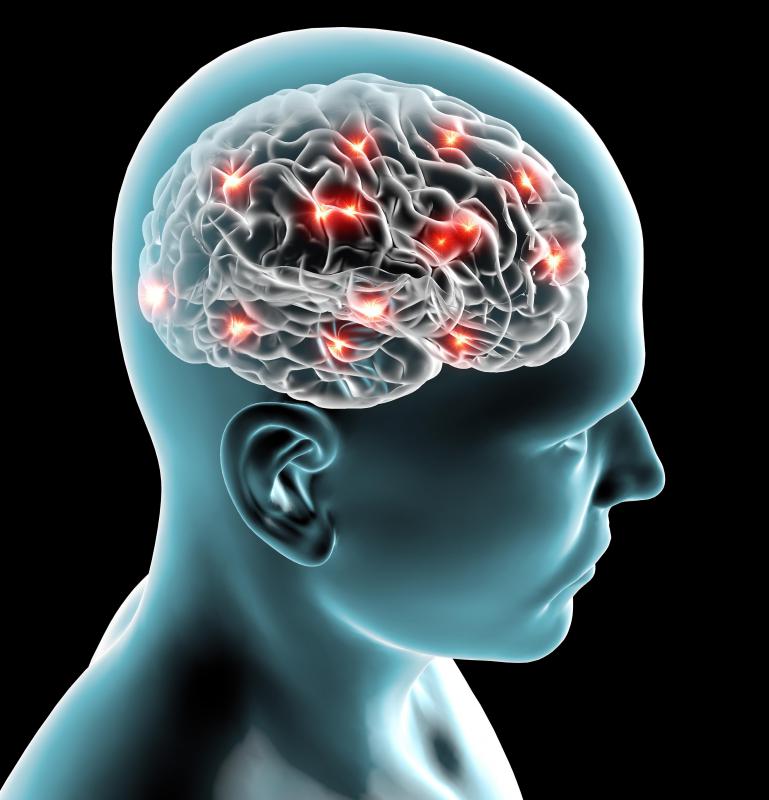
The main difference between an EEG and an EMG is what they test. While they are both used to test the electrical activity or impulses going on inside a patient’s body, each test is used for a different part of the body. An EEG is used to test electrical activity in a patient’s brain. To perform this test, a medical professional typically attaches electrodes to the scalp using a non-toxic adhesive that can be washed off the skin once the test is over. The electrodes transmit to a computer, which works to analyze the brain’s electrical activity.

In contrast to an EEG, an EMG is used to measure the electrical activity in a patient’s muscles. To perform this test, a medical professional inserts needles into a patient's muscles. These needle electrodes are typically small and solid inside, and they are usually connected to an amplifier and a special screen. The amplifier and the screen allow a medical professional to analyze the electrical activity within a person’s muscles.

An EEG and an EMG also differ in terms of where and by whom they are performed. An EEG typically is performed in a neurology clinic by an EEG technician, though the results are usually analyzed by a doctor. An EMG, on the other hand, often is performed in an electromyography lab or clinic by an electromyographer or a neurologist. Both tests are also performed in hospitals and medical offices.

When one is considering the difference between an EEG and an EMG, he may also consider the amount of time each test takes to complete. An EEG may last for an average of about an hour or two. An EMG, on the other hand, usually lasts for about 30 minutes to an hour. The amount of time an EEG or an EMG takes may depend on the person performing the test and the cooperation of the patient.
Nicole Madison
Nicole’s thirst for knowledge inspired her to become a TheHealthBoard writer, and she focuses primarily on topics such as homeschooling, parenting, health, science, and business. When not writing or spending time with her four children, Nicole enjoys reading, camping, and going to the beach.
Learn more...
Nicole Madison
Nicole’s thirst for knowledge inspired her to become a TheHealthBoard writer, and she focuses primarily on topics such as homeschooling, parenting, health, science, and business. When not writing or spending time with her four children, Nicole enjoys reading, camping, and going to the beach.
Learn more...AS FEATURED ON:
AS FEATURED ON:


-
![An EEG involves the use of electrodes attached to the skin for recording electrical impulses while an EMG involves the insertion of needles into the muscles that will be tested.]() By: TobilanderAn EEG involves the use of electrodes attached to the skin for recording electrical impulses while an EMG involves the insertion of needles into the muscles that will be tested.
By: TobilanderAn EEG involves the use of electrodes attached to the skin for recording electrical impulses while an EMG involves the insertion of needles into the muscles that will be tested. -
![An electroencephalogram -- or EEG -- machine measures electrical impulse activity in the brain and can help give a diagnosis for conditions such as epilepsy.]() By: satoriAn electroencephalogram -- or EEG -- machine measures electrical impulse activity in the brain and can help give a diagnosis for conditions such as epilepsy.
By: satoriAn electroencephalogram -- or EEG -- machine measures electrical impulse activity in the brain and can help give a diagnosis for conditions such as epilepsy. -
![A doctor may order an EEG for patients suffering from headaches.]() By: JPC-PRODA doctor may order an EEG for patients suffering from headaches.
By: JPC-PRODA doctor may order an EEG for patients suffering from headaches. -
![An EEG will measure the electrical activity in a person's brain.]() By: NaeblysAn EEG will measure the electrical activity in a person's brain.
By: NaeblysAn EEG will measure the electrical activity in a person's brain. -
![Electromyography may be used to diagnose carpal tunnel syndrome and other repetitive stress injuries.]() By: waxartElectromyography may be used to diagnose carpal tunnel syndrome and other repetitive stress injuries.
By: waxartElectromyography may be used to diagnose carpal tunnel syndrome and other repetitive stress injuries.



Discussion Comments
EMGs do not necessarily require needle insertion. They can be done just as easily with electrodes placed on skin like you described for EEGs.
@turquoise-- EMG electrode testing is painful but your doctor may allow you to take something for anxiety prior to the test if you're particularly scared.
I didn't even have that chance because I had it the same day that I found out I needed it. Maybe in the future, they will come up with an easier method to measure muscle activity. But for now, this is it.
@turquoise-- Yes, I had both tests when my doctor suspected that I might be showing signs of multiple sclerosis.
The EEG is definitely much easier. The EMG did hurt a little bit, but it wasn't as bad as I had expected. The good news is that they both last a very short time, about five minutes each in my case.
I know you're not looking forward to the EMG, but both of these tests are very important and necessary to diagnose some conditions. If your doctor wants you to have these tests, don't think about how it's going to be. I hope your results come back great!
I'm scheduled to have both of these tests next week. I'm not worried about the EEG but I'm scared of the EMG. Having needles inserted doesn't sound too fun.
Has anyone here had an EMG? Is it very painful? How long does it take?
Post your comments