
At AllThingsNature, we're committed to delivering accurate, trustworthy information. Our expert-authored content is rigorously fact-checked and sourced from credible authorities. Discover how we uphold the highest standards in providing you with reliable knowledge.
What is the Difference Between a Turtle and a Tortoise?
A division of reptiles called chelonia includes turtles, tortoises and terrapins. For the most part, the difference between a turtle and a tortoise is more of a matter of semantics than a strict scientific separation. Colloquially, both biologists and laypeople use the word "turtle" to mean all chelonians. In general, the reptiles referred to as turtles live in or near the water and have adapted to swim by holding their breath underwater. The reptiles referred to as tortoises typically live primarily in arid regions and are built for storing their own water supply and walking on sandy ground.
From a biological perspective, a tortoise is a kind of a turtle, but not all turtles are tortoises. Tortoises occupy their own taxonomic family, called testudinidae. All types of land and aquatic turtles come in a wide range of sizes, colors and shapes. Sometimes, the name "terrapin" is used to refer to an animal that falls somewhere between a turtle and a tortoise. Terrapins live in swampy areas or begin life underwater and eventually move to dry land.
Turtles

Turtles can live on land but often live in freshwater, the ocean or brackish ponds and marshland. Their front feet might be fins or merely webbed toes, and they typically have streamlined back feet to help them swim. Some ways in which a turtle and a tortoise are different are that a turtle has a flatter back and might spend much of its life underwater.
A turtle typically mates and lays eggs on the shore. Some turtles sun themselves on logs, rocks or sandy banks. During cold weather, they often burrow in mud and go into a state called torpor, which is similar to hibernation. Sea turtles migrate great distances. They are often omnivorous, eating plants, insects and fish.
Tortoises
Tortoises live almost entirely above water. They typically wade into water only to clean themselves or to drink. In fact, they cannot swim and could drown in deep water. Unlike sea turtles, tortoises rarely migrate.
A tortoise's feet are hard, scaly and nubby so that it can crawl across sharp rocks and sand. Tortoises often have claws to dig burrows, which they occupy during hot, sunny weather or when they sleep. Their shell forms a rounded dome, allowing the tortoise's limbs and head to withdraw for protection.
Another difference between a turtle and a tortoise is that a tortoise is mostly herbivorous. It typically eats grasses, flowers and weeds. Tortoises also eat shrubs, cacti and other plants that have a lot of moisture. They sometimes eat fruit and leafy greens, especially in captivity. Some tortoises also eat insects, worms and carrion.
Frequently Asked Questions
What are the main differences between turtles and tortoises?
Turtles and tortoises are both reptiles from the order Testudines, but they diverge in habitat and physical traits. Turtles primarily live in water and have webbed feet or flippers for swimming, while tortoises are land-dwellers with stout, bent legs for walking on ground. Tortoises also typically have a dome-shaped shell, compared to the flatter, more streamlined shell of turtles.
Can tortoises swim like turtles?
No, tortoises are not adapted for swimming and can actually drown if placed in deep water. Unlike turtles, which have limbs suited for aquatic environments, tortoises have heavy, columnar hind legs and are built for life on land. They do, however, require occasional soaking to stay hydrated and to help with their digestion.
How do the diets of turtles and tortoises differ?
The diet of turtles varies widely among species, with some being carnivorous, others herbivorous, or omnivorous. Many aquatic turtles eat fish, insects, or aquatic plants. Tortoises, on the other hand, are primarily herbivores, feeding on grasses, weeds, leafy greens, and sometimes fruits. Their plant-based diet is high in fiber and low in protein.
Do turtles and tortoises have similar lifespans?
Turtles and tortoises are both known for their longevity, with many species living several decades. However, tortoises often outlive turtles, with some species like the Aldabra giant tortoise (Aldabrachelys gigantea) living over 150 years. Lifespan varies widely among turtle species, but sea turtles, for example, can live between 50 to 100 years.
Are turtles or tortoises better suited as pets?
Whether a turtle or tortoise is better suited as a pet depends on the potential owner's lifestyle and commitment. Turtles generally require aquatic setups and can be more challenging to care for due to their need for both land and water environments. Tortoises, while requiring ample space for movement and specific diets, can be easier to accommodate in a terrestrial habitat.
How do turtles and tortoises contribute to their ecosystems?
Turtles and tortoises play vital roles in their ecosystems. Aquatic turtles help control aquatic vegetation and serve as both predator and prey in their food webs. Tortoises contribute to seed dispersal and the maintenance of plant diversity. Their burrowing behavior also helps aerate the soil, which benefits plant growth and provides shelter for other animals.
AS FEATURED ON:
AS FEATURED ON:









-
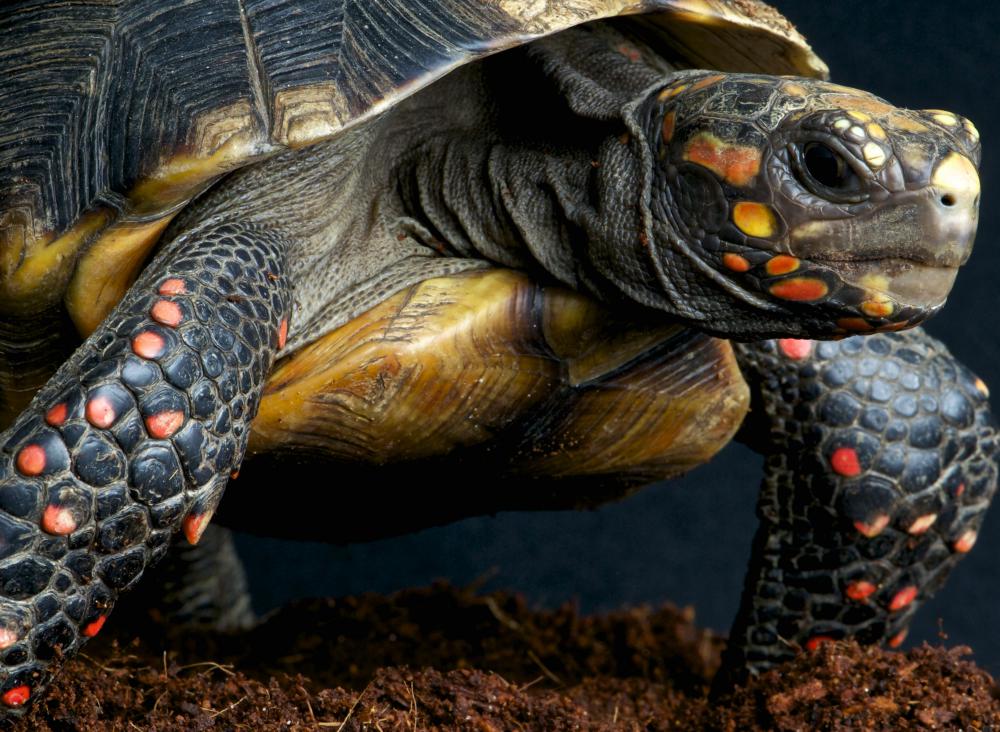
![There are dozens of species of tortoises, and some will live up to hundreds of years old while others can weigh in the hundreds of pounds.]() By: mgkuijpersThere are dozens of species of tortoises, and some will live up to hundreds of years old while others can weigh in the hundreds of pounds.
By: mgkuijpersThere are dozens of species of tortoises, and some will live up to hundreds of years old while others can weigh in the hundreds of pounds.
Discussion Comments
I have just been to Croatia on holiday. I went to an island called Locrum just off Dubrovnic and found a probable turtle in the undergrowth. It looked very much like a tortoise though with what looks like 3 letter E's on its back.
"Colloquially, both biologists and laypeople use the word "turtle" to mean all chelonians."
In America, maybe. Here in the UK, the word tortoise is used for the land dwelling ones and turtle for the flippered water ones.
I did not know there was a difference between a turtle and a tortoise. I also did not know there was a such mixture of the two called a terrapin.
how do you recognize females and males when talking about tortoises and turtles?
Tortoises live almost exclusively on land, so do not have flippers, but normal feet without webbing, often with sharp claws for digging. They only enter water to drink or wash themselves off, and can in fact drown in strong currents. They may be found in arid areas.
I live in constant fear that the turtles will one day ally themselves with the tortoises and, in a large coordinated attack, wipe out the terrapins.
A turtle is a water reptile. It only really comes on land to lay eggs. A tortoise is a land reptile and doesn't go in water at all (apart from to drink it). A terrapin is more similar to a turtle, but is smaller and lives in fresh water rather than sea water.
I am soumili and this article helped me understand the concept of turtles and tortoises clearly. before this the topic was a great mystery to me but now all my doubts are clear.
it helped me in doing my holiday homework.
i think a tortoise can come out of its shell but a turtle can't. i think a turtle lays its babies up on land and a tortoise doesn't.
A box turtle is a land turtle. It seems like it should be a tortoise because it will go in water but only shallow water and is a land turtle. Maybe there is a scientific explanation I don't know?
natural selection - the way in which species naturally select the best characteristics for survival.
i think that turtles are the ones that stay in water most of the time. And tortoise are the ones that are mostly on land.
thanks a lot for the information, because I didn't get it for a few days, but now I do.
answer to comment 8: a red eared slider is a turtle. I know because I have caught them while fishing.
Turtles may live in freshwater, the ocean, or brackish ponds and marshland. Their front feet might be fins or merely webbed toes with streamlined back feet to help them swim. Turtles have flatter backs than tortoises, and may spend all or part of their lives underwater. They mate and lay eggs underwater or on the shore. Some turtles sun themselves on logs, rocks or sandy banks. During cold weather, they burrow in mud and go into torpor, a state similar to hibernation. Sea turtles migrate great distances. They are more often omnivorous, eating plants, insects and fish. Tortoises live entirely above water, only wading into streams to clean themselves or to drink. In fact, they could drown in deep or swift current. Their feet are hard, scaly, and nubby so it can crawl across sharp rocks and sand. Tortoises often have claws to dig burrows, which they occupy during hot, sunny weather or during sleep. Tortoises are mostly herbivorous, eating cactus, shrubs, and other plants that have a lot of moisture. They rarely migrate. Their shell forms a rounded dome, allowing the tortoise's limbs and head to withdraw for protection.
a red eared slider is a turtle, and for the other person who has a gala and another tortoise...separate them by separating your yard...if they are fighting...that is not good.
I'm glad there is information available to everyone on the difference between the two...though much the same- it should be made clear to those who may come across a turtle/tortoise which reptile it actually is. A prime example...my next door neighbor was nice enough to come and get me (to ask if I wanted the turtle in her yard) before she threw it into the lake behind our house...the "turtle" was a box turtle and clearly would not have found being thrown into the water funny! Now she knows better- and I also asked her in the future to please "not offer" these "turtles" to children in the neighborhood and to just let them be....Unless of course the poor thing is trying to cross a road with heavy traffic...zoiks!
I <3 Reptiles :)
A terrapin is a specific species of turtle (Malaclemys terrapin) that lives in brackish water.
I Have a Galapagos turtle (2 months) and a British Tortoise (2 months also). They are both babies, but they fight all the time. How do I get them to stay away from each other?
Tortoises are sometimes in water, such as the eastern longneck tortoises. Also terrapins are easily sorted out by the pattern on its flesh.
Which one lives longer, turtles or tortoises?
Terrapins are, well, edible. Yuck, right! i own a large medeteranean marginated tortoise named sheldon.
I'm not an expert but Turtles can be either land or water, I believe the same is true of tortoise. I think they can most be distinguished by their shells, tortoises have a more dome like shell. I own two red eared sliders, they are turtles. Hope this helps
I just saw a Silcott Tortoise at the Roloff Farm in Hillsboro, Oregon. The farm is open in October for the pumpkin sales and now has animals for viewing including a gorgeous 22-year-old tortoise. It's the same farm featured in tv show, "Little People, Big World" shown on The Learning Channel weekdays at 11:30 a.m. and Mondays at 8 p.m. A future episode will feature the tortoise and his great escape. --R
I'm German and I have Australian, English and American friends. I'm totally confused 'cause in German we have only one word to describe all of these species...
i think there is a lot of confusion surrounding terrapins...in England, "turtle" and "terrapin" may be used interchangeably. however, in the United States, terrapin may be used to describe turtles that live in brackish, swampy water, not fresh waters in streams and rivers. although they seem to be more related to sea turtles, than land turtles, terrapins belong to a different family.
They don't grow very large, the males only to around five inches, and the females only to around 7-8 inches. i found that the biggest female measured was 9 inches long, so anon15640, that's probably not a terrapin that you found.
I have recently found a terrapin in my yard, it seems rather large. It is approx 12 inches long and about 10 inches wide. What is their average size?
Let me get this right... Turtle = water, Tortoise = land?
i was doing a project for science and this really helped!
what is a red eared slider???is it a tortoise or a turtle???
What exactly are terrapins in contrast with turtles and tortoises? I always thought "terrapin" was just another word for "turtle".
Post your comments