
At HomeQuestionsAnswered, we're committed to delivering accurate, trustworthy information. Our expert-authored content is rigorously fact-checked and sourced from credible authorities. Discover how we uphold the highest standards in providing you with reliable knowledge.
What Is the Difference between a Fuse and a Circuit Breaker?
Large power overloads may potentially destroy electrical equipment, or in more serious cases, cause a fire. A fuse and circuit breaker both serve to protect an overloaded electrical circuit by interrupting the continuity, or the flow of electricity. How they interrupt the flow of electricity is very different, however. A fuse is made up of a piece of metal that melts when overheated; a circuit breaker has an internal switch mechanism that is tripped by an unsafe surge of electricity. Fuses tend to be quicker to interrupt the flow of power, but must be replaced after they melt, while circuit breakers can usually simply be reset.
How Fuses Work

There are many different types of fuses for residential and commercial use, but the most common type is made up of a metal wire or filament that is enclosed in a glass or ceramic and metal casing. In a home, the fuse is typically plugged into a central fuse box where all the building’s wiring passes through. When the electricity is flowing normally, the fuse permits the power to pass unobstructed across its filament, between circuits. If an overload occurs, the filament melts, stopping the flow of electricity.

It generally takes very little time for the filament in the type of fuse used in a home to melt, so any power surge is quickly stopped. Once a fuse is blown, however, it must be discarded and replaced with a new one. There are many different voltage and ratings available that handle different capacities of electricity, and the best fuse for a circuit is typically one that is rated for slightly higher than the normal operating current.
How Circuit Breakers Work

A circuit breaker works in one of two ways, with an electromagnet (or solenoid) or a bi-metal strip. In either case, the basic design is the same: when turned on, the breaker allows electrical current to pass from a bottom to an upper terminal across the solenoid or strip. When the current reaches unsafe levels, the magnetic force of the solenoid becomes so strong that a metal lever within the switch mechanism is thrown, and the current is broken. Alternately, the metal strip bends, throwing the switch and breaking the connection.

To reset the flow of electricity after the problem is resolved, the switch can simply be turned back on, reconnecting the circuit. Circuit breakers are often found in a cabinet of individual switches, called a breaker box. The simple switch action of a circuit breaker also makes it easy to turn off an individual circuit in a house if it's necessary to work on the wiring in that location.

Another use of the circuit breaker is a ground fault circuit interrupter (GFCI) outlet, which functions to prevent electric shock instead of overheating. It works by breaking the circuit in an outlet if the current becomes unbalanced, and can be reset by the push of a button. This technology is particularly useful in bathrooms or kitchens where electrocution is a risk due to the frequent use of electric appliances near a source of water.
Advantages and Disadvantages

The fuse and circuit breaker both have advantages and disadvantages, each of which can depend on the situation in which they are used. Fuses are inexpensive and can be purchased from any hardware store. They also tend to react very quickly to overloading, which means that they can offer more protection to sensitive electronic devices. This quick reaction can be a disadvantage, however, if the circuit is prone to surges that regularly cause fuses to blow. This is why it's important to have a reliable surge protector for your home.
Fuses must always be replaced once they are blown, which can be challenging in a darkened room or if the appropriate replacement is not immediately available. Another issue is that a do-it-yourselfer can mistakenly select a fuse that has a voltage or current rating that is too high for his needs, which can result in an overheated circuit. In addition, there may be exposed electrical connections in a fuse box, which can pose a danger to someone who does not follow the proper safety precautions.
Circuit breakers have many advantages, not the least of which is how quickly they can be reset. It is usually clear which switch has tripped, and it can be easily reset in most cases. For the average homeowner, it is also safer because there is no question about choosing the right fuse rating and all of the electrical connections are hidden in a breaker box.
A drawback to using a circuit breaker is that it is usually more expensive to install and repair. A circuit breaker also typically does not react as quickly as a fuse to surges in power, meaning that it is possible that electronics connected to the circuit could be damaged by "let-through" energy. It also is more sensitive to vibration and movement, which can cause a switch to trip for reasons unrelated to an electricity overload.
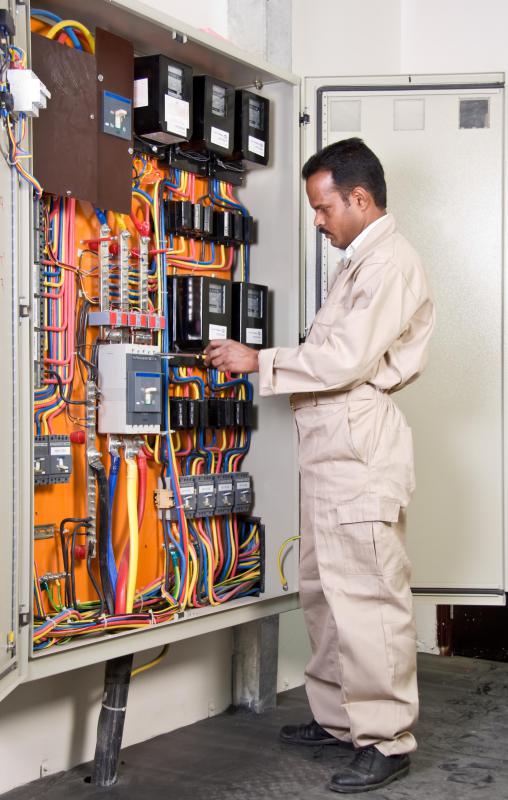
A fuse and circuit breaker are not interchangeable for all power applications. For example, a fuse cannot be used in situations that require a GFCI. Electricians are best qualified to determine whether a fuse or circuit breaker system is better for a particular electrical installation or upgrade.
AS FEATURED ON:
AS FEATURED ON:


-
![Circuit breakers.]() By: Paulo OrdovezaCircuit breakers.
By: Paulo OrdovezaCircuit breakers. -
![Screw-in plug fuses are an alternative way to protect an overloaded electrical circuit.]() By: George KellyScrew-in plug fuses are an alternative way to protect an overloaded electrical circuit.
By: George KellyScrew-in plug fuses are an alternative way to protect an overloaded electrical circuit. -
![A glass fuse.]() By: Willee ColeA glass fuse.
By: Willee ColeA glass fuse. -
![A fuse. Fuses are designed to burn out if too much current runs through a connected wire.]() By: Willee ColeA fuse. Fuses are designed to burn out if too much current runs through a connected wire.
By: Willee ColeA fuse. Fuses are designed to burn out if too much current runs through a connected wire. -
![Electricians are best qualified to determine whether a fuse or circuit breaker system is better for a particular electrical installation or upgrade.]() By: Sudheer SakthanElectricians are best qualified to determine whether a fuse or circuit breaker system is better for a particular electrical installation or upgrade.
By: Sudheer SakthanElectricians are best qualified to determine whether a fuse or circuit breaker system is better for a particular electrical installation or upgrade. -
![Most homes built today use a circuit breaker system.]() By: auremarMost homes built today use a circuit breaker system.
By: auremarMost homes built today use a circuit breaker system.



Discussion Comments
My dryer circuit is somehow running 110 outlets that are on another breaker. How is this happening?
What does AGC stand for when stamped on a 1/2 amp fuse?
I just renovated my bathroom, and moved my washer and dryer to other side of the bathroom. The electrical plug and wire for the washer were long enough to move to the opposite side of the room. But the electrical plug and wire for the dryer comes up short.
My question: instead of running a new wire back to the main fuse panel through a finished ceiling, can I put a second fuse panel (breaker) between the dryer plug and main panel?
where is a circuit breaker used?
where, in a circuit, should a circuit breaker be located and why?
circuit breakers are usually more economical then fuses because, it means that you don't have to replace it every time your power overloads,
but when your power does overload and the circuit breaks, you usually have to wait a while before your power, lights, etc., turn back on.
hope my info helped a little.
"Our dryer is on two big fuses which we've had to replace twice since we got it only a couple of months ago. Would it be best to have it re-wired to one bigger, better fuse? Or to just get a circuit breaker box?"
Many appliances like dryers use what is known as induction current. This is an excess amount power which is required to get the motor started, but then drops away back to normal levels once up and running.
For example, if your dryer's "normal" running current is say 28 amps, it should be protected by a 32 amp fuse. But the dryer may require a starting surge of 35 amps (only for a couple of seconds) before dropping back to the normal 28. However, the 35 is greater than the 32 and thus the fuse will pop.
Changing to circuit breakers can actually make things worse in this case as they have less tolerance than fuses.
One mistake commonly made is using a higher capacity fuse or circuit breaker. In our example above, many people would install a 40 amp breaker. This solves the problem of tripping on start up but when the dryer goes back to normal range of 28 amps, the 40 amp breaker is way too high, and not affording any protection in the event of an earth fault or short circuit.
The way to fix the problem is to use "slow blow" fuses. These fuses are designed to absorb the high start up current for a greater period of time before blowing. This fixes the problem because the fuse is able to discriminate between which excess loads are temporary influxes and which are real faults.
Slow blow fuses are available from most good electrical suppliers.
does anyone know if constantly turning your circuit box off saves energy?
first you have to check the current load drawing from the dryer. according to that we can consider either the fuse or circuit breaker(cb) is required for your gadget.
Our dryer is on two big fuses which we've had to replace twice since we got it only a couple of months ago. Would it be best to have it re-wired to one bigger, better fuse? Or to just get a circuit breaker box?
I just purchased a top of the line Clothes dryer from Sears. It got delivered yesterday the 1st of May. It keeps powering down after 5 seconds or less. I think it's the circuit breaker, but it doesn't trip it. What could it be and what should I do? Now it won't even turn on. I am so frustrated.
how can we know whether to use fuse or circuit breaker in a circuit? on what basis is the selection done?
Post your comments