
At MyLawQuestions, we're committed to delivering accurate, trustworthy information. Our expert-authored content is rigorously fact-checked and sourced from credible authorities. Discover how we uphold the highest standards in providing you with reliable knowledge.
What is the Death Penalty?
The death penalty is a form of punishment that involves executing a person after he or she has been found guilty of a crime by his or her legal system. This may be done as an act of retribution, to ensure that the individual cannot commit future crimes, and/or as a deterrent for potential criminals. Most countries have used this form of punishment at some point in modern times for different crimes, putting people to death in a variety of ways that have evolved with society.
History of the Death Penalty

Often referred to as capital punishment, executions carried out by a government or ruling monarchy date back as far as humans have been recording history. Some ancient texts indicate that, originally, the death penalty was viewed as a price to pay for a crime rather than a punishment, meaning any person's blood being spilled could make up for the crime. For this reason, the original perpetrator did not necessarily have to be the one executed. Since then, however, it has evolved into a means of punishing the individual, ensuring he or she commits no other crimes, and, in many societies, as a way to bring closure to any people harmed by the criminal's actions. It has also been viewed as a means to deter people from committing more severe crimes, much in the way the threat of jail time is used to instill fear in "minor" criminals.
Crimes Earning the Death Penalty

This punishment is typically reserved for crimes that a culture or society has decided are "the worst of the worst;" however, this can vary drastically by country. In western countries that still practice capital punishment, it is usually reserved for murder, espionage, or treason. In some Middle Eastern and other countries, sexual crimes may warrant execution, including incest, rape, sodomy, or adultery. Certain jurisdictions also recognize religious crimes, drug trafficking, and human trafficking as serious enough to warrant execution, and a number of militaries around the world recognize nearly any crime committed by a soldier, including insubordination, as punishable by the death penalty.
Early Forms of Capital Punishment

In the past, the methods used to put people to death were what many in modern society would consider horrific. This was mainly due to the fact that death itself was not necessarily viewed as a punishment, which meant the manner in which a person was executed had to be painful. Drawing and quartering, flaying alive, or burning were not uncommon practices in Medieval Europe or in much of the rest of the world. Other common means of execution included boiling alive, dismemberment, and crucifixion.
Modern Methods

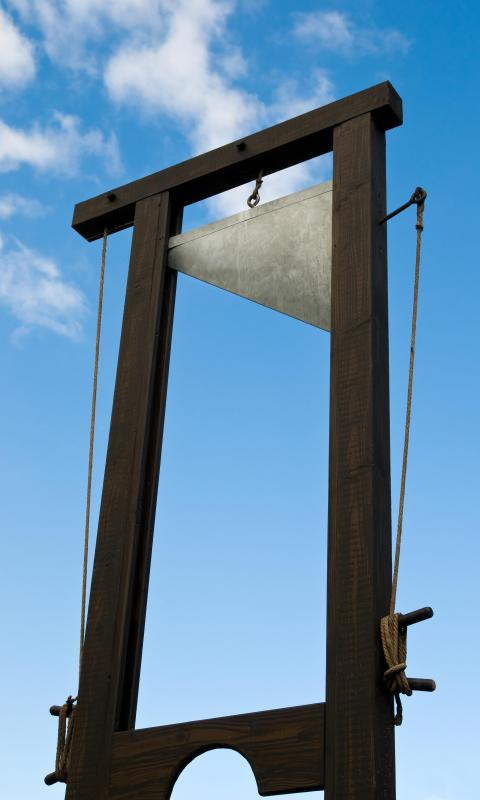
A movement began in the late-18th century towards more humane punishments and executions, resulting in the development of the guillotine in France. Other traditional methods were also adapted to meet this new ideal, with one example being hanging; although originally a person was hung so that he or she was strangled to death, this method of execution was altered to snap the neck immediately, which was viewed as more humane. This was followed by the use of the electric chair, death by firing squad, and the most commonly used form of capital punishment in the western world, lethal injection.
Criticizing and Supporting the Practice

The death penalty is one of the most hotly debated topics in the world. Many religions oppose it, although others support it or take no official position. Some modern philosophical theories of ethics disagree with the practice, although many philosophers argue that certain crimes should automatically result in the person losing his or her "right to life."

There are also arguments against some of the justifications for capital punishment. Supporters may argue that a serious crime deserves an equally serious punishment, while opponents say that this is revenge rather than punishment, and that life in prison is more punishing. While execution does prevent the person from committing another crime, spending the rest of his or her life in jail also removes the criminal from society. Many opponents also argue that it rarely has any deterrent effect, and that criminals seldom consider the possibility of a death sentence when committing a crime.
Many people who oppose the death penalty also contend that it is often applied unequally; in the US, for example, people convicted of murder are more likely to be sentenced to death if the victim was white. It has also been argued that factors such as how much money the defendant has, and the quality of lawyer he or she can afford, plays a bigger role in who gets a capital sentence than the severity of the crime. Supporters say that, while flaws within the legal system should be addressed, they do not mean that the entire process does not work.
Since capital punishment was reinstated in the US in 1973, more than 130 people have been released from death row because evidence was found to indicate that they were wrongly convicted. Opponents say that many more people who are sentenced to death may be innocent, and even if one innocent person is executed, it's too many. Supporters often argue that most death penalty convictions that are overturned are done so for technical reasons, not because the person wasn't guilty. In addition, while there is a small chance that an innocent person may be put to death, there are also wrongly convicted people sentenced to long prison sentences; if the chance that an innocent person is incarcerated is not a good enough reason to stop sending people to prison, then it's not enough reason to abolish the death penalty.
Abolishing the Death Penalty
Since the 18th century, a number of countries around the world have abolished the practice entirely, although some have reinstated it, most notably China. The Roman Republic of 1849, San Marino, Venezuela, and Portugal all outlawed the practice in the mid-1800s. Over a century later, Canada followed in others' footsteps, abolishing the practice 1976; France ended it in 1981 and Australia in 1985. In 1977, the United Nations issued a resolution stating that abolishing the practice as much as possible would be in everyone’s best interest.
Still Used Today
Despite the fact that a majority of countries no longer use the death penalty, 60% of the world’s population lives in a country that does as of 2012. Nearly 600 executions are known to have taken place in 2011, although there may have been more because not every country makes this information publicly available. The most verifiable executions took place in Iran, Saudi Arabia, Iraq, and the United States; some experts believe many more have likely been put to death in China.
AS FEATURED ON:
AS FEATURED ON:


-
![Guillotine.]() By: M.RosenwirthGuillotine.
By: M.RosenwirthGuillotine. -
![Electric chair in the former Louisiana State execution chamber.]()
Electric chair in the former Louisiana State execution chamber. -
![California's San Quentin Prison has a death row for male inmates.]() By: Eric BVDCalifornia's San Quentin Prison has a death row for male inmates.
By: Eric BVDCalifornia's San Quentin Prison has a death row for male inmates. -
![Those convicted of treason, such as disclosing top secret information, can face the death penalty.]() By: ArgusThose convicted of treason, such as disclosing top secret information, can face the death penalty.
By: ArgusThose convicted of treason, such as disclosing top secret information, can face the death penalty. -
![Individuals guilty of murder may be sentenced to the death penalty.]() By: puckillustrationsIndividuals guilty of murder may be sentenced to the death penalty.
By: puckillustrationsIndividuals guilty of murder may be sentenced to the death penalty. -
![Some jurisdictions consider human trafficking a serious enough offense to warrant execution.]() By: Rafael Ben-AriSome jurisdictions consider human trafficking a serious enough offense to warrant execution.
By: Rafael Ben-AriSome jurisdictions consider human trafficking a serious enough offense to warrant execution.





Discussion Comments
In Uganda we can't accept the death penalty, and as a human rights lawyer, I don't think its' the way to go.The incumbent practiced it, but when he realized he had executed innocent citizens he stopped and swore never to do it again. There are other better options, like life imprisonment.
Even though death is not a punishment, a killer deserves a heavy punishment which is not just jail, so I say if there is sufficient evidence beyond reasonable doubt an accused guilty of a capital offense deserves to be killed. Why take away someone's life?
Death is the easy way out. They should serve time in prison.
I am against the death penalty for three reasons. 1: The concept of "an eye for an eye" that supporters use is biased in my opinion. The law does not dictate that rapists get raped in return, that thieves get robbed in return, that those who commit battery get beaten up, etc. You can't just apply that to one crime and not another.
2: Yes, I know it's absolutely terrible and sinful to murder another human being, but I don't believe it's our place as fellow humans to seek vengeance. Murders have to ultimately answer to God, not us.
3: I am against it for the sake of the innocent people on death row, charged for crimes they didn't commit yet forced to die anyway. 1 innocent person executed is too many.
I think the death penalty is no deterrent whatsoever. I live in the UK and if I killed someone, I would rather be put to death than spend a lifetime of misery in a box.
If I were confronted by serious charges as such, I would find death very inviting, partly because martyrdom is slightly romantic. You commit the ultimate crime then you face the ultimate question of death. I'll take death over life because there is no life afterward.
I agree with the death penalty, because if that person is going to murder someone just because or for any reason, they deserve to die. But they should also have to suffer like their victois did -- not a quick death like the electric chair. Hanging is better because it is a slow, painful death.
Our justice system should not be dictated by vengeance. As a society, should we be more civilized than the murderers we condemn?
We, as a society, should not be involved in the practice of killing.
I used to be completely against the death penalty, on both spiritual and legal grounds. Spiritually, I felt that even someone who commits a heinous crime of passion like murder deserves an opportunity for redemption. Of course, the family of the victim(s) probably wouldn't agree with that, but the potential for committing a violent act when provoked sufficiently lies with *all* people. I'm sure there are circumstances that would make even the most even-tempered person alive consider killing another human being. The only reason most people don't actually go through with the act is all of those moral and ethical filters placed in our heads.
Legally speaking, I didn't believe any crime reached the level of death as a penalty. It's unfortunate that the criminal's irresponsible act ended in someone else's death, but the "death penalty" is carried out in *my* name, as well as the rest of the community. If *I'm* going to arrange to have someone killed for their crimes, I want a little more assurance that he or she did it, is completely beyond redemption or rehabilitation, and was given every legal opportunity to defend himself or herself. I don't always feel like I'm getting the entire story from the justice system before an execution takes place.
My opinion of the death penalty has modified over the years, however. I believe there are some people who are so incredibly damaged and anti-social that keeping them alive in prison would be cruel and unusual punishment for the guards and other inmates. They deserve to die for their especially heinous acts. In those cases, I wish the legal system would move even faster to carry out the executions. Making someone wait for decades on death row is not right, either. Let them make their peace with the victim's families, their own families and their God, then put them out of their misery.
I still don't believe the death penalty is an effective deterrent in general, but in specific cases, it is a logical punishment for the horrific nature of the crime.
Well, i agree with the death penalty. It is because it's the only thing that could justify one's crime, especially when he/she killed someone.
We all know that death penalty would probably oppose God's will and commandments but if were going to analyze it, only the death penalty will scare those stupid criminals/killers and could lead us to a safer and better society, for this could assure us that those criminals won't be around us anymore. If they could kill once, why not for the second time? So, go for the death penalty.
death penalty is good to lessen the population and criminals as well. for those innocent people that are only accused, never mind.
we all know that the word of God forbids us not to commit any type of killings. There's no exception with that "eye-for-an-eye"? That's retaliation. We can't take back the life that has been taken by killing another. If justice is needed, lay down the right punishment but not the death penalty because it cheapens life.
i say if somebody killed a person you loved, they should be killed. you just can't take someone's life away and just go to jail for it. that is unfair to the family of the one that has been killed.
if i was a judge for somebody who just killed someone because they were mad or angry, or anything else, i would sentence you to death.
Say no to the death penalty. They said that the one who kills the killer will be killed (Death Penalty)
so, the one who operates to kill the killer must be killed because he/she killed a killer.
and if we have a death penalty it is like you said that you did not give a time to change a person. and we don't know if he/she is only being accused.
but death penalty is changed into "life in prison" and what about those people who were just accused and are given the death penalty? after being given the death penalty, his/her case was reopened then was proven innocent?
I find it funny what anon116023 posted about "thou shalt not kill."
You just contradicted yourself. Thou shalt not kill? Isn't that what you are doing if you put someone on the death penalty?
well i agree with the death penalty. Yet there are instances where men kill and take justice to their own hands. They kill because of rage, hatred to those who have hurt them.
For instance, a rapist rapes his victim and in retaliation the victim kills him. Does the victim also die due to the law "eye for an eye" or do you sentence her to jail for protecting him/her self?
no matter how you kill, you are the killer! our mission is not to kill criminals or killers. humanity should work on uprooting crime, offense, guilt!
The death penalty is needed. If there is no death penalty then criminals will be going about their business, with never a thought of being killed for their actions. Just the thought of, "i could go to jail for a few years." But I, for one, will not stand by if one of my loved ones get killed. the court should give justice -- an eye for an eye.
If that killer took someone's life, then i see no reason why they should keep theirs. There should be no mercy for the killer. Thou shalt not kill. That's what God has commanded of us.
@dipster99: I understand your concerns about the death penalty, but I think we are far better off with it than without it. The death penalty provides a powerful deterrent against potential criminals and keeps society safer.
The question you posed should be rewritten to read: is it worth putting one innocent person to death to save the lives of 100 *innocent* people (whose lives would be saved by deterring would-be murderers). Following a utilitarian philosophy, my answer to the question would be *absolutely.*
I think if you support the death penalty, you must ultimately come to terms with the fact that we will end up executing innocent people. No system is perfect, and there is always some significant room for error.
An interesting philosophical question then emerges: is it worth putting one innocent person to death to put 100 murders to death?
Of course, this question already assumes that a murder should be executed—which is debatable to many who feel that even the life of a murder should valued by our society. Although I feel I am leaning against the death penalty, this is a tough issue for me.
Post your comments